
🤖Why Most Companion Robots Still Feel Unnatural

TLDR
- Most companion robots feel unnatural because physical movement, timing, and expression still lag behind human expectations.
- Small mismatches in voice, gesture, or response timing quickly break immersion.
- Hardware limitations restrict fluid motion and realistic interaction in real-world environments.
- Social behavior modeling is still inconsistent, especially across long conversations.
- The gap is not just technical; it is about aligning multiple systems to feel coherent at the same time.
You can spend five minutes with a companion robot and walk away thinking, “That was impressive.” Spend an hour with it, though, and the cracks start to show.
It is not always obvious what feels off. The voice might sound fine. The responses might even be relevant. But something does not quite click. The interaction feels slightly out of sync, like a conversation where the other person keeps missing subtle cues.
That “unnatural” feeling is not coming from one big flaw; it is the result of several small mismatches happening at once. When you stack them together, why AI robots feel unnatural becomes a central question for anyone interested in the future of home robotics.
The Breakdown of Realism
| Element | Human Expectation | Current Robot Reality |
| Response Time | < 200ms for verbal cues | 500ms – 2s (processing lag) |
| Movement | Fluid, organic, anticipatory | Linear, rigid, reactive |
| Social Cues | Sustained, meaningful eye contact | Static or wandering gaze |
| Memory | Full context retention | Turn-by-turn focus |
⏱️ Timing Is Everything
One of the biggest reasons interactions feel unnatural comes down to timing. Humans are extremely sensitive to conversational rhythm. We expect responses within a certain window. Too fast, and it feels abrupt. Too slow, and it feels like the other side is struggling to keep up.
Companion robots often fall into that second category. Even small delays between speech input and response output can disrupt the flow. You end up waiting, even if it is just a second or two, and that pause breaks the illusion of a fluid exchange.
This is one of the what limits current AI companions technologically in the modern market. Getting that balance right is still a work in progress.
Expert Tip: If you notice a lag, check your internet connection. Many robots rely on cloud-based vs local AI processing, which can add significant delay to the conversation.
🏗️ Movement Still Feels Mechanical
Physical movement is another major factor. Even the most advanced robots today rely on actuators that produce motion in discrete steps rather than smooth, organic transitions. The result is movement that looks slightly rigid, contributing to the Uncanny Valley in social robotics.
You notice it in small things: a head turn that stops too abruptly or a gesture that feels slightly exaggerated. Humans are incredibly good at spotting these inconsistencies. We have spent our entire lives reading body language, so anything that deviates from that baseline stands out immediately.
This is the primary difference between domestic robots vs companion robots where the latter must mimic life, not just perform tasks.
Factors in the “Creepy” Factor
- Visual vs Behavioral Realism: A robot that looks human but moves like a machine is more jarring than a stylized one.
- Dead-Eye Syndrome: Lack of micro-movements in the eyes and eyelids.
- Inorganic Pacing: Speech that continues perfectly while the body remains frozen.
🔇 The Voice-Body Disconnect
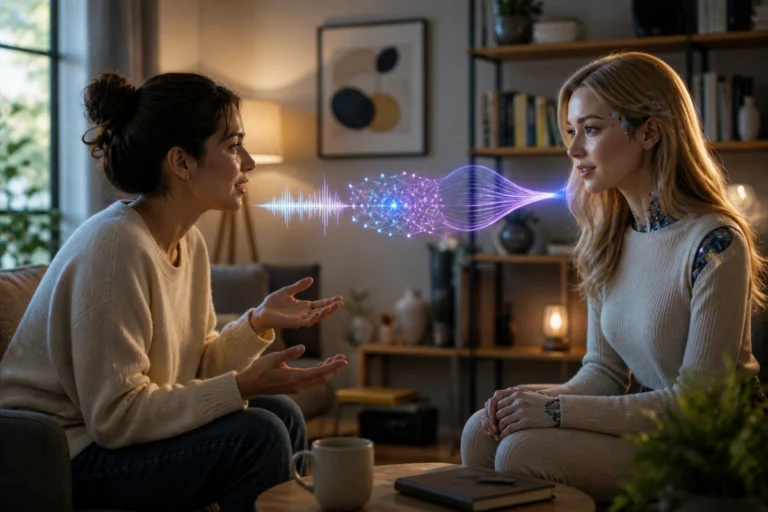
Interestingly, voice technology has improved faster than physical expression. Modern speech systems can sound quite natural, but when that voice is paired with limited facial or body movement, the mismatch becomes obvious. You hear something that sounds expressive, but you do not see it reflected physically.
This creates cognitive dissonance in human-robot interaction. It is similar to watching a film where the audio and video are slightly out of sync. Individually, both elements are fine; together, they do not quite align.
This is why many developers argue that conversation quality matters more than appearance when trying to build trust with a machine.
🧠 Context Breaks Over Time
Short interactions often feel better than long ones. Maintaining context over extended conversations is still difficult. Systems can handle a few turns well, but over time, details get lost. You might mention something early in a conversation, expect it to be remembered, and then realize it has been forgotten.
In human interaction, memory and context are foundational. Without them, conversations feel shallow. This struggle is part of how AI companions differ from virtual assistants, as companions are expected to build a history with the user. When the memory fails, why social AI is still awkward becomes frustratingly clear.
Read More: See how AI companions learn over time to see the methods engineers use to fix these memory gaps.
🎭 Emotional Responses Lack Depth
Another reason interactions feel unnatural is the limited range of emotional response. Systems can simulate tone and phrasing that suggest empathy, but the depth of those responses is narrow.
Over time, patterns start to repeat. You notice similar phrasing, similar reactions, and similar conversational structures.
It is not that the responses are wrong; it is that they lack variation. For people using AI for mental health support, this lack of nuance can prevent deep bonding. Solving this requires better emotion simulation vs recognition to ensure the AI is not just reciting a static script.
🌍 Environmental Awareness and Social Cues
Real-world environments are unpredictable. People move, objects shift, and noise changes. Companion robots rely on sensors, but those sensors have limits.
If a system reacts incorrectly to something you clearly see, it breaks trust. This is a common issue for social robots used in elder care, where safety depends on accurate perception.
Modeling subtle social cues like eye contact, pauses, and micro-expressions is equally difficult. Many robots simplify these cues, leading to responses that are technically correct but socially slightly off.
Modern research into social robotics and human cues suggests that even a misaligned blink can lower human comfort with social machines. Companies are currently focused on solving the uncanny valley 2026 by prioritizing psychological comfort over hyper-realistic skin textures.
Synchronization Checklist
- Does the mouth move in time with the audio?
- Do the eyes track the user’s face during speech?
- Does the body lean in or tilt during “emotional” moments?
🏗️ Integration Is the Real Challenge
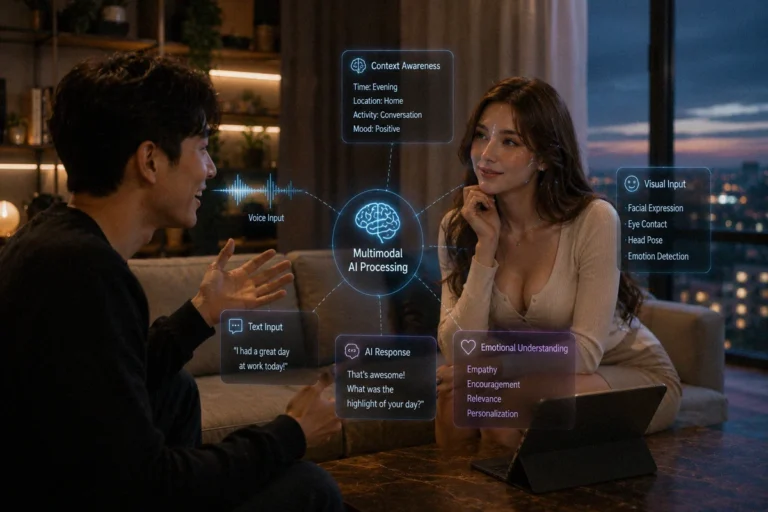
What stands out is that none of these issues exist in isolation. A robot might have decent speech recognition and reasonable movement, but if those elements are not perfectly synchronized, the experience still feels off.
Making robots feel more natural depends on total alignment. Right now, that level of integration is difficult to achieve consistently. As a result, we often see a “broken” experience where one system is miles ahead of another.
This is a key reason why people are turning to AI companions that are primarily screen-based. Removing the physical body often removes the most jarring part of the Uncanny Valley.
Expert Tip: When testing a new robot, try a long-form conversation first. Most social robots used today excel at short commands but struggle with 20-minute chats.
🏁 Conclusion
Most companion robots feel unnatural not because they are fundamentally flawed, but because they are slightly out of sync with human expectations. Timing, movement, context, emotion, and environment all need to align.
As these systems become more integrated, that “off” feeling will likely shrink. Progress is happening in all of these areas, though what to expect from AI companions in the future suggests a long road ahead for physical realism.
For now, understanding why it happens gives you a clearer way to evaluate the technology. Because once you see the pattern, it is hard to unsee it.