🤖 How AI Companions Differ From Virtual Assistants

TLDR
- 🛠️ Virtual assistants are built for task execution, while AI companions are designed for ongoing interaction and engagement.
- 📈 Assistants focus on efficiency and productivity; companions prioritize conversation, personalization, and social presence.
- 🎭 AI companions emphasize emotional tone and continuity, whereas traditional assistants prioritize accuracy and speed.
- 🧠 Memory and personality play a much larger role in companion systems than in functional, task-oriented software.
- 👥 Both serve distinct roles, and most users will likely interact with a combination of both rather than choosing just one.
At first glance, the difference isn’t obvious. You ask a question, you get a response. Whether it’s a smart speaker helping you set a timer or a companion app chatting about your day, the interaction looks similar on the surface.
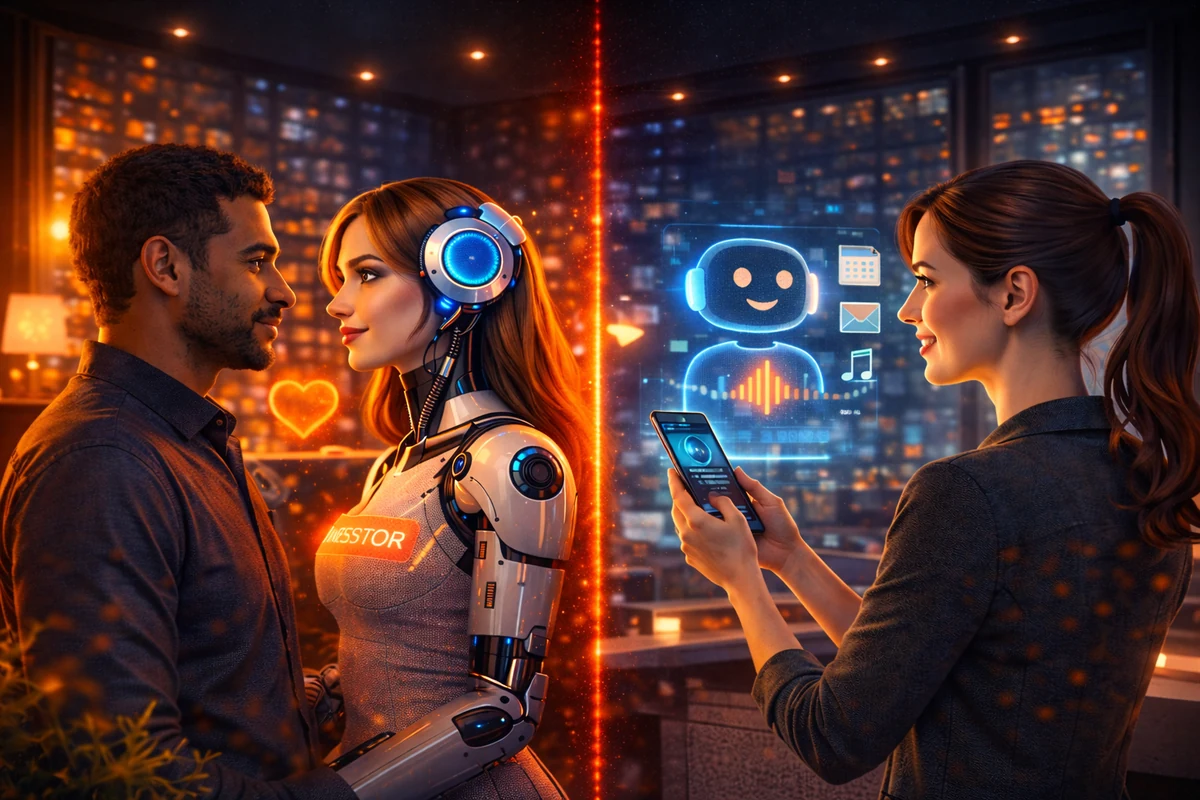
But spend a bit more time with both, and the gap becomes clear. One is trying to help you get things done. The other is trying to stay with you while you do them. That distinction, subtle at first, is shaping the entire direction of this space.
Let’s break down the AI companions vs virtual assistants divide properly.
🛠️ Built for Tasks vs Built for Interaction
Virtual assistants have a clear job description: they exist to perform tasks on your behalf. This might mean setting reminders, checking the weather, or pulling up information. They are functional software agents designed to execute commands with minimal friction.
Companions are built differently. Their primary goal isn’t task completion, it’s engagement. They are designed to hold conversations, adapt to your preferences, and maintain a sense of continuity. This highlights the core utility vs companionship in AI debate.
| Feature | Virtual Assistant | AI Companion |
| Primary Goal | Task Efficiency | Social Engagement |
| Response Style | Brief & Direct | Conversational & Open |
| User Intent | Getting things done | Spending time/Interaction |
Export to Sheets
In many cases, companions are less focused on “doing” and more focused on “being there.” It is a different design philosophy entirely that separates social vs functional AI agents.
Read Also: AI companions vs traditional robotics
⚡ Efficiency vs Presence
If you’ve ever used a virtual assistant regularly, you’ll notice how streamlined the interaction is. Research on Virtual Assistants highlights their role as productivity tools, optimized to save time.
Companions, on the other hand, slow things down. They are designed for longer interactions and idle chatting. Instead of minimizing interaction time, they intentionally extend it to build a sense of presence.
💡 Expert Tip: If you want a quick answer, use an assistant; if you want to explore a topic or share a thought, a companion is the better choice.
This is a major part of choosing between assistant and companion AI. One feels like a tool you use, while the other feels more like a system you live alongside.
Read Also: Why conversation quality matters more than appearance in AI companions
🧠 Memory and Personalization
Both systems use personalization, but in very different ways. Virtual assistants typically remember functional preferences like your location or calendar to perform tasks better.
But the memory is usually shallow and task-oriented. Companions go much further by attempting to build a sense of history. This is the difference between Siri and a social robot in a nutshell.
- Communication Style: Learning your slang or preferred brevity.
- Recurring Topics: Bringing up things you mentioned days ago.
- Emotional Context: Remembering if you were stressed during the last chat.
The goal isn’t just to respond correctly; it’s to respond in a way that feels familiar. This deep memory is a hallmark of the assistant vs friend AI dynamic.
Read Also: How AI companions learn over time
🎭 Emotional Tone and Interaction Style
Virtual assistants are neutral by design. Their tone is functional and devoid of variation, which keeps interactions predictable. This is exactly why Alexa is not a companion in the traditional sense.
Companions are built to simulate emotional tone. They adjust language and phrasing to match the flow of conversation. Some even attempt basic emotional recognition.
💡 Expert Tip: The role of empathy in AI types is the biggest differentiator; companions “mirror” your mood, while assistants remain professional.
This doesn’t mean they feel anything, but the interaction is designed to feel human-like. This is a key part of the social vs functional AI agents landscape.
Read Also: What makes an AI companion feel human
🔄 One-Off Commands vs Ongoing Context
Virtual assistants often operate on a “stateless” model where each command is treated independently. You ask something, it answers, and the interaction ends.
Companions move toward a “stateful” model. They aim to maintain context across interactions so that conversations don’t fully reset. This cumulative experience is a defining characteristic of utility vs companionship in AI.
| Interaction Type | Virtual Assistant | AI Companion |
| Logic Model | Stateless (Isolated) | Stateful (Cumulative) |
| Context | Immediate command | Long-term relationship |
| Success Metric | Accuracy/Speed | Retention/Engagement |
Export to Sheets
Read Also: The psychology behind human-machine bonding
🏠 Role in Daily Life
Virtual assistants tend to sit in the background of your routine. You use them when needed, to set a timer or check traffic. They are integrated into your environment but not constantly present in your attention.
Companions occupy a different space, often used during downtime or moments of reflection. This is a significant shift from utility to presence.
- Assistants: Used during active tasks (cooking, driving).
- Companions: Used during passive time (relaxing, winding down).
Understanding this helps when choosing between assistant and companion AI. Your need, whether functional or social, dictates which one you should engage with.
Read Also: Why people are turning to AI companions
🏗️ Design Priorities Behind the Scenes
If you look at how these systems are built, the differences become even clearer. Assistants prioritize integration with external services and reliability in structured environments.
Companions prioritize natural conversation flow and personality consistency. While both use Large Language Models in care and interaction, the application varies wildly.
💡 Expert Tip: Accuracy in task execution is the “North Star” for assistants, while engagement is the “North Star” for companions.
Read Also: Natural language processing explained for non-engineers
🤝 Overlap Is Increasing
The line between these two categories is starting to blur. Some virtual assistants are becoming more conversational, adding elements of personality.
At the same time, companions are gaining functional capabilities. This convergence is creating hybrid experiences that combine AI companions vs virtual assistants into a single interface.
- Conversational Assistants: Siri or Alexa getting “smarter” and more talkative.
- Functional Companions: A social robot that can also control your smart lights.
- Ecosystem Integration: Your “friend” AI knowing your schedule to help you plan.
Read Also: What are companion robots
🤳 A Small Personal Observation
Switching between these two feels like switching between a calculator and a chat app. When I use a virtual assistant, I’m focused and expect a quick result.
When I use a companion, the interaction is looser and I often don’t even have a goal. That difference in mindset explains why Alexa is not a companion for those seeking social connection.
🏁 Conclusion
AI companions and virtual assistants share technological roots but serve different masters. One is built to help you get things done; the other is built to interact with you over time.
As the technology evolves, the gap will narrow, but the core difference between Siri and a social robot remains one of intent. Some systems will always be tools; others will be presence.
Knowing which is which makes all the difference in how you integrate them into your modern life.