
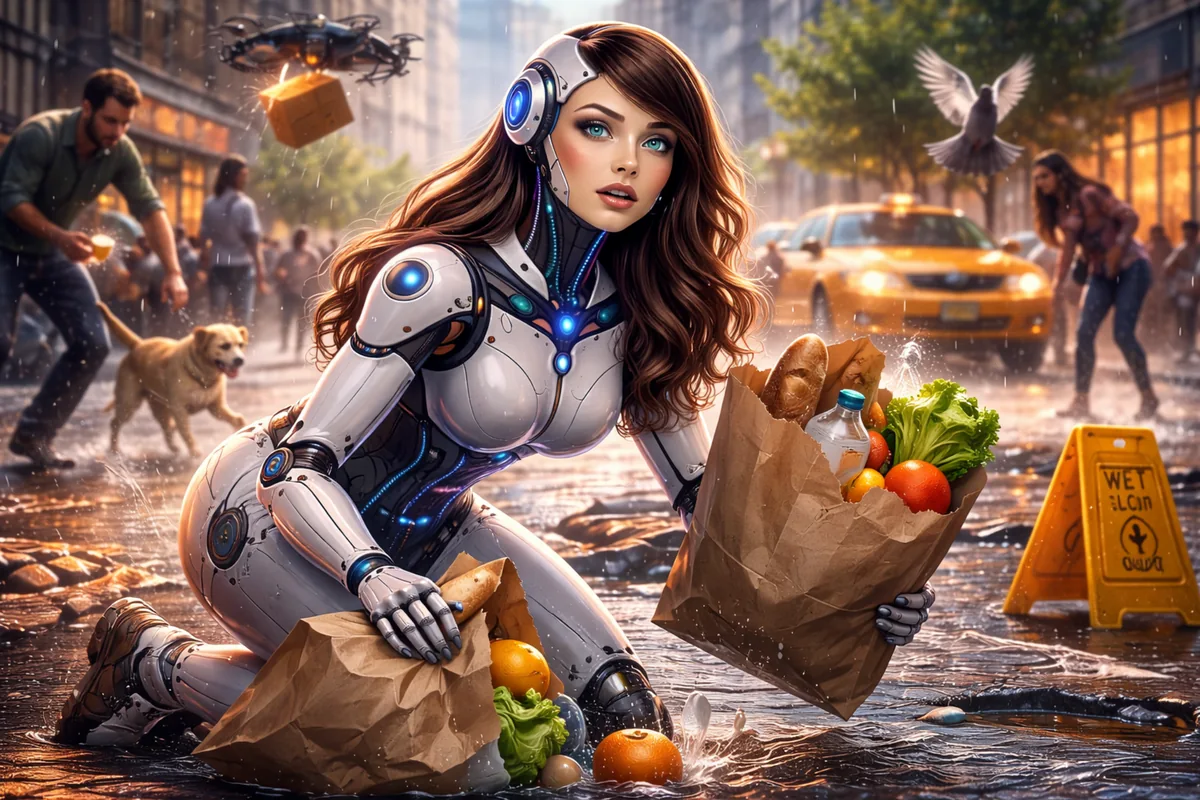
Why Companion Robots Struggle With Real-World Environments

Key Take-Aways
- Companion robots perform well in controlled settings but struggle in unpredictable real-world environments.
- Physical navigation, object recognition, and human behavior variability remain major challenges.
- Sensors and perception systems are still limited compared to human awareness.
If you’ve ever watched a companion robot demo online, it probably looked smooth, responsive, almost effortless.
The robot navigates a room, recognizes a person, and maybe even holds a simple conversation. It gives off the impression that the technology is nearly there.
Then you put that same system into a real home, with uneven lighting, background noise, cluttered floors, and unpredictable human behavior, and things start to break down.
That’s not even mentioned the vast complexity of an AI sex robot. Sure, it’ll be laying down most of the time, but it still needs to perform certain positions.
That gap between controlled demos and real-world performance is where things get interesting.
Companion robots are not failing because the technology is weak. They struggle because the real world is messy in ways that are incredibly hard to model.
This fundamental difficulty is why robots struggle in the real world.

The Reality Gap Between Labs and Homes
Most robotics systems are developed and tested in controlled environments. Lighting is consistent, objects are placed deliberately, and interactions follow expected patterns.
Real homes do not work like that. Furniture gets moved. Objects are left in unexpected places. Lighting changes throughout the day. Some people might want different sexual positions. People behave differently every time.
Why Home Layouts Are Difficult
- Shadows: Natural light changes can trick depth sensors into seeing holes or obstacles.
- Reflections: Glass doors or mirrors often cause robotic navigation problems during mapping.
- Clutter: Small objects like cables are hard for computer vision and real-world obstacles detection to isolate.
Even small variations can throw off a robot’s perception system. A chair slightly out of place or a noisy TV in the background can create enough uncertainty to disrupt performance.
This reality gap is one of the biggest hurdles. It is not a single problem; it is hundreds of small inconsistencies happening at once, illustrating the difficulty of home-based robotics.
Perception Is Still a Bottleneck
Humans are incredibly good at interpreting their surroundings. You can walk into a dimly lit room, avoid obstacles, recognize faces, and understand context almost instantly.
Companion robots rely on sensors like cameras, microphones, and sometimes lidar. These systems provide useful data, but they do not replicate human perception.
| Sensor Type | Function | Real-World Limitation |
| Camera | Object/Face Recognition | Struggles in low light or high glare |
| Microphone | Voice Recognition | Drowns in background noise/echoes |
| Lidar/Depth | Mapping | Confused by glass, pets, and moving feet |
For example, object recognition systems can identify common items, but they often struggle with variations. A cup might be recognized on a table, but not if it is partially covered or tilted.
This is a primary reason why conversation quality matters more than appearance because if the robot cannot see you clearly, the social bond weakens.
Navigation Is Harder Than It Looks
Getting from point A to point B sounds simple, but indoor navigation is surprisingly complex. Robots use mapping and localization techniques to understand where they are and how to move.
These systems work best in stable environments where the layout does not change much.
In real homes, obstacles appear and disappear constantly. A bag on the floor, a pet walking by, or even a door left half-open can disrupt navigation.
This explains why robots trip or get stuck so often. Unlike industrial units, domestic robots must be compared to companion robots because they need to move safely around people, predicting human movement to avoid collisions in a socially acceptable way.
Human Behavior Is Unpredictable
One of the most underestimated challenges of unstructured environments is human behavior itself.
People do not interact with robots in consistent ways. Tone of voice changes. Instructions are phrased differently. Sometimes people speak while moving.
Interaction Variability
- Verbal Shorthand: Humans use vague phrases like “Put it over there” that robots struggle to parse.
- Body Language: Humans expect robots to respect personal space based on the psychology behind human-machine bonding.
- Interrupting: Users often change their minds mid-command, confusing the robot’s logic loop.
For a system designed to interpret and respond in real time, this variability is difficult to handle.
There is also the issue of expectations. Humans naturally project social understanding onto robots. If a robot hesitates, it feels more noticeable than a simple software glitch.
Limited On-Device Processing Power
Companion robots operate under tight hardware constraints. They need to be energy-efficient, relatively compact, and often battery-powered.
This limits how much processing can happen locally. Complex models for vision and decision-making require significant computational resources.
Some systems rely on cloud processing to handle heavier tasks. However, as noted in the debate between cloud-based vs local AI companions, this introduces latency and dependence on network connectivity.
In real-world environments with unstable internet, that can affect responsiveness. This technical wall is a major part of what limits current AI companions today.
Environmental Diversity and Edge Cases
No two homes are the same. Layouts differ, lighting varies, and cultural differences influence how spaces are used.
Training a robot to handle all possible environments is extremely challenging. This is why social robots stay in one room or specific safe zones.
Generalizing how social robots are used today requires massive datasets that still cannot cover every edge case.
Many home-based robotics experts suggest that the best way to integrate a robot is to treat it like a new pet, slowly introducing it to one room at a time to build a stable map.
A reflective surface might confuse depth sensors. Background conversations might interfere with natural language processing during voice recognition.
A pet might move unpredictably. Individually, these issues seem minor, but together they create a constant stream of disruptions.
Safety and Social Integration
Companion robots operate in close proximity to humans, which means safety is non-negotiable. This often leads to conservative behavior.
Robots may move slower or hesitate before acting. While this improves safety, it can also make the system feel less capable.
Beyond physical interaction, robots are expected to engage socially, which is highly context-dependent. Knowing when to speak or stay silent requires situational awareness.
This is why AI companions in elder care are so specialized; the context of a senior’s home requires a specific balance of proactive help and unobtrusive presence.
Even the latest research on autonomous home agents highlights that integrating perception and social cues is still the “holy grail” of the industry.
The Complexity of Integration
- Cascading Effects: A delay in computer vision can lag the entire decision-making loop.
- Hardware Squeeze: Balancing sensor weight with motor power and battery life.
- Consistency: Maintaining socially acceptable behavior over months of use.
Conclusion
In summation, companion robots struggle in real-world environments not because the technology is failing, but because the problem itself is incredibly complex.
You are asking a machine to perceive, move, and interact in a world that humans themselves take years to fully navigate.
The gap between controlled demos and everyday use is narrowing through improvements in how AI companions learn over time.
If you are using or considering a companion robot, it helps to understand this context. What you are seeing is not a finished product; it is a system learning to operate in one of the most unpredictable environments possible.
When you look at it that way, the fact that they work at all is already pretty impressive.