
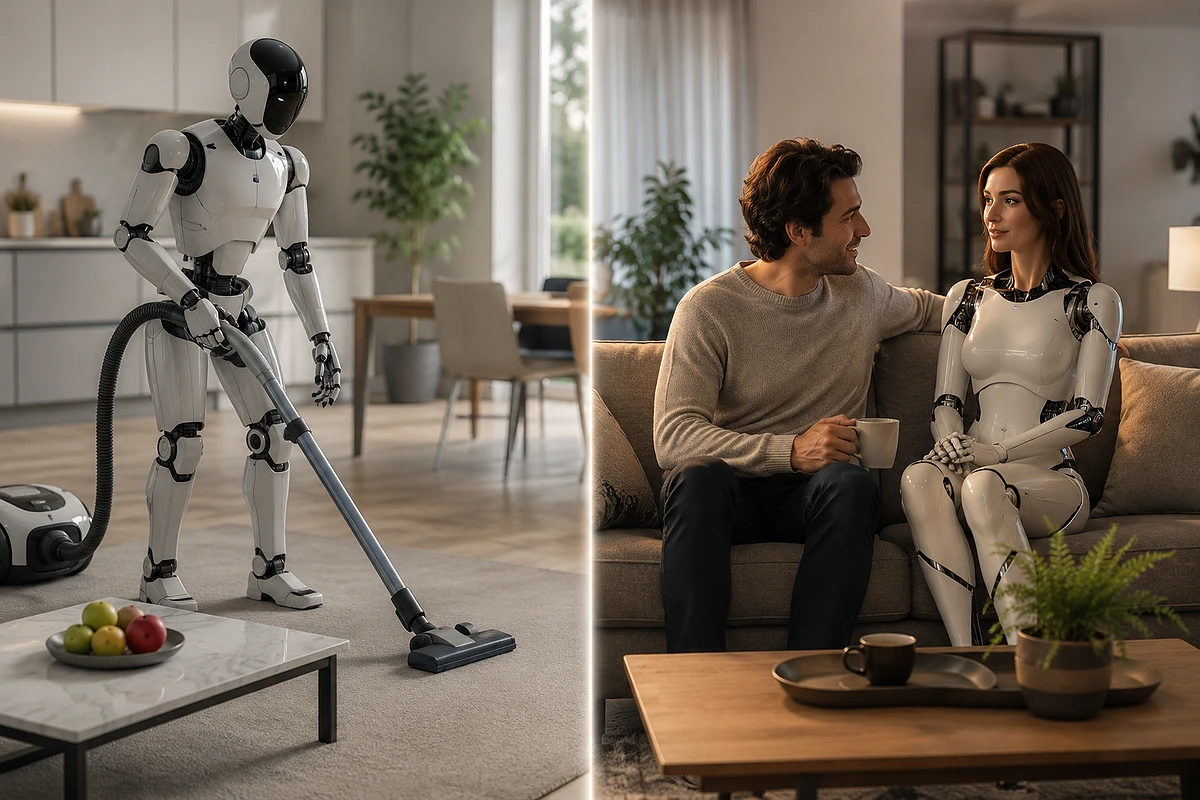
🤖 Domestic Robots vs Companion Robots Key Differences

TLDR
- Domestic robots automate physical household chores like vacuuming, lawn mowing, and safety patrols.
- Companion robots focus entirely on social interaction, emotional engagement, and speech.
- Engineering for domestic machines optimizes for mapping, spatial navigation, and torque.
- Design for social agents prioritizes natural conversation, dialogue flow, and low latency.
- The overlap between these systems is growing, but their core purposes remain separate.
If you walk into a modern home, you might spot a small disk vacuuming the floor. In the living room, you might see a different device telling a story or playing music.
Both machines operate with autonomous software, but they exist for entirely different reasons. They represent two branches of engineering that often get mixed up in casual conversation.
The core distinction shapes how engineers build hardware, write code, and measure performance. Let’s look closely at the architecture that separates these home technologies.
🛠️ What Defines a Domestic Robot
Domestic robots are built to take over physical labor around the living space. These machines handle repetitive, tiring chores that normally require human muscle and time. Common examples include smart vacuums, automated lawn mowers, and pool cleaners.
The engineering behind a domestic device focuses on physical manipulation and movement. To work well, these machines need to master spatial mapping and obstacle avoidance. They must handle the unpredictable terrain of a normal family home without getting stuck.
Most vacuuming devices use specific sensors to map rooms out accurately. A great example of this is mapping technology, which bounces light beams off walls to build a clear spatial layout. This process helps the machine calculate the best path forward.
Expert Tip: When buying automated cleaning tools, check the suction power and wheel clearance rather than smart home extras. The mechanical build determines how well the chore actually gets done.
💬 What Defines a Companion Robot
Companion robots prioritize digital interaction over physical labor. Their main job is to provide a sense of social presence through speech, facial expressions, and movement. Instead of scrubbing floors, these systems focus entirely on what are companion robots designed to do best: keeping people company.
The development process here focuses on soft skills like speech recognition and behavioral timing. Instead of measuring motor torque, developers track conversational metrics. The goal is to build an interface that responds naturally during an ongoing conversation.
These machines use complex language models to break down human speech and form quick answers. They often include cameras that track eye movement and expressions. This creates a feedback loop where the machine alters its tone based on your current mood.
🦿 Hardware Priorities: Mobility vs Expression
The hardware choices for domestic robots vs companion robots highlight their separate paths. A cleaning unit requires rugged components, durable gearboxes, and tough plastic shells. It has to survive bumping into table legs and driving over thick rugs day after day.
On the flip side, social hardware prioritizes expressive elements over raw durability. These devices utilize animated eyes, tilting head joints, and smooth speaker arrays. The physical movement of a social machine is meant to communicate feelings rather than move heavy objects across a room.
| Robot Type | Primary Hardware Focus | Key Components |
| Domestic Systems | Rugged durability and movement | Heavy-duty wheels, brushes, high-torque motors |
| Social Systems | Non-verbal cues and warmth | LED screens, micro-servos for expressions, mic arrays |
💻 Software Architecture Differences
The coding frameworks for these machines address totally unique challenges. Domestic software spends its computing power on path planning, sensor fusion, and error correction. The system needs to know exactly what to do when a rogue sock jams its main brush roll.
Social software focuses on dialogue management and real-time audio processing. A big challenge here is reducing the delay between a human question and a robotic response. When you are chatting with a machine, a delay of just two seconds can make the interaction feel broken.
Engineers spend thousands of hours optimizing how these systems handle language. Minimizing lag is what makes a digital entity feel truly alive. You can see this system latency dynamic explained firsthand within modern frameworks built around how speech-to-text accuracy impacts user experience for conversational models.
📈 Measuring Success: Clean Floors vs Emotional Engagement
We grade a cleaning device based on clear, objective results. Did the machine clear the debris from the carpet? Did it finish the backyard without running out of battery? The success metrics for home automation vs companion AI could not be more distinct.
A social machine is graded using subjective metrics like user retention, smile detection, and conversational length. In medical care or retirement facilities, staff look at whether the technology successfully reduces feelings of isolation. The goal centers on comfort rather than speed.
- Domestic Metric: Area covered per hour, dirt collection weight, docking success rate.
- Social Metric: Daily interaction time, conversational depth, emotional comfort levels.
🔄 Overlapping Capabilities
The boundary between domestic AI vs social AI has become slightly blurred lately. Some high-end vacuum models now accept direct voice commands. At the same time, certain tabletop social devices can log into your smart home system to dim the lights or adjust the thermostat.
Even with these new features, the primary engineering intent does not change. A vacuum that answers back is still a cleaning appliance at its core. A desktop social tool that tells you the weather remains focused on digital interaction.
📖 Read More: To understand where these hybrid consumer spaces diverge completely from simpler consumer alternatives, view our deep dive exploring companion robots vs smart toys where the line is drawn.
🧠 Human Psychology and Design Intent
Building social agents requires a deep understanding of human behavioral psychology. Designers carefully calibrate things like vocal pitch, head tilt angles, and blinking rates. These tiny details help users feel comfortable, preventing the machine from seeming creepy or robotic.
Industrial household tools do not need to worry about maintaining eye contact with you. Their software simply needs to prevent them from falling down the basement stairs. The emotional stakes are much lower when a device is just clearing dust.
If a kitchen cleaning device acts up, you might find it mildly annoying. But if a social machine acts erratically, it can feel genuinely unsettling. This reality requires developers to pay close attention to the psychology behind human-machine bonding during the initial build.
⚖️ Ethical Considerations
Social machines bring forward unique dilemmas because they simulate genuine human affection. Developers must carefully manage user boundaries to prevent unhealthy psychological habits. It is critical that users always recognize they are interacting with an artificial program.
Autonomous household tools face different ethical challenges, mostly centered around data security and indoor mapping. A machine that creates a digital blueprint of your home layout presents a clear technical data risk. You can read up on the raw technical compliance challenges within public studies regarding domestic robotics frameworks.
Critical Note: While a mapping leak exposes the physical layout of your home, a social data leak can expose your deepest personal thoughts, emotional vulnerabilities, and private conversations.
💰 Cost Structures and Market Positioning
Companies market functional vs emotional robotics to completely different consumer groups. A vacuum or lawn mower is framed as a time-saving appliance. The purchase decision is based on a practical calculation of labor hours saved over the lifespan of the machine.
Social tools are positioned around lifestyle improvement, mental wellness, or cognitive support. The financial value is tied to personal development or elder care assistance. This changes how companies price their hardware and software subscriptions.
- Hardware Costs: Domestic tools invest heavily in batteries, brushes, and durable sensors.
- Software Costs: Social tools invest in speech licenses, server processing, and animation.
🧔 My Personal Take
When I compared a traditional cleaning unit with a modern social robot, the difference between Roomba and social robots became instantly clear. The cleaning machine went about its chore silently, paying zero attention to the people in the room. It was an incredibly useful appliance, but it felt completely cold.
The social device looked up when I walked in, tracked my movement, and adjusted its stance. It did not possess a physical body capable of washing dishes, but its presence altered the room’s energy. One felt like an industrial tool, while the other felt like a guest.
That shift in perspective shows the true classification of household robots today. One fills a physical need, while the other steps into a psychological space.
🏁 Conclusion
While personal service robots vs companions share similar code foundations, their daily objectives point in different directions. Domestic models exist to automate manual labor with speed and precision. Their world is defined by physical obstacles, battery runtimes, and mechanical reliability.
Social agents exist to bridge an emotional gap through expressive design and dialogue. As technology progresses, we will see these two branches share more features. However, the dividing line between task-based robots vs social agents will remain a cornerstone of the industry.