
🧩How Multimodal AI Improves Companion Interactions

TLDR
- Sensory Integration: AI helps companion systems understand more than words by combining voice, vision, gestures, and environmental context.
- Better Flow: High-level context leads to more natural conversations, reducing awkward misunderstandings and repetitive responses.
- Responsiveness: Voice tone, facial cues, and physical surroundings improve responsiveness in social robots and embodied assistants.
- Human-Like Presence: Companion interactions feel more human-like when systems can sense multiple signals simultaneously.
- Situational Awareness: The biggest shift is contextual awareness, allowing companion technologies to respond appropriately to everyday situations.
If you have ever spoken to an older voice assistant and felt vaguely annoyed afterward, you are not alone. You ask a simple question, pause for half a second, and suddenly it thinks the conversation is over. You mention something indirectly, and it completely misses the point. Maybe you are clearly frustrated, but the response arrives with the emotional awareness of a toaster.
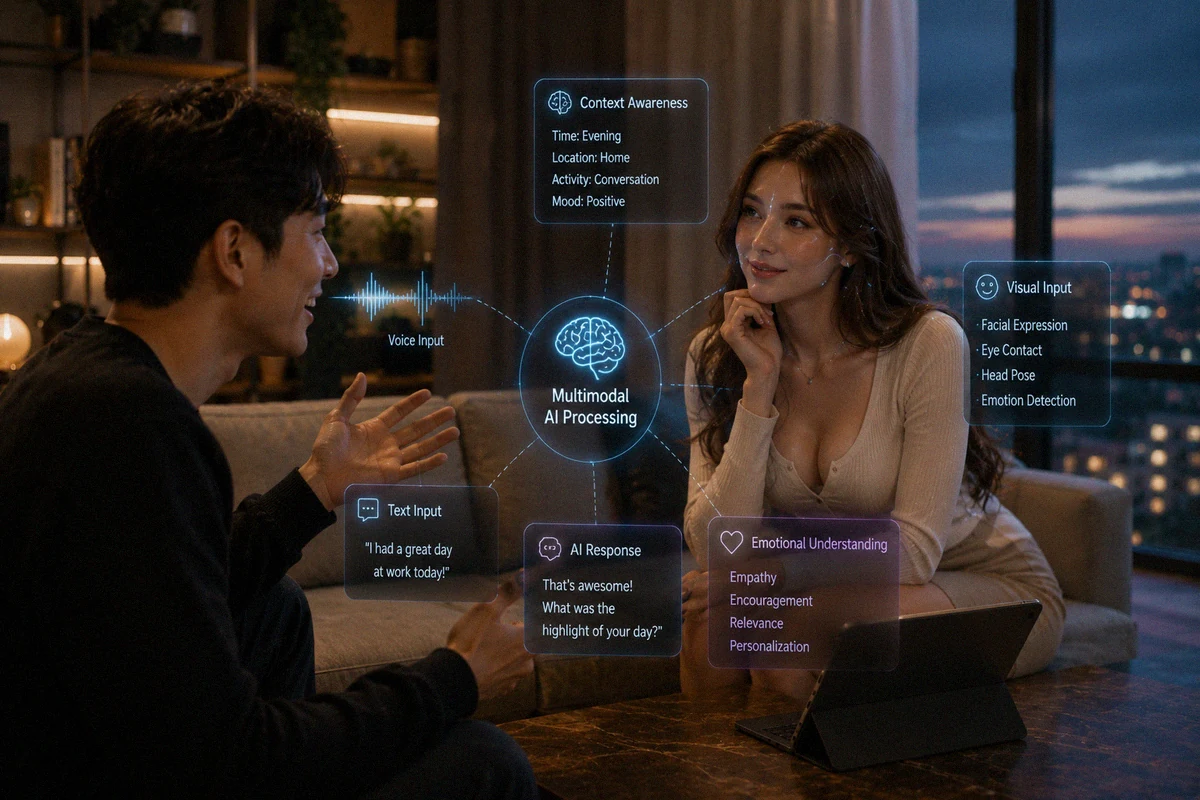
That awkwardness has defined much of human-machine interaction for years. But things are changing. One of the biggest reasons companion technologies are becoming noticeably more natural is multimodal AI in companions. Instead of understanding just one kind of input, such as text or speech alone, these systems are combining senses for better AI interaction.
- Words: The literal meaning of the language.
- Voice Tone: Pacing, pitch, and emotional weight.
- Images: Visual data of the room and objects.
- Facial Expressions: Non-verbal cues of mood.
- Context: History of interactions and environmental signals.
When companion systems begin blending these together, conversations start feeling less mechanical. Not perfect. Definitely not magical. But much closer to something genuinely useful.
🧠 What Multimodal AI Actually Means
Traditional conversational systems usually worked through one communication channel. You typed something, or you spoke something, and the system responded. Multimodal vs text-only companions work differently by processing several types of information simultaneously.
Imagine this scenario: You say, “I’m fine,” but your voice sounds strained, your posture looks tired, and the interaction history suggests you have had a stressful week. Because it can process more signals at once, a multimodal system may interpret that moment differently than a text-only chatbot would. Not because it “understands feelings” in the human sense, but because it can process more signals at once.
Why Extra Context Matters
- Reliability: Words are often the least reliable part of communication.
- Depth: Understanding what makes an AI companion feel human requires sensing nuance.
- Speed: Systems can react faster when they don’t have to wait for explicit verbal commands.
- Error Correction: Visual data can clarify ambiguous speech (e.g., “Put that there”).
🎭 Humans Communicate in Layers
Think about everyday conversation for a second. If someone says, “Sure, everything’s great,” you instinctively evaluate much more than the sentence. Their expression matters. Tone matters. Timing matters. Context matters. Were they smiling? Hesitating? Exhausted? Sarcastic? Humans constantly interpret layered signals without consciously noticing.
Companion systems historically struggled because they only had access to fragments of communication. Text-only systems missed vocal emotion. Voice assistants missed visual context. Robots sometimes reacted to commands without understanding what was happening around them. Multimodal systems attempt to bridge that gap.
Core Communication Layers
- Verbal: The literal script of the conversation.
- Vocal: The rhythm and prosody of the speech.
- Visual: The importance of vision in social AI to see body language.
- Proxemic: The physical distance and orientation of the user.
Giving a machine more context generally improves interaction quality. Turns out communication is easier when you can actually “see the room.” This is a primary reason why people are turning to AI companions for more meaningful engagement.
🎙️ Voice Recognition Has Gotten Smarter
Voice remains one of the biggest upgrades. Older assistants treated speech mostly as text conversion. You spoke, the machine transcribed words, and then it generated a response. Modern systems increasingly analyze vocal characteristics too. Pacing, volume shifts, pauses, and stress patterns are now data points.
Vocal Nuances Analyzed by Modern AI
- Prosody: The “melody” of speech that indicates a question vs. a statement.
- Breathiness: Can indicate fatigue or specific emotional states.
- Latency: The time between a prompt and a response, signaling hesitation.
- Pitch Variation: Distinguishing between excitement and boredom.
This matters in companion scenarios because emotional context changes conversation. A cheerful “I need help” sounds different from an anxious one. Likewise, hesitation can signal uncertainty. The system does not experience emotions, but it can sometimes recognize patterns associated with emotional states.
This is a key distinction between emotion simulation vs emotion recognition. Even modest improvements here make conversations feel dramatically smoother.
👁️ Vision Adds Another Layer of Context
For what are companion robots especially, computer vision changes the experience considerably. A robot that can visually interpret surroundings behaves differently than one operating blind.
Imagine a companion robot noticing you entered the room carrying groceries. Instead of launching into a random reminder, it waits. Or consider a home assistant recognizing that multiple people are present and adjusting how it communicates.
Practical Features of Visual Sensing
| Feature | Description | Benefit |
| User Recognition | Identifying familiar faces. | Loads personal preferences and memory. |
| Room Conditions | Monitoring light and clutter. | Adjusts movement and alerts accordingly. |
| Gesture Detection | Recognizing a wave or a point. | Enables natural language processing to be hands-free. |
| Activity Monitoring | Seeing routines in eldercare. | Detects falls or mobility issues. |
| Accessibility | Visual cues for the hearing impaired. | Provides multi-channel feedback. |
For older adults, multimodal systems can sometimes help identify mobility issues or unusual inactivity patterns. This is a major factor in how AI companions are used in elder care today. However, the role of cameras in social AI also raises significant privacy concerns. Organizations like the NIST are consistently evaluating how this data is managed.
🤝 Gesture and Movement Make Robots Feel More Social
If companion robotics has taught us anything, it is this: movement matters more than people expect. A surprising amount of communication happens through physical behavior. Eye contact, head movement, pauses, and body orientation are essential for sensory integration in social robots.
Non-Verbal Cues in Robotics
- Gaze Following: The robot looks at what you are looking at.
- Micro-gestures: Small tilts of the “head” to signal listening.
- Joint Attention: Coordinating movement with conversation to show focus.
- Social Cueing: Using timing to make interactions feel less robotic.
Research in human-robot interaction consistently shows people respond differently to robots that use timing and movement naturally. A robot that slightly turns toward you while speaking feels more attentive than one staring blankly into space. Humans are incredibly easy to socially cue; we assign personality to objects with alarming enthusiasm.
Multimodal systems help coordinate those signals better, ensuring that speech, gesture, and timing become synchronized rather than disconnected. This directly impacts the psychology behind human-machine bonding.
📉 Better Context Means Fewer Weird Moments
Anyone who has tested conversational systems long enough knows the pain of bizarre misunderstandings. You reference something obvious, and the system responds as though it came from another universe. Multimodal processing reduces some of that friction by providing a future of multimodal human-robot interaction that is grounded in reality.
Examples of Contextual Awareness
- Thermal Comfort: You mention being cold; the system checks the smart thermostat.
- Deictic Expressions: You point at a lamp and say “Fix this,” and the system uses vision to understand.
- Social Dynamics: Recognizing when you are on a phone call and staying quiet.
- Environmental Noise: Filtering out a TV in the background to focus on your voice.
Because systems can combine environmental signals with memory and conversation history, responses increasingly feel context-aware. The system no longer depends exclusively on perfect wording. You communicate more naturally, and natural communication tends to feel easier. This is why conversation quality matters more than appearance.
📈 Personalization Improves Over Time
Multimodal systems also support richer personalization. Instead of learning solely from text conversations, companion technologies may gradually adapt to routines, preferences, communication styles, and environments. This is a core part of how AI companions learn over time.
Elements of Multimodal Personalization
- Routine Recognition: Knowing your morning habits without being told.
- Communication Style: Adapting to your pace of speech or preferred vocabulary.
- Visual Preferences: Noticing which parts of the house you spend the most time in.
- Predictive Assistance: Offering help based on observed patterns rather than requests.
The best companion technologies are often not the smartest ones technically. They are the ones that quietly adapt without making you constantly reconfigure settings. When you stop noticing the technology, it is usually a good sign. This is why loneliness, AI, and modern society are becoming so intertwined; the tech is becoming more invisible.
🔒 The Privacy Question Gets Bigger
Here is the tradeoff: more awareness requires more information. A multimodal companion system may process voice recordings, images, behavioral patterns, routines, movement, and contextual data. That creates obvious privacy risks of AI companions that cannot be ignored.
Major Privacy Considerations
- Data Storage: Understanding how AI companions store and use your data.
- Processing Location: Choosing between cloud-based vs local AI companions.
- User Control: The ability to delete specific visual or auditory memories.
- Third-Party Access: Who else sees the environmental maps created by the role of cameras in social AI?
Governments and regulators are increasingly focused on these concerns, particularly for products involving children, healthcare, or eldercare. Companion technologies become more useful when context improves, but context and privacy tend to pull against each other. Understanding the regulation and future laws around social robots is essential for any early adopter.
🚧 Multimodal AI Still Has Limits
Despite all the progress, this technology is nowhere near flawless. Misunderstandings still happen. Emotion recognition remains inconsistent across situations. Lighting affects visual accuracy. Background noise affects voice analysis. Cultural differences influence communication styles.
Current Technical Limitations
| Challenge | Impact on Interaction |
| Environmental Lighting | Degrades the importance of vision in social AI. |
| Audio Overlap | Multiple speakers confuse what current AI companions are capable of. |
| Latency | Processing multiple streams can cause “laggy” responses. |
| Hardware Costs | High-end sensors contribute to hardware limitations. |
Even advanced systems occasionally interpret normal behavior strangely. You laugh nervously, and the system misreads excitement. You speak quietly because you are tired, and it assumes sadness. Humans misunderstand each other constantly, too. Still, expectations matter. Multimodal companion systems are becoming more responsive, not all-knowing.
🏁 Conclusion: Companion Technology Is Becoming More Context-Aware
The biggest change multimodal systems bring to companion interactions is not intelligence in the dramatic science-fiction sense. It is context. Machines are gradually getting better at interpreting how robots see and hear in the real world: through words, tone, gestures, surroundings, and routines combined.
That shift makes companion interactions feel smoother, more helpful, and occasionally surprisingly natural. As we look toward where AI companionship is likely headed next, the goal is clear: machines that finally get access to more of the conversation.
After years of yelling at assistants that misunderstood basic requests, even small improvements feel oddly satisfying. The future of companion technology may simply depend on them becoming better listeners through the power of multimodal vs text-only companions.