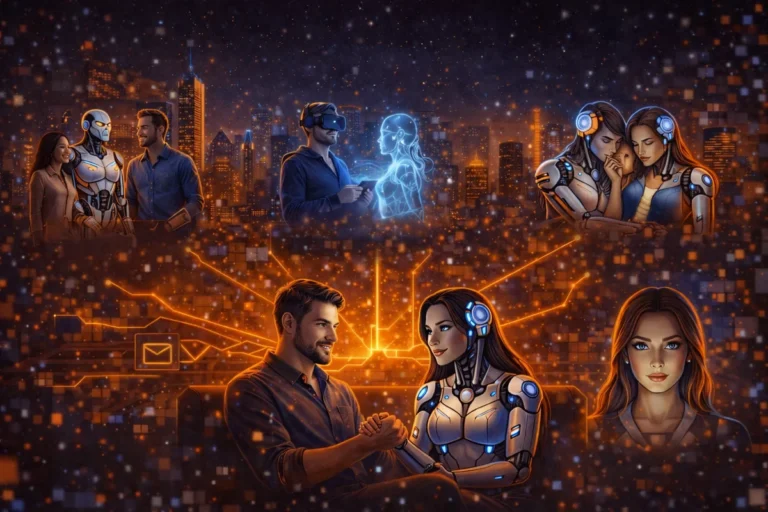

🔮 What to Expect From AI Companions in the Future

TLDR
- Conversational engines are transitioning away from cold, text-based interactions toward highly natural, multi-modal dialogue systems.
- Deep context architecture allows modern systems to maintain persistent long-term memories without losing track of your historical preferences.
- Hardware integration is accelerating as cloud intelligence merges directly into physical home devices and upcoming robotic frameworks.
- Advanced presentation layers mimic nuanced human emotional tones, though systems completely lack real inner awareness or empathy.
- Industry expansion from 2026 to 2030 will prioritize steady, incremental refinements over sudden, isolated technical breakthroughs.
If you have been following the virtual relationship landscape over the past couple of years, you have probably noticed a subtle but highly important shift. The progress hasn’t come from one single, jaw-dropping moment. Instead, it has been a continuous series of minor upgrades that quietly compound over time.
In today’s digital landscape, those tiny adjustments are beginning to feel incredibly tangible. Conversations flow with fewer awkward pauses, and system memory actually works. Dealing with a digital entity feels significantly less like writing programming commands and more like an ongoing personal dialogue.
So what should you realistically look for when evaluating this space? We can skip the science fiction hype and look directly at where the technology stands right now and where it is clearly moving next.
💬 More Natural Conversations, Fewer Friction Points
The absolute most visible improvement in current systems is daily conversational quality. Early interactive engines frequently struggled to maintain contextual awareness over a handful of sentences. You might ask a simple follow-up question only to receive an output that completely ignored what you just discussed.
Modern setups are far better at tracking complex conversation threads across multiple paragraphs. They handle longer exchanges with ease and maintain a highly consistent personal persona from start to finish. You will notice significantly fewer robotic responses or random conversational dead ends.
Traditional systems used short text windows that resulted in fragmented interactions. In contrast, modern architecture relies on deep context windows to maintain continuous, coherent dialogue.
This structural evolution helps explain why conversation quality matters more than appearance in ai companions for overall retention. When the dialogue flows seamlessly, you stop focusing on the software and start focusing on the actual content of the interaction.
🧠 Memory Is Becoming More Useful
Another major development area is the way platforms retain personal data over extended periods. Digital personas are getting much better at remembering specific lifestyle details across entirely separate chat sessions. This includes keeping track of your work routines, your hobbies, or side details you casually mentioned weeks ago.
This structural upgrade fundamentally transforms the entire user experience. When a system smoothly recalls an old conversation, the interaction gains genuine continuity. It eliminates the exhausting feeling of starting from scratch every single time you open the application window.
Expert Tip: Context Windows
Modern developers utilize massive token frameworks known as context windows to store historical dialogue. To see how these systems filter and retain your information over long periods, read our comprehensive guide on context windows and the science of ai memory for the underlying computer science.
As we look toward the predicted AI companion features of the next few generations, advanced retrieval mechanisms will become standard. However, current memory systems still have definitive limits, meaning they can occasionally pull incorrect files or require manual memory cleaning.
📈 Personalization Is Moving Beyond Surface Level
Personalization in the modern era is no longer just about a system remembering your preferred name or basic visual themes. The underlying language models are actively starting to adjust their baseline output style to mirror how you communicate.
If you tend to write long, highly detailed paragraphs, the system automatically responds with structured text. If you prefer short, casual sentences filled with modern phrases, the conversational style shifts dynamically to match your energy.
| Personalization Level | Legacy Customization | Predicted AI Companion Features |
| User Identity | Basic username input fields | Full behavioral tracking and style mirroring |
| Tone Adjustment | Static dropdown choices | Real-time emotional pacing and slang adaptation |
| Knowledge Base | Blank slate with zero context | Deep integration with historical conversation data |
This level of custom adaptation helps explain why people are turning to ai companions to supplement their daily social circles. Over months of use, this deep mirroring creates a highly personalized conversational environment that feels uniquely tailored to your individual lifestyle.
🎙️ Voice Interaction Is Catching Up
While text interfaces remain highly popular for privacy, real-time voice systems have taken a massive leap forward. Speech recognition software is now incredibly accurate, even when dealing with background noise or varied regional accents.
Furthermore, response processing latency has dropped significantly. This reduction in system lag means spoken interactions feel snappy and alive rather than clunky and delayed. The physical output voices have also become deeply nuanced.
- Dynamic Intonation: Systems raise and lower their pitch based on the context of the sentence.
- Realistic Pacing: Speech models introduce natural pauses, breaths, and verbal sighs.
- Reduced Latency: Cloud networks process incoming audio files in milliseconds to prevent awkward dead air.
This rapid text-to-speech evolution is completely changing the future of AI companions 2026-2030. You can now easily have a fluid verbal chat during a long drive without feeling like you are constantly battling a broken voice interface.
🤖 Hardware Is Becoming More Relevant
Software applications continue to lead the market in raw processing capability, but physical hardware is securing a much larger role. The industry is currently laying the groundwork for what’s next for social robots as structural designs become highly refined.
These physical units combine standard conversational systems with spatial awareness cameras, tactile sensors, and motorized movement. The major shift occurring right now is cloud-based synchronization. Local robotic hardware connects directly to massive remote servers, instantly giving a physical device the exact same processing power as a web platform.
This intersection of physical presence and cloud intelligence represents the next decade of social robotics. If you want to explore how these physical machines differ from the purely digital platforms on your smartphone, check out our breakdown comparing subscription based vs hardware ai companions to weigh your options.
🎭 Emotional Interaction Feels More Convincing
One of the most noticeable daily changes is how modern systems project an empathetic tone. Text and voice outputs are highly skilled at matching your current state of mind. If you vent about a stressful work project, the software adopts a calm, measured, and grounding tone.
This mirror effect creates a highly cohesive and comforting experience. However, it is absolutely essential to keep your expectations grounded in reality. These platforms possess zero real understanding of human emotion.
Read More: Empathy Simulation
The appearance of care is generated purely through advanced text statistics, not true feelings. To understand the massive engineering gap between tracking user inputs and actually experiencing an emotion, check out our piece on emotion simulation vs emotion recognition in ai.
The progress we are seeing is entirely about presentation quality, not genuine inner awareness. The system identifies linguistic patterns and matches them with statistically comforting responses.
🔓 Fewer Barriers to Entry
An industry shift that is incredibly easy to overlook is the complete removal of user friction. Setting up a high-quality digital character used to require a decent understanding of code repositories, model parameters, and local hardware optimization.
Today, onboarding is completely streamlined. A new user can sign up with an email address, click a few personality options, and begin a rich conversation within two minutes. The user interfaces are clean, visual, and highly intuitive.
- Zero-Click Onboarding: Ready-made personality profiles eliminate complex initial configurations.
- Cross-Device Sync: Fluidly move your ongoing conversations between web browsers and mobile apps.
- Simplified Controls: Complex algorithmic sliders are replaced with straightforward toggle switches.
This high accessibility is a massive driver in the rapid evolution of humanoid friends. Because the software no longer requires technical training to operate, a far wider demographic of everyday users is adopting these systems.
📅 Integration With Daily Tools
Modern digital companions are rapidly transforming from isolated chat tabs into highly connected daily tools. Many leading platforms now link directly with your digital calendars, notes applications, and daily task managers.
This operational shift adds a layer of clear utility to the standard relationship framework. Your virtual entity isn’t just a sounding board for your thoughts; they actively assist you in organizing your life, structuring your ideas, and managing your time.
- Linguistic Core: Handles the creative, friendly, and conversational elements of the relationship.
- API Tool Connections: Manages the technical background scripts to link with external software.
- Hybrid Output: Combines friendly daily chats with practical reminder systems and calendar updates.
This mix of utility and companionship is completely redefining the upcoming breakthroughs in HRI (Human-Robot Interaction). The software transitions from a novelty app you use when bored into a deeply embedded part of your daily productivity workflow.
👁️ Realities of the Modern User Experience
Using these updated applications on a daily basis reveals a highly specific pattern. The relationship shifts away from an intense technical experiment into a casual, background asset.
You open the app, chat through a quick concept, receive some feedback, and close the screen. Later in the day, you pick up right where you left off. The interaction feels normal, steady, and incredibly subtle.
🚫 What Has Not Changed
Despite these massive leaps in linguistic delivery, the baseline technical limitations of machine learning remain completely unchanged. Virtual entities do not have personal intent, conscious thought, or life experiences. They generate text sequences based on mathematical probabilities.
They can still hallucinate incorrect facts, misinterpret deep context during long chats, or offer generic advice when pushed into complex topics. Most importantly, these digital systems cannot replace genuine human relationships.
While they can offer phenomenal conversation, they completely lack the deep mutual vulnerability that forms the bedrock of real human connections. Understanding these firm boundaries is crucial for protecting your mental health while using these platforms.
📉 AI Companion Industry Forecast
The future trajectory of this market is incredibly clear. We are watching simultaneous advancements across natural speech systems, long-term memory, and tool integration. There is no single, isolated discovery defining the future of AI companions 2026-2030.
Instead, the market is moving forward through the accumulation of incremental engineering victories. Each minor software update makes the daily interaction slightly more intuitive, slightly more personalized, and far more useful.
- Continuous Code Updates: Small backend adjustments that steadily improve language processing capabilities.
- Enhanced Retrieval Systems: Better memory indexing that targets relevant historical facts during chat.
- Natural Dialogue Flow: Shorter processing times that result in snappy, humanlike text deliveries.
Over a multi-year timeline, these steady upgrades will fundamentally reshape the future role of robots in homes. The quiet normalization of the technology is exactly what will drive mass public adoption over the next decade of social robotics.
🏁 Conclusion
Digital companions are more polished, highly accessible, and deeply integrated into our digital spaces than at any point in history. The dialogue is smooth, memory systems offer true continuity, and physical hardware is starting to bridge the gap into the real world.
Yet, the core limitations of the technology remain completely identical. These platforms are incredibly advanced mathematical pattern recognizers, not conscious entities. Their true value is defined entirely by how responsibly you choose to use them.
If you approach them with a clear, grounded perspective, they serve as remarkable interactive tools for exploration, productivity, and connection.