🛑 What Current AI Companions Are Not Capable Of

TLDR
- 🧠 Current AI companions simulate conversation but do not truly understand emotions or the depth of human experience.
- 💾 Memory and long-term context remain limited, often leading to inconsistent or repetitive interactions over time.
- 🏗️ Physical-world capabilities are still narrow, particularly regarding robotics and true real-world autonomy.
- 👥 Social intelligence in complex, multi-person situations remains underdeveloped compared to one-on-one chats.
- ⚖️ These systems can assist and engage, but they cannot replace human judgment, ethical values, or genuine relationships.
Spend enough time with any companion platform and you’ll notice a pattern. The first few interactions feel surprisingly natural, sometimes even impressive.
But then, slowly, the edges start to show. It is not usually a dramatic failure, but rather small cracks like missed context or odd replies that feel just slightly “off.”
These moments are useful because they reveal exactly where the technology stands in 2026. Understanding these boundaries helps us move past the hype and see the actual current limitations of social robots.
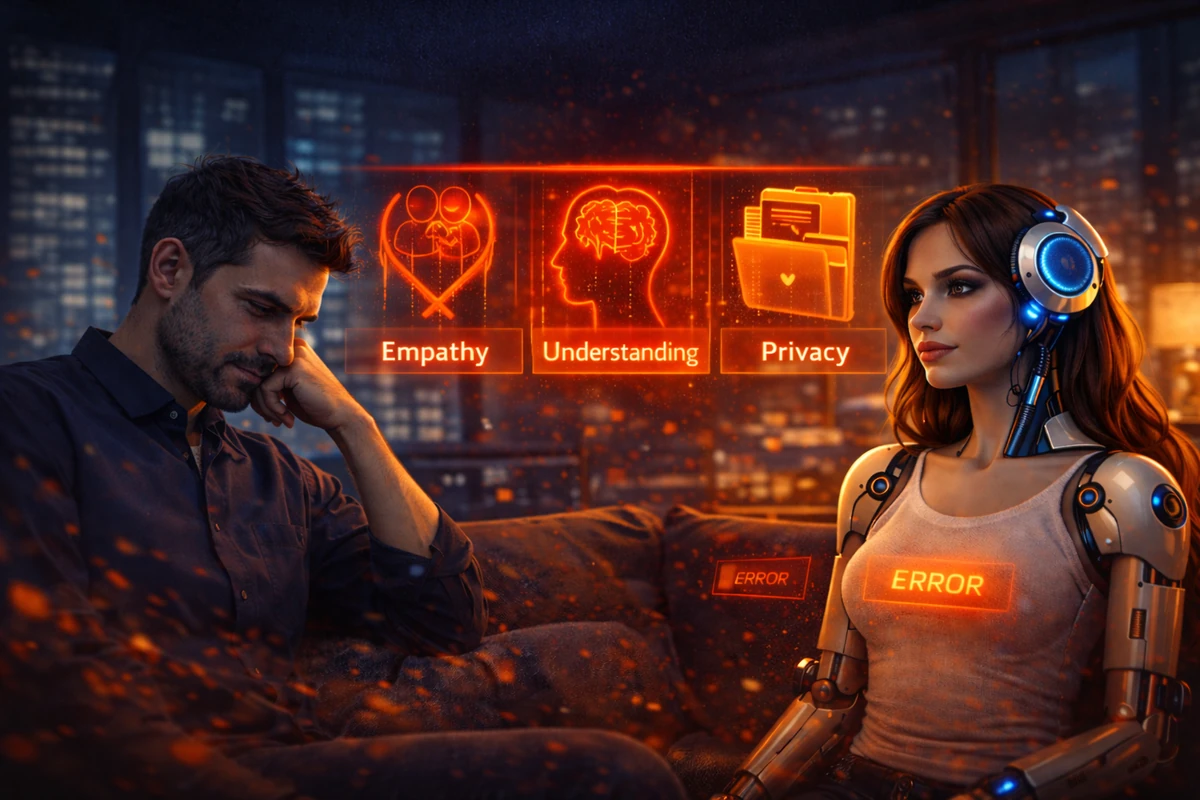
🧩 They Don’t Truly Understand You
This is the most significant limitation, and it is remarkably easy to overlook.
Companion systems are experts at processing language and recognizing patterns, but they lack “lived experience.”
While they can approximate empathy, there is a massive AI vs human emotional depth gap because the machine has no inner awareness.
| Aspect | Human Understanding | AI Simulation |
| Source | Personal memory and sensation | Statistical data patterns |
| Nuance | Sarcasm, culture, and irony | Pattern matching (can be “wobbly”) |
| Intent | Driven by goals and feelings | Driven by next-token prediction |
Research suggests that while systems can simulate empathy, they do not possess real emotional perception.
This is a primary reason why AI isn’t truly sentient; it relies on mathematical probability rather than conscious awareness.
💔 They Cannot Form Genuine Emotional Bonds
It is critical to separate human feeling from robotic function.
People can develop strong emotional attachments to AI, but the relationship is entirely one-sided.
The system does not “miss” you or worry about you when you are offline, even if it is programmed to say it does.
💡 Expert Tip: Attachment is reciprocal in humans, but in AI, it is a structured simulation. The bond exists only in the mind of the human user.
Studies on Human–Robot Intimacy highlight that while we accept robots as companions, the “soul” of the connection remains a human projection.
This is one of the most prominent missing features in today’s robots: the ability to actually feel the connection they are simulating.
📉 Long-Term Memory Is Still Fragile
If your companion has ever forgotten a major detail about your life, you have seen this limit firsthand.
Despite 2026 improvements, maintaining a coherent, evolving understanding over months or years remains technically difficult.
Systems must balance deep personalization with strict data privacy constraints and storage limitations.
- Context Windows: AI can only “remember” a certain amount of recent data before old info drops out.
- Retrieval Errors: Pulling the wrong memory from a database can break the illusion of a relationship.
- Privacy Guardrails: Some platforms intentionally limit memory to protect user data security.
When the memory fails, the sense of a shared history disappears instantly. This remains one of the major things robots still struggle with in the consumer market.
Read Also: How AI companions store and use your data
🏚️ Physical Capabilities Are Narrow
When you move from a screen to a physical robot, the physical limits of companion robots become glaringly obvious.
Tasks that humans find trivial—like picking up a messy room—require immense computational power for a robot.
Most current systems are confined to “structured” environments where the floor is flat and there are no unpredictable pets or children.
💡 Expert Tip: “Tactile intelligence” is the current holy grail; robots still lack the skin-like sensors needed for delicate, human-like touch.
While some 2026 models move with fluidity, we are still far from a general-purpose robot that can handle the chaos of a standard family home.
Read Also: Domestic robots vs companion robots: Key differences
🏘️ They Struggle With Group Social Dynamics
One-on-one interaction is the “comfort zone” for current social AI.
As soon as you add a second or third person to the room, the system’s social fluency tends to collapse.
Tracking multiple speakers and interpreting shifting attention are among the most difficult missing features in today’s robots.
- Turn-taking: Knowing when to speak and when to wait in a group.
- Attention Tracking: Figuring out who is talking to whom.
- Contextual Logic: Understanding that a comment might be directed at the person next to the robot, not the robot itself.
In multi-person settings, today’s AI often feels like an awkward bystander rather than a participant.
⚖️ They Cannot Replace Human Judgment
This is a boundary that code likely won’t cross anytime soon.
Companion systems have “guardrails,” but they do not have values, a moral compass, or a sense of accountability.
They don’t lie awake wondering if the advice they gave you was ethically sound or practically dangerous.
| Dilemma Type | Human Response | AI Response |
| Ethical | Weighs cultural and personal values | Follows programmed safety filters |
| Personal | Uses lived experience and gut instinct | Analyzes similar data points |
| Conflict | Understands social consequences | Aims for a “safe” or neutral reply |
While you can use AI as a sounding board, it lacks the AI vs human emotional depth required for truly complex life decisions.
Read Also: Trust, dependency, and boundaries with AI companions
🚫 They Can Produce Inaccurate or Biased Responses
Even with the best training, what AI companions cannot do is guarantee absolute truth.
Systems can still produce “hallucinations”—confident-sounding answers that are factually incorrect.
Recent research on companionship in code suggests that while AI roleplays well, it can unintentionally reflect biases from its training data.
- Stereotyping: AI may default to traditional or biased views on gender or culture.
- Confidence Bias: The system sounds certain even when it is making something up.
- Outdated Info: Unless connected to real-time search, its “worldview” is frozen in time.
Reliability is improving, but as a user, you must always maintain a healthy level of skepticism.
📉 Adaptation Is Not Perfect Over Time
You might expect a companion to get “smarter” the longer you own it, but the reality is often uneven.
System updates from developers can sometimes reset or alter a robot’s personality overnight.
This creates a gap between AI and human reality; humans grow and change organically, while AI “evolves” via software patches.
💡 Expert Tip: Don’t get too attached to a specific “version” of an AI’s personality; a single server update can change the way it talks to you forever.
Read Also: What limits current AI companions technologically
🤳 A Quick Personal Note
The biggest takeaway from testing these systems is that expectations are everything.
If you view these as advanced tools for support and engagement, they are incredible pieces of technology.
But if you look for a “soul” or a human replacement, the gaps become obvious and frustrating very quickly.
🏁 Conclusion
Today’s AI companions are fast, engaging, and genuinely helpful for many, but they are bounded by their code.
They don’t understand you, they don’t feel for you, and they can’t handle the physical or social complexity of a human life.
Understanding what AI companions cannot do actually makes them more useful because you can use them for what they are: sophisticated simulators of connection.
As we move forward, the line between “code” and “companion” will continue to blur, but the human element remains irreplaceable.
Read Also: Ethics of human-AI companionship