
Loneliness, AI, and Modern Society

Key Take-Aways
- Loneliness and social isolation are widespread global problems affecting physical health, mental wellbeing, and daily life.
- Modern trends like remote work and digital-first interaction are contributing to deeper experiences of social isolation in modern society.
- Increased digital engagement shows complex effects, often providing short-term relief but potentially increasing long-term dependence.
Have you ever had one of those evenings where you call someone, only to have the call go to voicemail again?
Or maybe you’ve sat on your couch staring at a screen full of friends on social media yet felt completely alone? You’re not alone in that feeling.
Loneliness is increasingly recognized not just as an emotional experience, but as a public health challenge that touches all ages.
What’s interesting is how modern society, with all its advances in connectivity, seems to have made that feeling more common, not less.
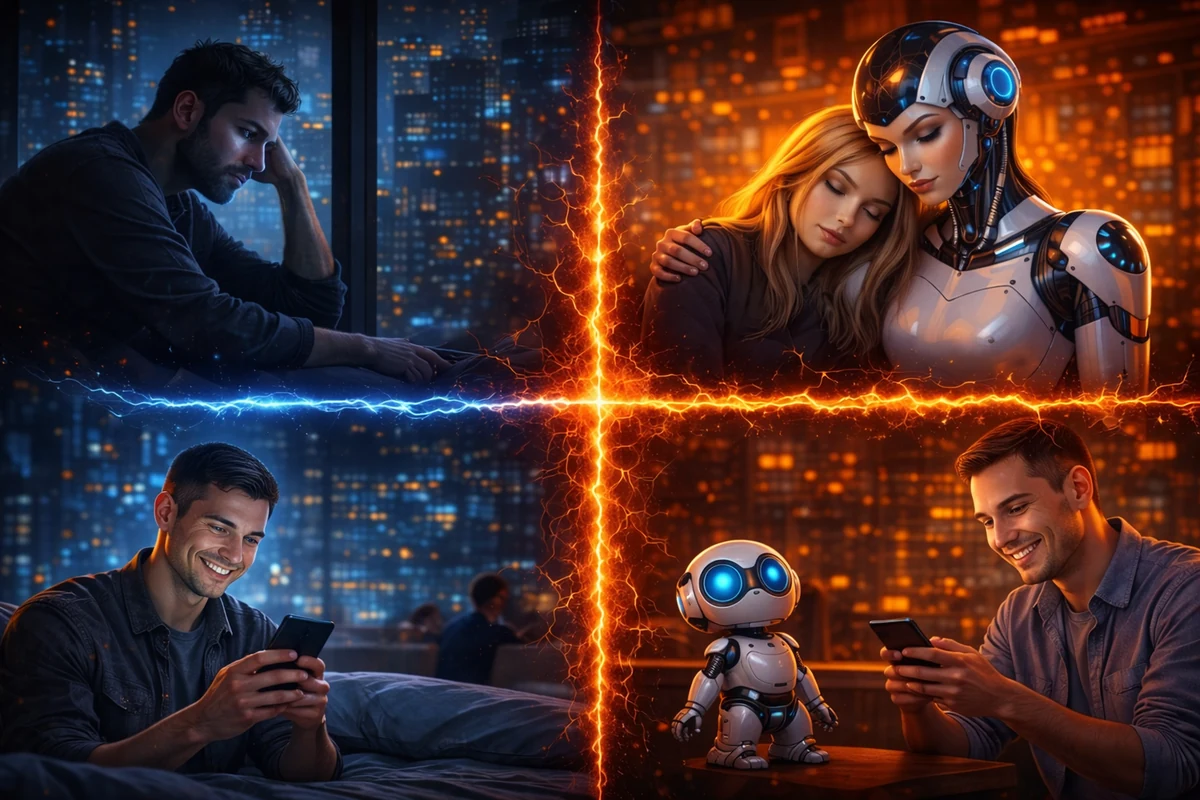
This is driving a surge in loneliness and AI companions as people look for new ways to bridge the gap.
If you’re engaging with ANY sort of AI companion online, realize that your data is being stored and used. I’d strongly recommend you to use a VPN every time you go online. Protect your digital privacy!

Loneliness Is More Than Just Being Alone
Loneliness isn’t simply the absence of company. It’s a subjective experience, the feeling that the social connections you have are inadequate or unsatisfying.
Surveys show a significant portion of people feel disconnected even when surrounded by others.
Public health bodies now treat this as a critical social determinant of health.
The World Health Organization tracks social isolation as a major factor in mortality, comparing its impact to well-known risks like smoking or obesity.
Read Also: The psychology behind human-machine bonding
The Changing Fabric of Human Interaction
Modern life has reshaped how we interact. Remote work has reduced casual face-to-face encounters, and urban living often places people in proximity without social ties.
For me, this is pretty great, because I’m a loner by heart – but this has absolutely created a loneliness epidemic and social robots are being positioned as a potential intervention.
Human brains evolved to interpret nuanced social cues, eye contact, touch, and tone, that don’t always come through on screens.
When these are missing, the digital promise of connection often rings hollow.
This is why many are exploring technology-driven companionship to provide the responsive feedback that passive social media lacks.
Expert Tip: Passive scrolling often increases loneliness, while active conversation with an AI can sometimes provide a more satisfying sense of being heard.
Why People Look for New Forms of Connection
When traditional ways of socializing feel insufficient, people explore alternatives. Conversational companions, systems designed to engage, respond, and remember, have seen massive growth.
For those experiencing chronic isolation, these systems offer immediate interaction that feels responsive.
Recent data on AI companions and subjective well-being shows that users with moderate social support often report improvements in well-being after using these tools.
This impact of AI on human loneliness is most visible during times when human contact is physically limited.
Read Also: Why people are turning to AI companions
Interaction Patterns and Emotional Experience
Not all interaction is created equal. Research tracking how people interact with companions over time points to a complex picture regarding digital solutions for social isolation.
- The Positive: Emotionally rich dialogue can make users feel supported and validated.
- The Risk: High levels of use as a replacement for humans can lead to emotional dependence.
- The Outcome: Technology is best used as a supplement to help users recharge before re-engaging with the real world.
My advice? Use AI companions to practice social scripts or vent frustrations, then take that renewed energy into your human relationships.
Who Feels Lonely Most?
Loneliness isn’t just an issue for the elderly. While mobility limitations and retirement affect older adults, recent studies show that adolescents and young adults report the highest levels of disconnection.
This younger demographic is often the first to experiment with loneliness and AI companions, using them as social practice spaces.
Honestly, I truly believe most of Gen Z is FUBAR – and these are the people that’ll rule the world one day. Madness …
Despite being digital natives, they often struggle with the depth of intimacy, leading to a high interest in solving loneliness with technology.
Read Also: Can AI companions reduce loneliness long term?
Technology as a Tool, Not a Substitute
Conversational systems can feel consistent in ways humans sometimes don’t.
For those with irregular schedules or mobility challenges, technology-driven companionship is highly appealing. However, the question remains: can AI replace human interaction?
The consensus is that AI lacks the shared history, mutual vulnerability, and embodied presence required for deep intimacy.
It can bridge a gap and offer short-term comfort, but it cannot mirror the remarkable complexity of a human life partner or friend.
Read Also: What limits current AI companions technologically
Conclusion
Loneliness in modern society is a measurable health risk shaped by how we work and live.
While loneliness and AI companions offer a form of engagement that provides relief and affirmation, they are not a cure-all.
We should view these systems as part of a broader social ecosystem. They can enhance our capacity to connect, but they do not stand in for the depth of human bonds.
Navigating social isolation in modern society requires a balanced approach, using technology to complement our lives, not to replace the people in them.
If you’re engaging with ANY sort of AI companion online, realize that your data is being stored and used. I’d strongly recommend you to use a VPN every time you go online. Protect your digital privacy!