
What Makes an AI Companion Feel “Human”?

Key Take-Aways
- People often feel that AI companions are human-like because they use natural language and respond in socially meaningful ways.
- Attributing human traits to machines, a process called anthropomorphism, strengthens the sense of connection.
- Elements such as perceived empathy, conversational responsiveness and sexual compatibility help you feel understood.

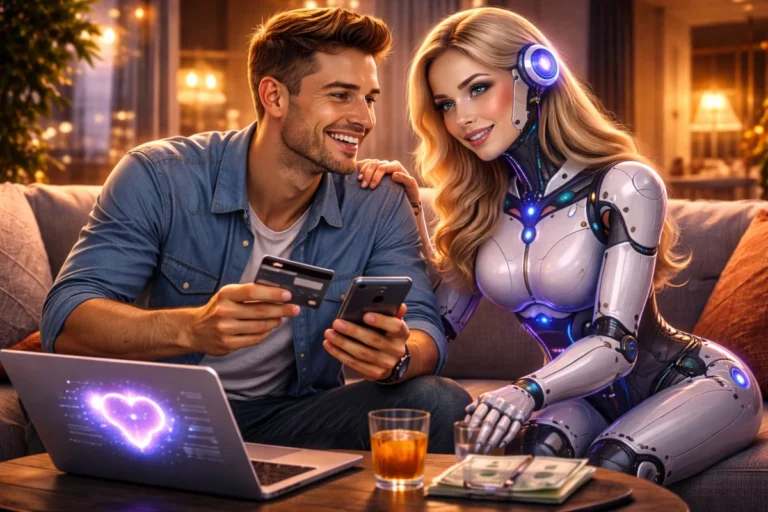
Have you ever chatted with a digital companion and felt like it got you? Maybe it responded with empathy, used your name, or seemed to remember something personal from a previous conversation.
We’ve all been there in this modern age, and that experience can feel surprisingly real.
Even though, and we all know this too, under the hood, it is built from patterns and models rather than a beating heart or an actual mind.
These lifelike AI interaction factors are meticulously engineered to resonate with us.
(And let’s not even open the whole can of worms that is sex with AI robots and how that complicates matters even more!)
Why do you experience these interactions as human-like? It has a lot to do with how our brains are wired to interpret social signals.
In this article, we’ll explore the psychological mechanisms that make some AI companions feel surprisingly alive and relatable.
Why We Treat Machines Like Social Partners
Humans are fundamentally social creatures. I’m more of a loner, always have been, but even I need social interaction every once in awhile.
It simply makes us happier, and most people who go without social interaction go crazy or become depressed. That’s a fact.
From a very early age, we learn to read faces, tone, eye contact, and emotional cues to connect with others.
Over time, our brains develop powerful shortcuts for interpreting social meaning.
This is exactly why people turn to AI companions today; they provide a low-stakes environment to exercise these social muscles.
The Science of Social Projection
- Neural Activation: When a machine talks back in a way that resembles human conversation, the same neural circuits we use for humans get activated.
- The Eliza Effect: This long-observed psychological tendency describes how people project agency and empathy onto even simple conversational programs.
- Pattern Recognition: We are wired to respond socially to certain patterns of communication, regardless of the source.
Research on human-mimicry in social robotics has found that people interpret empathy and emotional nuance in digital companions much the same way they do in person.
This may surprise you, but remember that we’ve evolved to be the way we are over millions of years.
Our brains have simply not had time enough to adjust to the reality and life-like-ness of AI.
This projection is not a sign that the machine feels anything, but it shows that our brains fill in social meaning whenever realistic AI personality traits are present.
Anthropomorphism and Emotional Projection
A big part of the sense that a companion feels human comes down to what psychologists call anthropomorphism.
This is the process by which people attribute human traits, intentions, or emotions to something that is not human. It is a core pillar of the psychology behind human-machine bonding.
Studies show that when individuals attribute more “mind” or agency to a conversational partner, they tend to feel more connected afterward.
In one research experiment, people who saw more human-like intentions in a chatbot also reported greater feelings of understanding.
This is an intentional result of anthropomorphism in AI design, where the goal is to trigger the social instincts that help AI companions reduce loneliness.
Traits That Make Interaction Feel Real
There are several specific human-like AI companion features in conversational design that help foster this perception of life:
- Natural Language Flow: Using language in a way that feels coherent mirrors how humans talk, often explained by natural language processing models.
- Perceived Empathy: Responses that acknowledge emotional content prompt you to feel listened to through pattern matching.
- Conversational Responsiveness: When questions feel answered rather than deflected, the flow stops feeling mechanical.
- Memory and Continuity: Systems that learn over time can feel like ongoing relationships rather than one-off sessions.
These traits do not mean the machine understands anything. Never forget, it’s just code – which is also why I find debates about what you can and can’t do during sex with AI bots hilarious.
Instead, they trigger psychological responses that we normally reserve for social partners, effectively creating empathy in AI through simulation.
Perceived Empathy and Connectedness
Most of us know what it feels like to be truly heard. There is a sense of validation when someone responds in an attuned way.
Modern systems are explicitly designed to mirror that style, even though they rely on emotion simulation rather than recognition.
How Empathy is Mirrored
- Cue Recognition: The AI identifies emotional keywords or sentiment in your input.
- Tailored Response: It selects a response that mirrors a high level of emotional intelligence.
- Validation: You then probably interpret this as the system caring about you.
Experimental research, such as studies in Nature, shows that consistent interaction with a chatbot increases users’ perception of empathy and lifelikeness.
That perception is key to what makes an AI companion feel human in daily use.
Predictability and Safety
Human relationships can be rewarding, but they are also unpredictable and involve mutual vulnerability.
Conversational companions are, by contrast, predictable.
People report that interacting with an AI feels less threatening than some human interactions because they are not being judged.
Feeling safe can foster emotional openness, and the human mind interprets that openness as a deep connection. The AI bot’s ability to provide a “safe harbor” for conversation is what makes them feel like legitimate social partners.
Conclusion
In summation, what makes an AI companion feel human does not come from the machine itself.
It comes from YOU, from how our minds interpret social cues, conversational responsiveness, memory continuity, and perceived empathy.
Psychological mechanisms like anthropomorphism and emotional projection shape the sense of connection.
When these factors align, the interaction feels warm and meaningful. But beneath that perception is a cold stream of algorithms.
Simulation is not genuine emotional life, but it tells us a lot about what we value in connection.