
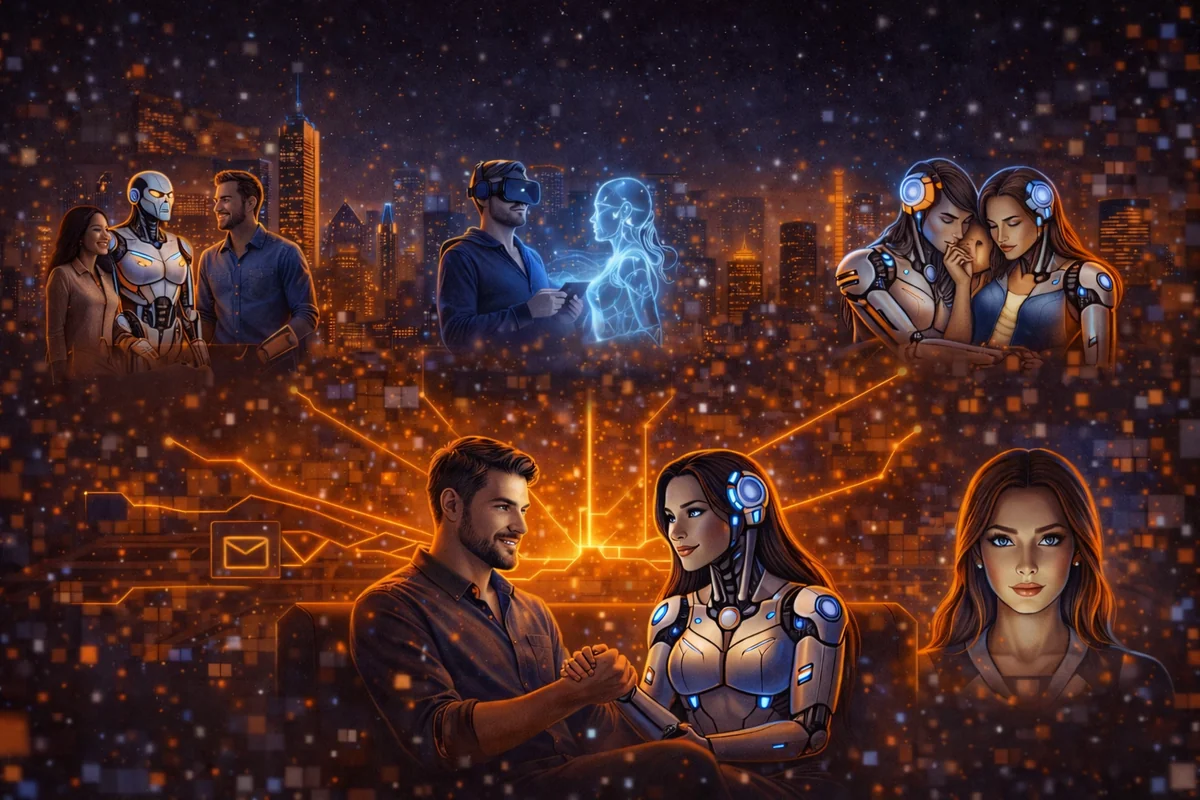
Where AI Companionship Is Likely Headed Next

Key Take-Aways
- AI companionship is moving towards physical sex robots, sooner than you think.
- Apart from that, social robots are moving beyond novelty, finding permanent roles in homes, clinical healthcare, and service sectors.
- The future points toward embodied, context-aware companions that are fully integrated into our daily routines and living spaces.
If you’ve spent any time around companion platforms lately, you’ve probably noticed something subtle but important: they’re no longer trying to impress you.
They’re trying to stay with you.
That shift matters. Early systems focused on novelty, clever responses, or quirky personalities.
What’s emerging now is quieter, more persistent, and frankly more ambitious.
The goal is no longer short-term engagement. It’s long-term presence.
So where is all of this heading next? Not in a sci-fi sense, but in the very real, already unfolding direction of the industry.
For the purpose of this article, I won’t stray too much into the physical side of things, i.e. AI sex robots. Today we’ll talk more about the digital part, the virtual “companionship” angle.

From Conversations to Ongoing Relationships
The biggest transition currently underway is the shift from simple interaction to true continuity.
Instead of isolated, one-off chats, platforms are now designed to maintain context over months and years.
Most of that functionality is locked behind pay walls and subscriptions for now, but the technology and the subsequent pricing is rapidly evolving.
This development is a cornerstone of the future of AI companionship trends, where systems remember your emotional patterns and recurring topics.
Research into the future of human-robot interaction shows that familiarity is the primary driver of user acceptance.
When a system feels predictable and consistent, us humans are significantly more likely to form a lasting bond with the machine – no matter how creepy and weird that may sound.
A Strong Push from Healthcare and Aging Populations
If you want to understand where is the AI market heading, you simply need to follow the demographic demand.
Aging populations are creating immense pressure on global healthcare systems, and robots are being positioned as a support layer.
These systems provide medication reminders and encourage cognitive activity while reducing the heavy burden of social isolation.
- Medication Management: Tracking schedules and providing verbal alerts.
- Cognitive Stimulation: Engaging users in games and memory exercises.
- Emotional Support: Offering consistent conversation when human contact is limited.
Research regarding elderly individuals’ acceptance of AI-powered companion robots suggests that these tools can significantly reduce anxiety and stress.
Read Also: How AI companions are used in elder care today
Expansion Into Everyday Service Environments
Outside the home, social robots are quietly spreading into various service industries like hotels and airports.
I’ve even seen one at my local grocery store. Creepy, clunky and, in my opinion, pointless – but it’s there, and the technology keeps evolving, which means more and more people will get used to them, and they’ll get better.
This isn’t just a quest for efficiency; it is a calculated move to normalize the future of human-robot interaction in public.
When people encounter these systems in low-stakes environments, they become more comfortable with the technology.
Recent data on the adoption of social robots in service operations shows that hospitality is the most active testing ground for these interactions.
The robot assisting you with your hotel check-in today is effectively training you to accept one in your living room tomorrow.
I’ve also seen this being used in random restaurants to take your orders – to various degrees of success.
Persistent Challenges That Will Shape the Future
Despite the rapid progress, several hurdles remain that will dictate where is the AI market heading in the coming years.
User acceptance is still uneven, and many people remain skeptical about the true utility of these devices.
For good reason, because the industry is wonky at best – but, and this is important, it’s improving daily.
There is also the engagement plateau where users lose interest once the novelty of the robot wears off.
In addition, you have to take the following into account:
- Privacy Concerns: Cameras and microphones in private spaces require high-level encryption.
- Data Usage: Most people want to know exactly how their personal conversations are being stored. I’ve got bad news for them: all your data is getting stored and shared.
- High Expectations: As tech improves, users become less forgiving of small errors or glitches.
Addressing these issues is vital for the personalized AI companion evolution to reach the mass market.
Read Also: Privacy risks of AI companions
What the Next Phase Looks Like
Looking ahead toward a 2030 vision for social robotics, a few patterns are becoming undeniable.
Companions will move from being standalone tools to becoming integrated AI in smart homes that manage your life.
There are two trains of thought here.
We might see a move away from humanoid robots toward compact, purpose-built devices that fit naturally on a shelf or desk.
OR, and this is what I 100% see happening, AI sex robots will become a reality – an accepted and integral part of life for many men.
These AI bots will provide sexual gratification AND will be used to clean, cook and manage other parts of your digital life.
- Context Awareness: Robots will understand the physical environment better (e.g., knowing you are busy if you are on a call).
- Long-Term Adaptation: The robot’s personality will shift over years to better match your own.
- Blurred Lines: The distinction between a utility tool and a friend/lover will continue to fade.
This evolution will eventually make these systems an unremarkable but essential part of the modern household.
Read Also: What to expect from AI companions in the future