
🚀What Will Drive Mass Adoption of AI Companions

TLDR
- Falling hardware and compute costs are making AI companions more accessible at the consumer level.
- Improvements in conversational intelligence and multimodal interaction are closing the “awkwardness gap.”
- Trust, privacy design, and predictable behavior are becoming central adoption factors.
- Integration into daily ecosystems (phones, wearables, home devices) is accelerating usage habits.
- Social normalization is likely to be the biggest long-term trigger for mainstream acceptance.
Right now, AI companions still sit in an awkward middle space. They’re common enough to be recognizable, but not yet normal enough to disappear into daily life the way smartphones or streaming apps have. You’ve probably seen them framed as futuristic gadgets or emotional tools, depending on the context.
But mass adoption of AI companions rarely happens because something feels futuristic. It happens when something becomes simple, useful, and socially unremarkable all at once. That’s the real shift we’re watching unfold here. If you strip away the hype, AI companions are just systems trying to maintain ongoing interaction with a person.
The question isn’t whether the technology exists anymore; it’s identifying the triggers for social robot popularity that finally make people adopt them without hesitation.
💸 Cost, Scale, and the Quiet Drop in Barriers
One of the most basic drivers of adoption is cost reduction, and that pattern is already visible in AI systems. Training and inference costs for large models have been trending downward over time as hardware improves and optimization techniques mature.
Factors Lowering the Entry Barrier
- Compute Efficiency: Models now require less energy to process complex emotional responses.
- Subscription Models: Shifting from high upfront hardware costs to manageable monthly fees.
- Edge Computing: Moving processing to the device to reduce expensive server reliance.
- Market Competition: A surge in startups is winning over big tech by offering affordable, niche alternatives.
That matters because AI companions are not a one-time product. They require continuous computation, updates, and cloud interaction. When those costs are high, the user ends up paying either directly or indirectly through limited access. As infrastructure becomes cheaper, this is a major factor driving the social AI boom.
🗣️ The Quality Threshold: When Conversation Stops Feeling Artificial
The biggest barrier to adoption is still interaction quality. People don’t reject AI companions because they “don’t work.” They reject them when the interaction feels off. Natural conversation depends on timing, tone adaptation, context awareness, and the ability to hold continuity over time.
The Realism Gap: Current systems are improving, but small failures still break the illusion. The shift from text to multimodal interaction voice, gesture, and visual context is what finally closes the “awkwardness gap.”
What’s changing in 2026 is the shift toward multimodal interaction. Voice, gesture recognition, and visual context are increasingly part of the same system. According to recent research on human-AI interaction, the “awkwardness gap” closes significantly when systems utilize natural language processing to match human conversational rhythms.
🛡️ Trust is Becoming a Product Feature
A major driver of mass adoption is not capability, but trust. And trust in AI systems is increasingly being treated as an engineering problem rather than a philosophical one. You see this in the way systems are designed to be more transparent about limitations, uncertainty, and data handling.
Trust-Building Design Elements
| Feature | User Impact | Adoption Value |
| Local Storage | Data stays on the home device. | Essential for privacy-conscious users. |
| Predictable Personality | No sudden shifts in “moral” alignment. | Builds long-term trust and boundaries. |
| Error Transparency | AI admits when it is unsure. | Prevents the frustration of mechanical “lying.” |
AI companions are particularly sensitive here because they often involve personal conversation. The more intimate the interaction, the higher the expectation that data is handled responsibly and predictably. This is why choosing an AI companion platform responsibly is becoming a prerequisite for will AI companions go mainstream.
📱 Integration Into Existing Ecosystems
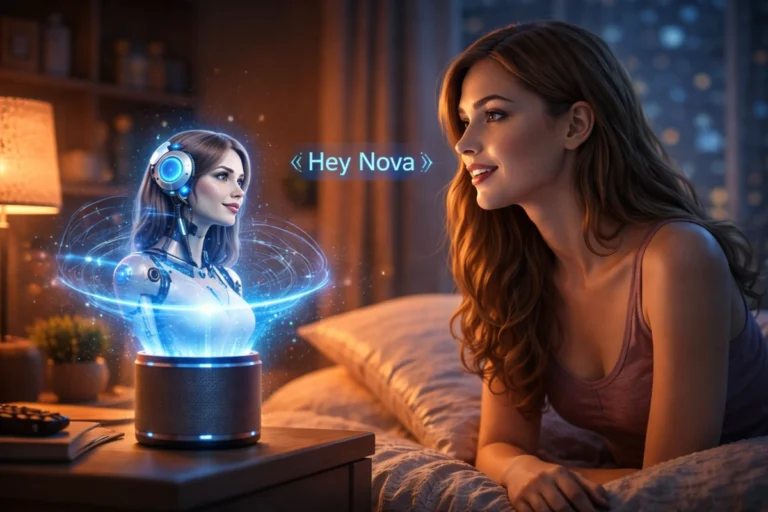
Standalone devices rarely achieve mass adoption anymore. The pattern that actually works is integration. AI companions are increasingly appearing inside systems people already use daily: phones, earbuds, smart speakers, and wearable devices.
- Frictionless Entry: You don’t need to “go use” the companion; it is already in your pocket.
- Habit Formation: Integration turns occasional use into a daily ritual.
- Cross-Device Memory: Your phone companion knows what you discussed with your home-based robot.
This removes friction. If something requires a separate action or device, it competes with existing routines. If it is embedded, it gradually becomes part of them. This is how we move toward a world where social robots are used today in every home, effectively addressing the hurdles to mass market robotics.
🎭 Emotional Design and the Realism Threshold
There is a subtle but important difference between intelligence and emotional believability. Even when responses are accurate, they can still feel flat if timing, phrasing, and tone don’t align with human expectations. This is why why conversation quality matters more than appearance.
Why Pacing Outperforms Knowledge
- Acknowledging Silence: Knowing when not to speak is a key factor in feeling human.
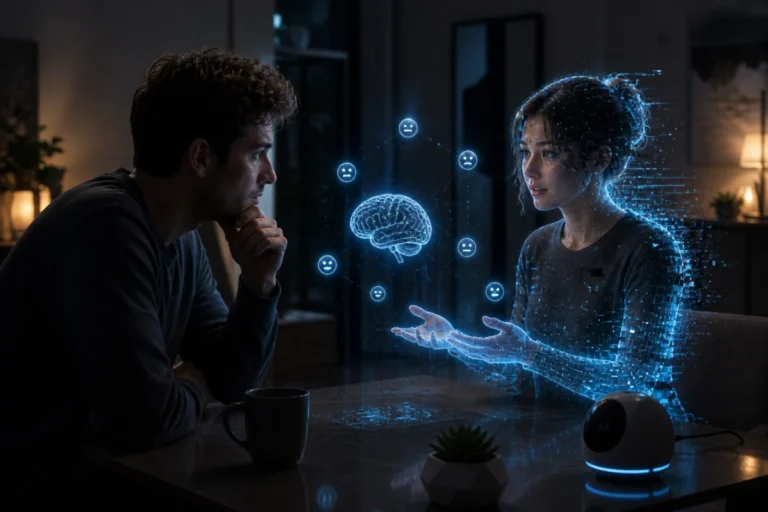
- Tone Matching: Adjusting energy levels based on the user’s vocal stress using emotion recognition.
- Conversational Rhythm: Avoiding the “instant” robotic reply to simulate human thought.
The most noticeable improvements in 2026 haven’t been in pure knowledge, but in pacing. This presence is what users actually respond to, and it is a major factor in why people form emotional attachments to AI.
🤝 Social Acceptance and Normalization Effects
Even if the technology is ready, adoption still depends heavily on cultural acceptance. People don’t adopt tools in isolation; they adopt them when they stop feeling unusual. This is where mass adoption of AI companions is still in an early phase, but the tide is turning.
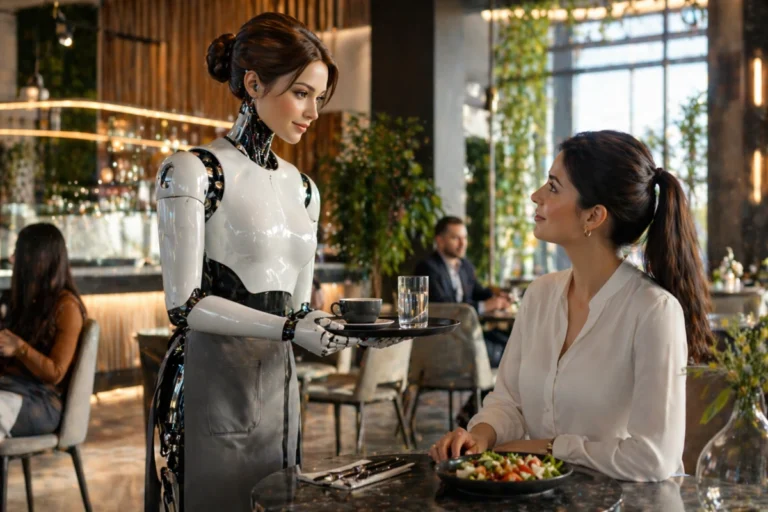
The Social Shift: Acceptance often happens once a technology is seen as a tool for aiding those with disabilities or supporting the elderly.
Over time, that tends to change through exposure, media normalization, and gradual integration into everyday tools. The key point is that social acceptance often lags behind technical capability, but the gap is narrowing as we move toward the future of household robots.
🏗️ Predicting the Next “iPhone Moment” for Robots
What does the actual tipping point look like for the mass adoption of AI companions? Many analysts point to the convergence of cloud-based and local AI as the moment when the “brain” becomes fast enough for everyone.
The Mass-Market Checklist
- Price Point: When a functional social robot drops below the price of a high-end smartphone.
- Reliability: Overcoming why companion robots struggle with real-world environments.
- Utility: When the AI transitions from “chatting” to performing complex domestic tasks.
At a certain point, users stop evaluating the system and start simply using it. That’s usually when a technology stops being a trend and becomes infrastructure. We are currently witnessing that transition for predicting the next “iPhone moment” for robots.
🏁 Conclusion
Mass adoption of AI companions is not going to come from a single breakthrough. It will come from a stack of small improvements that collectively remove friction. Lower cost, smoother conversation, better emotional timing, stronger privacy guarantees, and deeper integration into daily devices all contribute to that shift.
None of them alone is enough, but together they change behavior. At a certain point, users stop evaluating the system and start simply using it. That’s usually when adoption stops being a trend and becomes infrastructure, marking a new chapter in the future of household robots.