
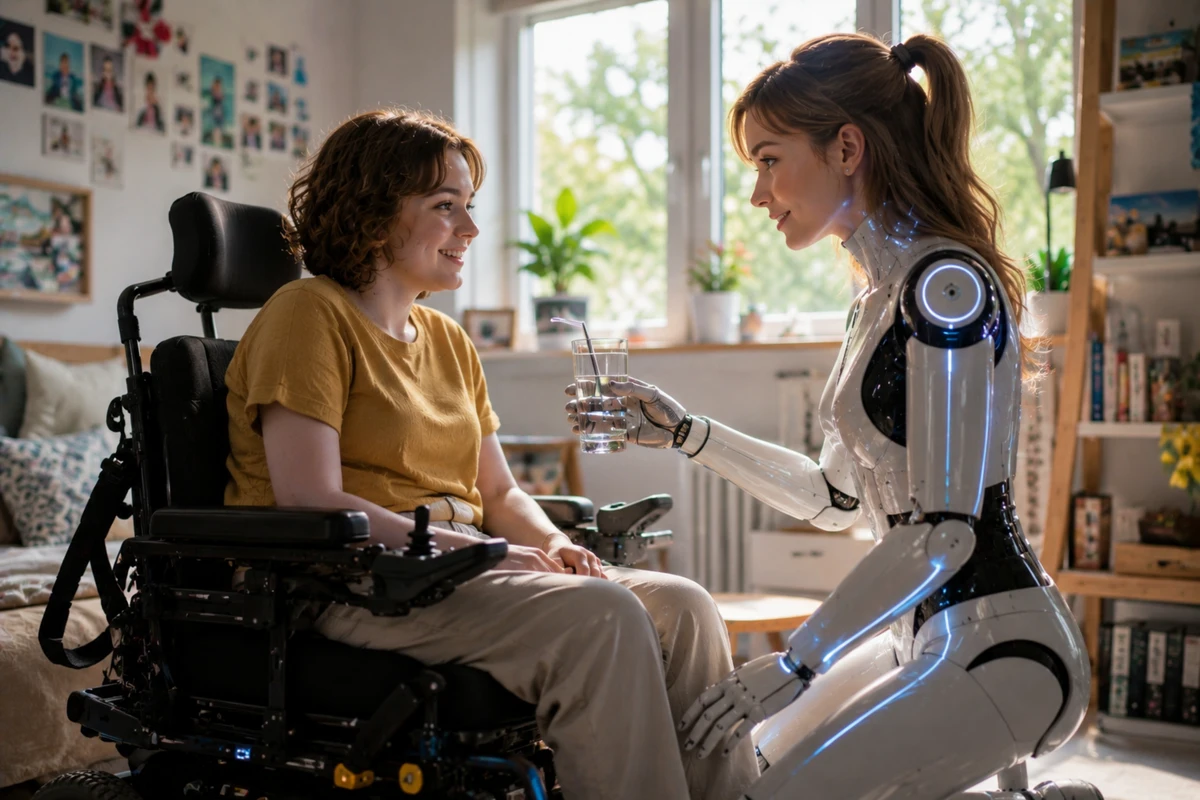
Social Robots for People With Disabilities: Real Progress and Guardrails

Key Take-Aways
- AI companion robots can assist in disability care through communication practice, cognitive exercises, and therapy motivation.
- These hardware systems currently only function as targeted tools rather than direct replacements for human caretakers.
- Practical deployment of these AI bots requires deliberate optimization of local accessibility, overall safety, and personal data rules.

Have you ever considered an AI companion for well-being? (No, I’m not just talking about AI sex bots!)
It’s a fact that social robots have moved WAY past the phase of isolated lab experiments and simple trade show demonstrations.
These days, many specialized machines are actively operating inside diverse classrooms, clinical facilities, and rehabilitation spaces worldwide.
This is of course great news for people with various physical or cognitive challenges, because these interactive platforms (and/or robots) provide specialized assistance, conversational practice, and vital therapeutic enforcement.
Perhaps you need it, want it, or are just interested in social robots for people with disabilities? Let’s see what the (near) future holds!
Neurodiversity and Social Robotics
Honestly, when I first heard about the application of robotic companions for autism, I thought it was a match made in heaven.
And as such, this has become one of the most thoroughly documented areas of modern assistive research.
For many neurodivergent individuals, interacting with a human peer can introduce overwhelming social complexity due to unpredictable micro-expressions or voice variations.
We’ve all seen, or even experienced, crashes or sensory overload from someone on the spectrum – and it’s heartbreaking.
An automated system eliminates this variability by offering highly structured, repeatable, and non-judgmental conversational responses.
Perfect, right?
Core Advantages in Autism Support Programs
- Reduced Interaction Anxiety: The predictable movement and vocal pacing lower overall sensory overload during learning sessions.
- Targeted Expression Modeling: Onboard visual screens or mechanical features display clear, distinct emotional states.
- Structured Practice Loops: Users can practice foundational conversational sequences repeatedly without social fatigue.
Clinical trials show that children interacting with these systems display increased motivation during structured skill-building tasks.
Dementia and Cognitive Support
Another area where AI companions can play a vital role, is with elder care, for example people with dementia.
As someone with multiple grandparents suffering from this horrifying disease, I know full well the strain this puts on family members and human care givers. It’s really, really not fun to deal with.
And so, in many elder care facilities, automated systems are more and more being deployed to support residents navigating varying stages of cognitive decline.
Specialized robotic pets equipped with touch sensors and vocal feedback loops are used to reduce evening agitation and improve daily mood.
Of course, this requires some … gentle introduction, because a full-on “I, robot” machine is going to scare the shit out of seniors.
That said, some larger and non-threatening-looking humanoid systems are being used to guide residents through structured daily schedules, memory games, and light physical movement routines.
These continuous prompts help maintain cognitive activity levels throughout the day, and it definitely shows how AI companions are used in elder care today to support staff.
Physical Disabilities and Assistive Interaction
Then we have individuals living with significant physical limitations, such as being wheel-chair bound, missing limbs, and so on.
In these cases, social robots for disabilities provide an intuitive, hands-free interface for managing environments and maintaining autonomy.
A robot can support you, perhaps even carry you around (although that’s in the future).
In addition, such systems can connect directly to local smart home nodes, which means they could help you by controlling doors, lighting, or media – although personally, I’d be careful with that and focus mainly on voice-activated-control.
Let the AI companion be a back-up, but try to retain as much control as you can.
For individuals utilizing advanced alternative communication tools (like text-to-voice devices operated via your mouth), an assistive robot can provide vital conversational scaffolding.
The machine delivers tailored prompts that encourage verbal pacing and consistent speech practice.
Social Robots for Physical Therapy
If you’ve ever been in this situation, you know that maintaining personal motivation throughout long-term physical rehabilitation represents a significant challenge.
Think stroke survivors and individuals recovering from major injuries.
Assistive robots for special needs within physical therapy environments can absolute help these individuals, by maintaining long-term compliance with repetitive physical exercises.
How does this work? Well, the automated system does not physically move the patient’s limbs during a standard session.
I’m no expert at all, but I think the benefits of that would be limited and exhausted pretty quickly, no? The goal of PT seems to be to have the patient learn how to do it themselves again.
And as such, the AI companion demonstrates the required physical movements, counts exercise repetitions, and provides consistent verbal encouragement based on visual feedback.
It may sound silly, and I would have reservations too, but apparently, when a therapy session is structured around interactive responses rather than static instructions, patients often show higher adherence to their routines.
This behavioral shift demonstrates the unique value of technology for accessible companionship within clinical frameworks.
Inclusive AI Design for Disabilities
As you can probably imagine, building hardware platforms for vulnerable populations requires strict adherence to advanced inclusive engineering principles.
System designers must prioritize total physical stability, smooth edges, and reliable safety overrides to prevent accidental injury during operation.
If a robot is a bit rough with you or I (for example a sex robot), we can usually resist a bit, shrug it off.
However, people with disability may not have that luxury and are more left at the mercy of, what is an sich, a machine.
Yeah… this could go wrong if it’s not handled well.
Furthermore, internal software systems must incorporate deep personalization capabilities to support diverse users.
Vocal engines require adjustable speech pacing, while visual tracking systems must account for involuntary movements or non-standard posture.
Essential Design Parameters for Accessibility
- Dynamic Gain Control: Microphones and other input devices must capture whisper-level speech or non-standard vocalizations accurately.
- Flexible Cognitive Triggers: The underlying software must allow adjustable response delays for users processing language at different speeds.
- Robust Local Fallbacks: Critical safety and speech options must function even if local network connections drop out.
Future Horizons for Assistive Tech
So where is all of this going? The basics are there, and it’s clear that both the software and the hardware are heading very strongly towards a brighter future for people with disabilities.
Ongoing developments in automatic language processing, responsive computing, and lighter hardware materials will expand the capabilities of these tools.
Future systems will likely adapt to user emotional states with much greater accuracy.
However, the core purpose of these platforms will remain the same. They are assistive tools designed to support specific communication, learning, and therapeutic goals.
Social robots for individuals with disabilities represent a practical, steadily maturing application of embodied artificial intelligence.
They are currently providing reliable support within autism therapy programs, memory care settings, rehabilitation exercises, and assistive communication setups.
But in summation, always keep in mind that these systems are not magical solutions, and are very much still a work in progress.
They are tools built on speech processing, mechanical engineering, and behavioral design.
But when deployed responsibly under human supervision, they can significantly enhance long-term care outcomes – no doubt about that.