
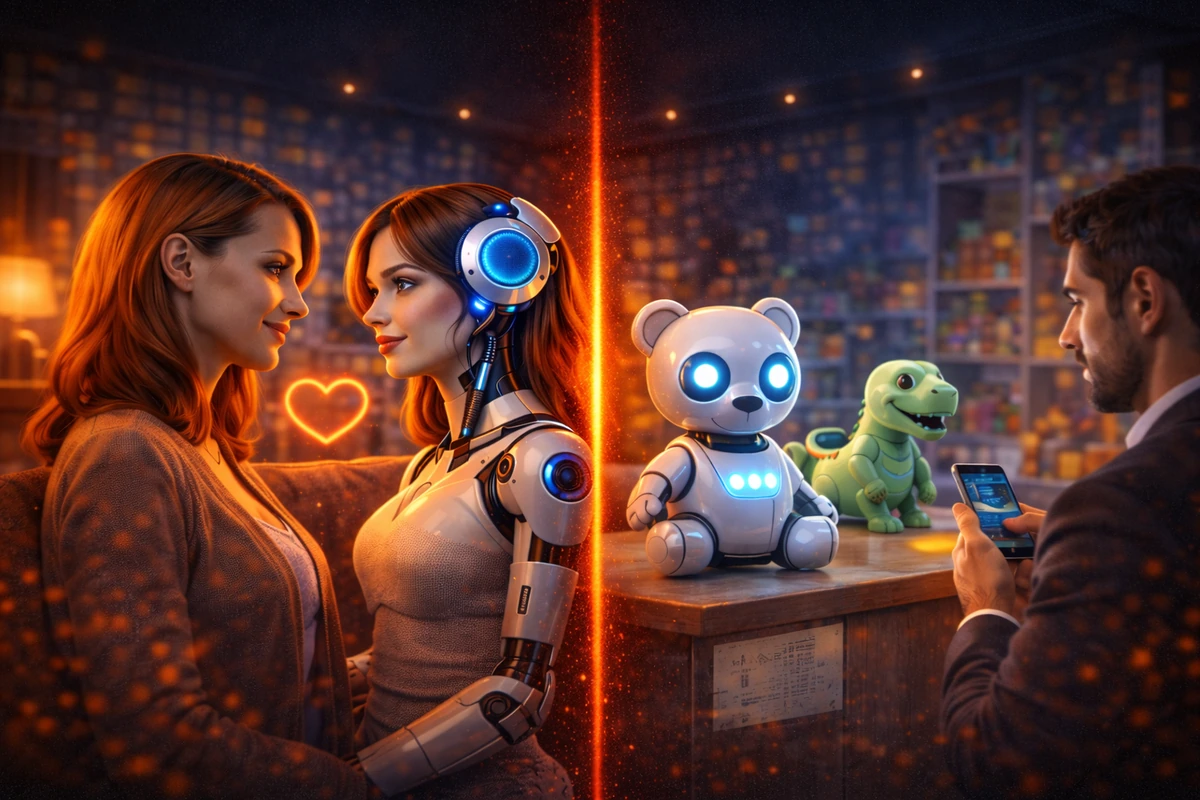
🤖Companion Robots vs Smart Toys: Where the Line Is Drawn

TLDR
- 🧸 Companion robots are physically embodied systems designed for long-term relationships, while smart toys focus on short-term entertainment.
- 🎯 The primary difference is intent: one aims for presence and habit-building, the other for play and immediate stimulation.
- ⚙️ Hardware in companion robots is far more complex, utilizing advanced sensor arrays and reactive actuators to feel “alive.”
- 🔐 Data privacy is a significant concern for both, but companion systems often collect more intimate behavioral and emotional data.
- 📉 While smart toys are often treated as disposable gadgets, companion robots are designed for longevity and continuous software updates.
Walk into any modern electronics store or browse a robotics startup showcase, and you’ll notice something interesting. Some products are clearly toys: bright colors, simple interactions, and short attention spans.
Others feel different. They are more persistent, more aware, and feel like they are meant to stay.
That’s where the distinction between companion robots vs smart toys starts to matter. On the surface, they can look surprisingly similar, as both talk and respond to touch.
However, the gap in their underlying “social intelligence” is massive once you look past the plastic exterior. Understanding this is the first step in the classification of interactive toys and sophisticated social systems.
📋 Defining the Two Categories Clearly
A companion robot is a physical system designed for sustained interaction with a human over time. It is not just something you pick up and put away; it is meant to exist in your environment and adapt to you.
Smart toys are a subset of connected devices designed primarily for play. While they may include microphones or simple AI features, their purpose is limited to entertainment or education in short bursts.
| Feature | Smart Toy | Companion Robot |
| Primary Goal | Play | Relationship |
| Interaction | Reactive | Proactive |
| Hardware | Basic sensors | Complex sensor arrays |
| Lifespan | Short | Long-term support |
Export to Sheets
Read Also: What are companion robots
🎭 The Role of Intent: Companionship vs Entertainment
If you had to draw one clean line between smart toys vs companion devices, it would be intent. Companion robots are built around the idea of presence; they check in on you and maintain continuity across weeks or months.
Smart toys don’t aim for that deep connection. Recent research into Human-Robot and AI Interaction highlights that while toys distract or entertain, social robots like Pepper or ARI are specifically designed to bridge the gap between industrial tools and emotional care.
This is the fundamental difference between AI toys and social robots. The robot is designed to be a peer, while the toy is designed to be a tool for a specific activity.
💡 Expert Tip: To spot the difference, look at the software. If it tracks your “mood” over several days, it’s likely a companion; if it just tracks your “high score,” it’s a toy.
⚙️ Hardware Complexity and Physical Presence
Spend five minutes comparing the two, and you’ll notice a significant hardware gap. Companion robots typically include multiple sensors like cameras, proximity sensors, and touch-sensitive surfaces.
These allow them to track your movements and adjust their orientation. The complexity of social AI in toys is usually much lower, often relying on a simple speaker and a few pre-scripted movements.
- Companion Sensors: Used for spatial awareness and maintaining “eye contact.”
- Toy Sensors: Used for simple trigger-response actions (e.g., ticking or pressing a paw).
- Actuators: High-end robots use motors to mimic human-like gestures or head tilts.
Read Also: AI companions vs traditional robotics
🧠 Memory and Personalization
Here is where the categories diverge sharply. Companion robots are designed to remember names, routines, and past conversations to create a sense of growth.
Smart toys rarely store deep history. If you reset a toy, the experience doesn’t fundamentally change because each session is independent. This lack of persistent memory is a defining answer to when does a toy become a companion.
Without “stateful” memory, a device cannot build a bridge between yesterday’s interaction and today’s needs. This is a core part of the personalized AI companion evolution.
Read Also: How AI companions learn over time
👨👩👧 Use Cases: Social Robots for Kids vs Adults
In practical terms, these categories serve different demographics. Social robots for kids vs adults often overlap in form, but their functions are specialized for their target audience.
Adult-focused companions are common in eldercare or for mental health support, focusing on routine and emotional check-ins. In contrast, educational toys vs companions for children focus on teaching programming or language skills through games.
- Elderly Care: Monitoring health and reducing isolation through conversation.
- Child Development: Interactive storytelling and teaching STEM concepts.
- General Home: Managing smart home features with a social “face” and personality.
Read Also: Social robots for people with disabilities
🔐 Data Collection and Privacy Implications
Both categories collect data, but companion robots gather far more sensitive information. Because they track routines and “learn” your personality, they create a detailed profile of your private life.
Recent studies warn that AI toys can pose safety concerns for children, as these internet-connected systems can misinterpret emotional cues or expose sensitive household data. This is a primary risk when evaluating smart toys vs companion devices.
💡 Expert Tip: Always check if the device processes voice locally or in the cloud; local processing is a major win for privacy in companion systems.
Read Also: Privacy risks of AI companions
🌫️ The Blurring Line Between Categories
The boundary isn’t as clean as it used to be. Some modern educational toys vs companions now include cloud connectivity and adaptive features that look like entry-level companion systems.
This overlap can make it difficult to categorize products like “robotic pets.” Are they toys, or are they tools for emotional support?
Often, they exist on a spectrum where the complexity of social AI in toys is slowly catching up to professional systems at a consumer price point.
Read Also: What to expect from AI companions in the future
🤳 A Quick Personal Observation
When testing these devices, I’ve noticed that humans are wired to personify almost anything that moves or makes eye contact.
Even a basic smart toy can feel “alive” for a few minutes. However, the illusion in a toy breaks the moment it repeats the same phrase three times without context.
A true companion manages to keep that illusion going by being unpredictable and context-aware, reinforcing the difference between AI toys and social robots.
🏁 Conclusion
The line between companion robots vs smart toys isn’t just about price, it’s about the relationship.
One category aims to stay with you and adapt to your life, while the other is meant to engage you for a moment and then step aside.
As AI continues to grow, we will see more smart toys vs companion devices merging into hybrid products. But the underlying purpose, play versus presence, will always remain the best way to tell them apart.
Read Also: Social acceptance of AI companions: Where society is headed