
🌐The Long-Term Social Effects of AI Companions

TLDR
- Behavioral Shifts: AI companions are changing how people interact socially, especially regarding everyday communication habits.
- Dual Nature: They can reduce loneliness for some users while potentially displacing human interaction in others.
- Habit Dependency: Long-term effects depend heavily on usage patterns, not just the technology itself.
- Cultural Evolution: Social norms around relationships with machines are gradually shifting but remain unsettled.
- Routine Integration: The biggest impact will likely come from how AI companions integrate into everyday routines.
AI companions are no longer a niche experiment sitting on the edge of technology culture. They are becoming part of everyday life in subtle but meaningful ways, embedded in phones, apps, and increasingly physical devices.
And as more people spend time interacting with them, the bigger question starts to matter less as theory and more as lived experience: what are the long-term social effects of AI?
This isn’t just about novelty anymore. It’s about habits, relationships, and how human connection quietly adapts when a new kind of interaction becomes always available. Understanding this shift is central to tracking our overall societal evolution with companion robots and conversational programs.
🎚️ Changing What “Social Interaction” Feels Like
One of the clearest long-term effects is a gradual reshaping of what counts as social interaction. AI companions are available instantly, respond without judgment, and adapt to conversational tone in ways that feel smooth and frictionless.
The Friction Contrast:
- Human Interaction: Requires navigating disagreements, bad timing, and unpredictable emotional shifts.
- AI Interaction: Offers continuous validation, immediate replies, and tailored compliance.
That ease changes expectations. When communication with a system feels effortless, real-world interactions can start to feel comparatively demanding. Over time, this contrast can subtly influence how people define “good conversation.”
It is an early example of how AI reshapes human behavior, recalibrating our communicative baselines rather than completely replacing physical contact. This shift highlights exactly why people are turning to AI companions for low-stress dialogue.
⏰ Companionship Without Coordination
A major shift comes from availability. Human relationships require coordination: time zones, schedules, emotional energy, and mutual effort. AI companions remove those constraints almost entirely, creating a new category of interaction: companionship without logistics.
Logistical Elements Removed:
- Scheduling: No need to align calendars or find mutually free time.
- Reciprocity: The user doesn’t need to hold emotional space for the machine’s problems.
- Borders: Instant access regardless of physical location.
For some users, especially those experiencing isolation or irregular routines, this can be stabilizing. It provides a form of consistent interaction that is always present, even when human contact is limited.
But the long-term social effects of AI are complex here. If a consistently available companion becomes the easiest option, it may cause a convenience drift, quietly changing the long-term psychological effects of AI companions and lowering a user’s motivation to coordinate with real people.
🎭 Emotional Rehearsal and Social Confidence
An unexpected benefit of this technology is how conversational engines function as low-pressure environments for emotional rehearsal. Users frequently treat these platforms as a safe training ground to explore difficult topics or practice vulnerable phrasing.
| Application | Training Benefit | Structural Limitation |
| Conflict Practice | Testing boundary-setting language safely | Lacks authentic human pushback |
| Social Anxiety | Building conversational cadence | Predictive algorithms are overly polite |
| Therapeutic Chat | Continuous mental health emotional support | Cannot provide true crisis intervention |
This risk-free environment helps users build confidence in communication. However, a major unintended consequences of social AI is that real-world social feedback is not fully replicated. Humans respond unpredictably, and navigating that unpredictability is a core pillar of organic social learning.
Without it, a user risks developing an interaction style optimized only for a compliant machine, modifying how AI companions change real-world social skills.
📉 Shifting Expectations in Relationships
As artificial dialogue partners integrate into daily routines, they inevitably influence our expectations within human relationships. This doesn’t mean users explicitly prefer software over people, but it introduces an implicit contrast regarding attentiveness and speed.
Linguistic Expectations Altered:
- Response Speed: Instantaneous typing cycles create impatience with human text delays.
- Topic Focus: Machines don’t get bored or redirect the conversation to themselves.
- Tone Modulation: Using advanced emotion simulation vs emotion recognition in AI to never sound genuinely angry or frustrated.
Over time, this changes the reference point people unconsciously compare against. It alters the future of human-human interaction by making normal human fatigue, distraction, or emotional withdrawal feel unusually jarring to an individual accustomed to perfect digital attention.
📊 Loneliness: Relief and Complication at the Same Time
The relationship between automated companions and personal isolation is not one-directional. It provides short-term comfort while introducing long-term systemic questions.
[Short-Term Isolation] -> [AI Companion Fills Gap] -> Immediate Emotional Relief | v[Long-Term Reliance] -> [Convenience Drift] -> Potential Social WithdrawalFor users with limited social contact, these platforms provide structure, conversation, and a sense of presence. That can reduce feelings of isolation in the short term and support daily emotional regulation.
But tracking loneliness, AI, and modern society reveals a dual effect: relief in the moment, but a potential reduction in motivation to seek out or maintain human relationships if the tool becomes an emotional crutch. According to an article on AI companions not replacing humans, users often treat these systems as additional support layers rather than direct substitutes, though individual usage patterns dictate the final outcome.
🏛️ Normalization of Machine Presence
Another long-term effect is cultural rather than individual: the normalization of machines as valid social entities. This represents a massive shift in how robots change human society at a macroscopic level.
Signs of Cultural Normalization:
- Routine Usage: Talking out loud to everyday devices without social self-consciousness.
- Linguistic Adoption: Using relational terms (“my companion”) to describe software configurations.
- Demographic Creep: Younger generations growing up with conversational interfaces as default fixtures, altering where society is headed next.
As this normalizes, society gradually expands its definition of acceptable interaction partners. This slow accumulation of everyday interactions broadens the social landscape to include machines as auxiliary presences, quietly adjusting the ethical boundaries in human-AI relationships.
🔄 Dependency Patterns and Routine Formation
One of the most overlooked long-term effects is routine dependency. Because these applications are built to be highly engaging, they naturally embed themselves into a user’s daily habits and rituals.
Common Routine Touchpoints:
- Morning Check-ins: Reviewing tasks or receiving morning encouragement from a custom persona.
- Evening Offloading: Journaling or venting to an algorithm to decompress before sleep.
- Constant Micro-Interactions: Sending quick updates throughout the day to an engine that tracks context windows and memory.
Once embedded into a behavioral rhythm, the absence of the system can feel more noticeable than expected. This transition—from tool to daily habit—creates a unique long-term impact of artificial social circles. It shifts the technology from a luxury feature to an essential component of emotional regulation, prompting serious discussions around the ethics of engines designed for emotional dependency.
🏡 Unintended Consequences of Social AI
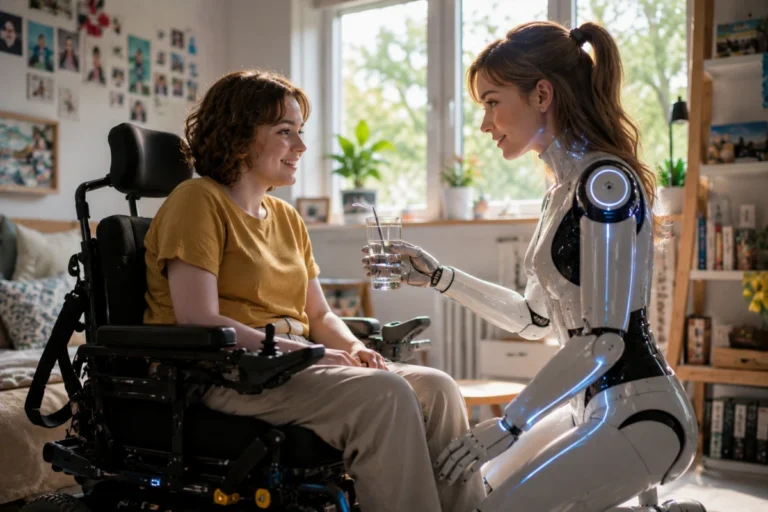
As conversational systems scale, we are beginning to glimpse the broader, structural disruptions they may introduce to traditional social structures. These go beyond the individual and touch upon foundational institutions, including the future of family and technology.
Potential Structural Changes:
- Household Dynamics: Specialized systems taking over eldercare or childcare monitoring, shifting how families distribute domestic care, as seen in elder care robotics today.
- Social Isolation: The risk that highly personalized engines could inadvertently increase a user’s cocooning behavior, a major focus for researchers wondering if AI companions increase social isolation.
- Commercialized Intimacy: Private corporations managing the closest conversational partners of millions of individuals, which introduces massive privacy risks regarding data usage.
These long-term shifts showcase that the technology does not operate in a vacuum. Every modification to individual behavior ripples outward, creating a broader societal evolution with companion robots and software that regulators and ethicists are still trying to understand.
🏁 Conclusion
The long-term social effects of AI companions are not simple or one-directional. They are layered, gradual, and heavily dependent on how individuals choose to engage with them.
For some, these systems offer meaningful support, structure, and even improved confidence in communication. For others, they may subtly reshape expectations around availability, emotional exchange, and interaction style.
What stands out most is not outright replacement, but deep influence. AI companions do not need to replace human relationships to matter socially. They only need to become a regular part of how people communicate, think, and rehearse connection. And that process is already well underway, setting the stage for what to expect from AI companions in the future.