
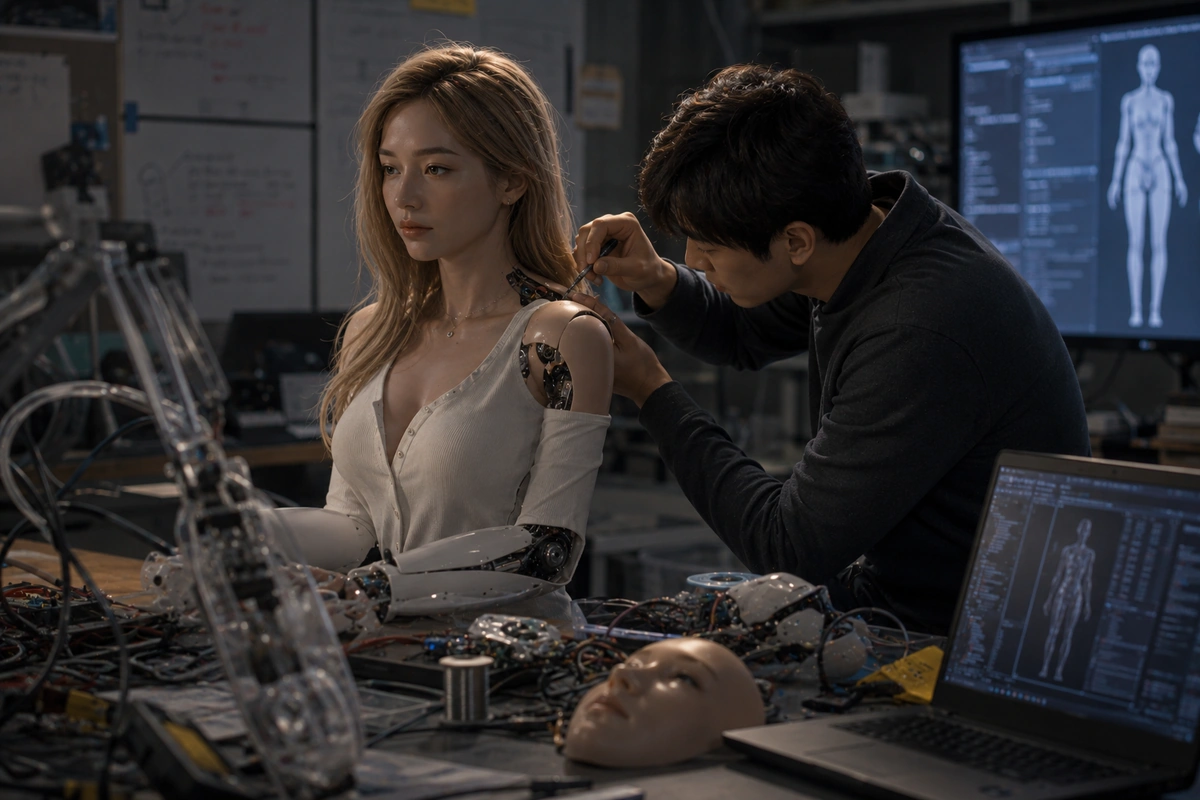
🤖The Hidden Engineering Challenges Behind Social Robots

TLDR
- Social robots look simple on the surface, but the engineering behind them is deeply complex and layered.
- Movement, perception, and real-time decision-making remain major technical bottlenecks.
- Hardware constraints like power, heat, and size heavily shape robot capabilities.
- Integration between mechanical and AI systems is where most real-world issues appear.
- Building “natural” human interaction is still one of the hardest unsolved engineering problems.
When people imagine social robots, they often picture something polished and intuitive. A machine that moves smoothly, understands context instantly, and interacts almost like a person without effort. The reality is a lot messier.
Behind every seemingly simple gesture or response is a stack of engineering decisions, trade-offs, and constraints that rarely make it into product demos. Social robots are not just AI systems wrapped in a body.
They are tightly coupled machines where hardware and software constantly push against each other. Understanding why making a social robot is hard requires looking past the plastic shell at the behind the scenes of AI hardware.
🏗️ Movement Is Far From Solved
One of the biggest misconceptions is that robot movement is already a mature problem. Industrial robotics gives that impression, but engineering challenges in social robots exist in a different world entirely. In industrial settings, movement is repetitive and predictable. In social environments, it must be fluid, responsive, and context-dependent.
The Complexity of Fluid Motion
To appear natural, a robot must coordinate multiple joints in real time while adjusting to human proximity, timing, and behavior. Even small delays or rigid transitions can break the illusion of lifelike interaction. Most systems still rely on electric motors and gear assemblies. While reliable, these introduce stiffness and latency.
- Latency Issues: Small delays in motor response break the illusion of life.
- Mechanical Stiffness: Traditional gears often lack the “compliance” needed for safe human touch.
- Coordination: Moving an arm while maintaining eye contact requires massive computational overhead.
- Social Timing: A gesture must complete exactly when the speech ends to be believable.
The result is motion that works mechanically but often feels slightly off socially. You notice it immediately, even if you can’t always explain why. This is a primary reason for the what limits current AI companions technologically, as the gap between a motor’s command and a human’s perception is where the “uncanny” feeling lives.
👁️ Perception Is Still Unstable in Real Environments
For a robot to behave socially, it first has to understand its environment. That sounds straightforward until you look at the actual conditions it operates in. Homes, offices, and public spaces are unpredictable. Lighting changes constantly. Background noise varies. People move in and out of view without warning.
Environmental Sensory Barriers
Sensors struggle with all of this. Cameras can lose tracking in low light or cluttered scenes. Audio systems can misinterpret overlapping speech. Depth sensors can misread reflective or irregular surfaces like glass or mirrors. Each sensor has its own failure modes, and none of them are perfect on their own.
| Sensor Type | Primary Failure Mode | Impact on Social Interaction |
| RGB Cameras | Low light / Glare | Fails to recognize faces or emotions. |
| Microphone Arrays | Reverb / Background noise | “The cocktail party effect” cannot isolate user voice. |
| LiDAR / Depth | Transparent surfaces | Robot may bump into glass tables or windows. |
| IMUs | Drift over time | Robot loses sense of its own physical orientation. |
The real challenge in the R&D in human-robot interaction is “sensor fusion.” This is the process of combining these imperfect inputs into a single coherent understanding of what is happening at any moment. This fusion process is where errors quietly accumulate, leading to the issues discussed in why companion robots struggle with real-world environments.
⏱️ Real-Time Response Is a Bottleneck
Even when perception works, timing becomes the next problem. Human conversation has tight timing expectations. A pause that is slightly too long feels unnatural. A response that arrives too quickly can feel robotic or disconnected.
The Processing Pipeline Delay
To meet these expectations, robots must process input, interpret meaning, decide on a response, and execute output in fractions of a second. That sounds simple until you account for the layers involved:
- Sensor processing: Converting raw data into digital signals.
- Language modeling: Understanding the user’s intent.
- Behavior selection: Deciding what to say and how to move.
- Motion planning: Calculating the physics of the movement.
- Motor execution: Sending the actual power to the limbs.
Each step introduces delay. Engineers must decide between cloud-based vs local AI companions. On-device processing helps reduce latency but is limited by the hidden tech of social robotics, while cloud systems offer more power but introduce network delay and dependency on connectivity.
So engineers are constantly balancing cost and performance in robots, often sacrificing one to improve the other.
🔋 Power and Thermal Limits Shape Everything
One of the most overlooked engineering challenges in social robots is energy. Every sensor, processor, and actuator consumes power. The more capable the robot, the more energy it needs. But increasing battery size increases weight, which then requires stronger motors, which consume even more energy.
The Physical Trade-off Loop
It becomes a cascading trade-off. This is why many social robots remain limited in mobility or operating time. It is not a lack of ambition. It is a physical constraint of mechanical vs software engineering in AI.
- The Weight Trap: Adding more battery life makes the robot slower and more dangerous to move around.
- Heat Management: High-performance processors generate thermal output that must be managed.
- Acoustic Comfort: Cooling fans add noise, which breaks the quiet, personal feel of a companion.
This is a major part of domestic robots vs companion robots key differences. Vacuum robots can be bulky and loud because they are utility tools. A social robot, however, must be sleek and pleasant to be around. Cooling solutions themselves take space, add weight, and sometimes introduce noise, which is especially noticeable in quiet home environments.
🎭 The Difficulty of Human-Like Expression
Facial and body expression is another area where engineering meets human expectation in a difficult way. Humans rely heavily on micro-expressions, timing, and subtle motion cues to interpret emotion and intention. Replicating that mechanically is extremely complex.
Expression Modalities and Their Limits
Some systems use screens to simulate faces. Others attempt physical facial actuation using layered materials and internal mechanisms. Both approaches come with trade-offs that affect what makes an AI companion feel human.
Engineering Comparison: Screen-based systems are easier to control but can feel less physically present. Mechanical systems can appear more realistic but are harder to maintain and control precisely over time.
The real difficulty is synchronization. Expression, speech, and motion must align perfectly. Even small mismatches can create a sense of unnaturalness that users pick up on instantly. Achieving this harmony is a core focus of current R&D in human-robot interaction.
🧩 Integration Is Where Systems Break Down
Individually, many components perform reasonably well. Cameras detect faces. Speech systems generate responses. Motors move limbs. The problem emerges when all of these systems are combined into a single chassis.
The Integration Chain Reaction
Integration is not just a technical step. It is where timing, data interpretation, and physical execution must all align under real-world conditions. This complexity is why making a social robot is hard.
- Data Bottlenecks: The CPU must manage hundreds of data streams simultaneously without lag.
- Mechanical Interference: Motor vibrations can interfere with sensitive microphone arrays.
- Logic Conflicts: The AI might want to look at the user, but the collision system might force it to look at an obstacle.
When manufacturing social robots at scale, these issues are magnified. A slight delay in perception can affect motion timing. A misinterpreted speech input can lead to an inappropriate response. This is why progress can feel uneven. It is not that nothing works. It is that everything has to work together at once for the user to be satisfied with choosing an AI companion platform responsibly.
🛡️ Durability in Real Human Spaces
Unlike factory robots, social robots are expected to operate in uncontrolled environments. That means they need to withstand accidental bumps, constant repositioning, and long-term wear from everyday use.
Built for Longevity
Materials must be lightweight but strong. Joints must handle repeated motion without degrading. Sensors must stay calibrated despite environmental changes. This kind of durability is difficult to achieve when manufacturing social robots at scale without dramatically increasing the price point.
- Material Selection: Plastics must be “soft” enough to feel pleasant but durable enough to resist cracking.
- Sensor Protection: Lenses must be protected from dust and fingerprints without losing clarity.
- Self-Calibration: The robot must be able to “reset” its internal sensors if it gets bumped or moved.
Even small compromises can affect reliability over time. This is why many users find traditional robotics vs AI companions comparison so stark. One is built for a clean lab, the other for a messy living room. A standard for robust robot design is still being established in the consumer sector.
🤔 Why “Natural” Still Feels Out of Reach
If there is one underlying theme across all these challenges, it is that “naturalness” is not a single feature. It is the result of many systems working together perfectly under unpredictable conditions. Movement, timing, perception, expression, and decision-making all need to align in real time.
The Accumulation of Constraints
That level of coordination is extremely hard to maintain outside controlled demonstrations. So when a robot feels slightly off, it is usually not because of one major flaw. It is the accumulation of small engineering constraints that haven’t been fully resolved yet. These constraints contribute to what current AI companions are not capable of today.
- Physics vs Software: Code can think at light speed, but motors take time to move.
- Logic vs Ambiguity: Robots struggle with “implied” social cues that humans take for granted.
- Cost vs Complexity: High-end components exist, but they make the robot unaffordable for most families.
This persistent gap drives the the ethics of AI companions designed for emotional dependency, as engineers must decide how much “illusion” to build into the system to compensate for hardware limitations.
🛠️ The Future of Social Robot Manufacturing
The next decade will likely see a shift in how we approach the hidden tech of social robotics. Instead of trying to build “all-purpose” humanoids, we are seeing a move toward specialized forms that excel in specific social niches.
Scaling and Commercialization
To reach mass adoption, the industry must solve the problem of balancing cost and performance in robots. High-fidelity actuators used in research labs often cost thousands of dollars per joint. Bringing these costs down while maintaining precision is the ultimate goal of anyone manufacturing social robots at scale.
- Advanced Materials: Moving away from heavy metals toward carbon-fiber composites and soft robotics.
- Edge Computing: Better on-device chips to handle NLP without relying on the cloud.
- Improved HRI: Better R&D in human-robot interaction to make interfaces more intuitive for non-technical users.
By focusing on these specific engineering challenges in social robots, developers can create machines that feel less like appliances and more like what are companion robots are truly meant to be: supportive, engaging members of the household.
🏁 Conclusion
Social robots sit at the intersection of mechanical engineering, sensing systems, computation, and human behavior. Each of those areas is already complex on its own. Combining them into a single responsive system multiplies that complexity significantly.
What looks like a simple interaction on the surface is actually the result of tightly constrained trade-offs in mechanical vs software engineering in AI. Understanding the behind the scenes of AI hardware is key to seeing where the field actually stands today. As we continue balancing cost and performance in robots, the gap between the technical and the “natural” will steadily close.