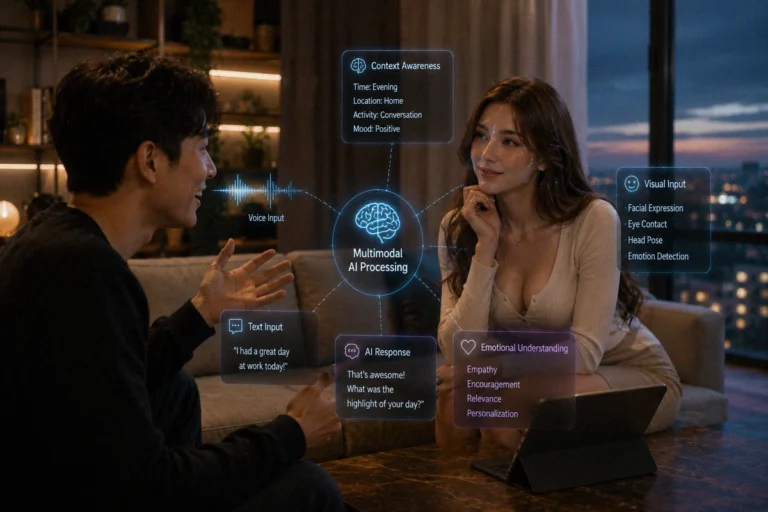

⚡How Edge Computing Changes AI Companion Performance

TLDR
- Edge computing allows AI companions to process tasks locally, reducing delays and making conversations feel more natural.
- Faster response times improve emotional realism, voice interaction, and social flow in companion systems.
- On-device processing can strengthen privacy by limiting how much personal data leaves your device.
- Hybrid systems that combine local processing with cloud computing are becoming increasingly common.
- Battery life, hardware limitations, and model size remain major engineering challenges for edge-based companions.
There is a moment in almost every digital conversation where timing matters more than people realize. You ask a question, and then a pause happens. Maybe it is only a second or two, but suddenly the interaction feels strange, slightly awkward, and less natural than it should be.
That tiny delay matters far more in companion technology than most people expect. If you are chatting with a search engine or productivity app, waiting a second might not bother you. But when a system is designed to feel conversational, emotionally responsive, or socially aware, latency changes everything.
This is exactly why edge computing has become such an important topic in companion technology. It affects nearly every part of the experience including speed, privacy, emotional responsiveness, reliability, and trust. If companion systems continue evolving, on-device intelligence may end up becoming one of the biggest invisible upgrades users never consciously notice.
⚙️ First, what exactly is edge computing?
The easiest way to think about edge computing is simple. Instead of sending every single piece of data to a distant cloud server for processing, certain tasks happen locally on your hardware. That device could be a smartphone, a home robot, a smart speaker, a wearable device, or a dedicated companion robot.
Traditionally, many conversational systems rely heavily on cloud infrastructure. You speak, your request travels to remote data centers, gets processed by massive computational models, and a response travels all the way back to your screen or speaker.
While this process works well for basic information retrieval, distance creates delay. Even high-speed internet connections introduce systematic latency, especially when an application is juggling speech recognition, language understanding, memory retrieval, emotional cues, and response generation all at once.
💻 Local Processing vs. Cloud Infrastructure
- Data Transmission: Cloud architectures require continuous external data travel, whereas edge systems keep processing localized.
- Network Dependence: Cloud systems require constant high-bandwidth connectivity, while edge hardware functions independently of signal strength.
- Computational Range: Cloud infrastructure handles massive multi-billion parameter models, while edge chips manage specialized, highly optimized models.
Understanding these structural differences highlights why developers are shifting focus. For an in-depth look at how these internal setups compare in standard consumer devices, read our comprehensive guide on cloud-based vs local AI companions.
⏱️ Why speed matters more than people think
Human conversation runs entirely on timing, a reality that becomes obvious when you pay close attention to social interaction. People interrupt slightly, react quickly, pause naturally, and adjust conversational rhythm without consciously thinking about it. A delay of even a second can subtly change how an interaction feels.
Researchers studying communication timing have repeatedly shown that conversational pauses influence social perception. Long delays can feel uncomfortable or emotionally off, even if the actual words remain identical.
For companion systems, this becomes a major hurdle. If a companion responds too slowly, it feels less emotionally aware. Too fast, and it risks sounding unnatural or scripted. The sweet spot depends heavily on timing, which is why edge computing matters so much in the current development landscape.
Local processing reduces the waiting time between interaction and response, allowing for much faster AI interactions with edge tech.
📊 Conversational Latency Benchmarks
| Response Delay | User Perception | Impact on Emotional Realism |
| Under 200ms | Instantaneous, highly fluid | Excellent; mimics human reflex patterns |
| 300ms to 600ms | Noticeable but acceptable | Moderate; feels like a standard digital assistant |
| Over 1000ms | Fragmented, awkward pauses | Poor; breaks social immersion completely |
📖 Read More: To better understand how these reaction speeds impact human perception, check out our analysis on what makes an AI companion feel human.
🗣️ Voice conversations improve immediately
Voice interaction is one area where local processing becomes especially noticeable. Text-based conversation hides delays pretty well because most people tolerate waiting a few seconds for a text message to render.
Voice is completely different because the entire experience depends on rhythm. If a companion robot or voice-based assistant pauses awkwardly after every sentence, the social flow breaks apart quickly.
Local speech recognition helps solve this problem entirely. Instead of sending every spoken word to distant servers, some companion systems can process speech directly on-device or partially on-device. This creates smoother interaction, fewer awkward pauses, and less conversational friction.
You stop thinking about the underlying code and focus more on the interaction itself. Even slightly faster conversational timing changes the emotional feel of interaction more than most people expect, proving how edge AI improves robot performance during voice-to-voice sessions.
💡 Expert Tip
When evaluating voice-based hardware, check if the device supports offline speech-to-text processing. This ensures conversational pacing remains stable even when local network traffic spikes.
📖 Read More: For a breakdown of the software that decodes vocal patterns, explore our guide on natural language processing explained for non-engineers.
🔒 Privacy becomes much stronger
Here is something users increasingly care about: where does all the conversation actually go? Companion systems often handle highly personal information. People discuss emotions, daily routines, relationships, private concerns, goals, and sometimes deeply vulnerable experiences.
When everything depends entirely on cloud systems, more information travels externally for processing. Local data processing changes part of that equation. If speech recognition, memory retrieval, or conversational analysis happens locally, certain data sets may never need to leave the hardware.
This architecture highlights the inherent benefits of on-device AI processing for daily security. While it does not automatically mean complete anonymity, local processing drastically reduces exposure. For privacy-conscious users, you are probably more comfortable speaking openly if you know certain information stays closer to home.
📋 Core Privacy Safeguards of Edge Systems
- Local Anonymization: Stripping identifying metadata on-device before any hybrid cloud requests are made.
- Offline Data Vaults: Storing relationship histories and personal preferences locally rather than in central corporate databases.
- Reduced Interception Risks: Minimizing the transmission of raw audio files across public networks where they can be compromised.
📖 Read More: To learn more about protecting your digital personal space, look over our article on how AI companions store and use your data.
🌐 Reliability improves when internet fails
This benefit gets overlooked surprisingly often. Cloud-based systems depend heavily on continuous connectivity. Weak Wi-Fi, a poor mobile signal, or a server outage can cause the experience to deteriorate instantly.
Companion systems are especially sensitive to this because they aim for lifestyle continuity. People do not want emotional support, reminders, or conversation disappearing whenever the connection gets unstable.
On-device computing creates systemic resilience. Basic functions can continue even during major connectivity problems. Speech recognition may still work, memory access may remain available, and certain conversational abilities can continue without interruption.
That reliability becomes especially important for home robots, elder-care systems, and always-available companion devices. No one wants a socially interactive robot freezing mid-conversation because the internet had a bad afternoon. Utilizing decentralized micro-chips is a key pillar in the future of decentralized social robots.
📖 Read More: For an overview of how constant availability affects long-term usage, explore our report on whether AI companions can reduce loneliness long-term.
🧠 Memory systems become faster and more useful
One underrated challenge in companion technology is memory retrieval. Good companion systems increasingly aim to remember preferences, routines, recurring conversations, and personal details. When memory systems rely entirely on cloud infrastructure, every recall request adds additional processing time.
Local architecture helps streamline part of this. Locally stored memory allows quicker access to preferences and context. Instead of slowly reconstructing information from remote systems, a companion might instantly remember recurring habits, communication preferences, or prior topics.
The result feels smoother, creating less repetitive interaction and more continuity. Continuity is surprisingly important for emotional realism, as nothing breaks immersion faster than repeating the same basic information over and over to an application that forgot your previous session.
[User Input] ---> [Local Memory Cache] ---> [Instant Context Match] ---> [Immediate Response]This rapid loop bypasses external network queues entirely. To understand the technology that allows software to retain these personal details efficiently over time, read our technical breakdown on how AI companions learn over time.
🎭 Emotional responsiveness feels more believable
Companion systems increasingly try to detect conversational signals such as tone, pacing, pauses, or emotional shifts. These cues help systems respond more appropriately to a user’s current mental state. For example, slower speech patterns or changes in vocal energy may suggest frustration, sadness, or stress.
Processing emotional cues in real time requires immense speed. If a system notices emotional context five seconds too late, the moment passes, making responses feel disconnected and robotic. Local processing helps because it allows faster contextual awareness.
A companion responding more quickly to emotional signals feels more attentive, even if users never consciously notice why. Social awareness often depends on tiny timing details that can only be captured through localized analysis, showcasing why developers emphasize why conversation quality matters more than appearance in AI companions.
🛠️ Real-Time Emotional Processing Pipeline
- Vocal Prosody Analysis: Local algorithms analyze pitch and speed changes instantly as you speak.
- Contextual Evaluation: The model matches your current emotional tone against your stored memory profile.
- Dynamic Adjustment: The system modifies its text-to-speech engine outputs to match your emotional state without a server lag.
📖 Read More: To delve deeper into how software simulates empathy, explore our research piece on emotion simulation vs emotion recognition in ai.
⚠️ There are still major limitations
Of course, this approach is not magic. Running advanced models locally introduces serious tradeoffs. Large conversational systems require massive processing resources, which many consumer devices simply cannot handle efficiently.
This forces engineers to constantly balance speed against depth, navigating the distinct tradeoffs of edge vs cloud for companion devices.
- Computing Power: Hardware must be equipped with specialized neural processing units to handle complex linguistic structures.
- Battery Life and Heat: Local processing drains mobile batteries rapidly and generates substantial heat during prolonged chats.
- Model Size Restrictions: Highly advanced reasoning models are currently too large to fit onto standard consumer electronics chips, illustrating what limits current AI companions technologically.
🤝 The rise of hybrid intelligence
Rather than forcing a rigid choice between local or cloud processing, many companies increasingly combine both architectures. This hybrid approach tries to combine the best of both worlds: speed and privacy where possible, alongside expanded intelligence when necessary.
For companion technology, that balance feels especially practical because you want fast interaction without losing analytical capability.
┌---> Local Processor (Speech, Timing, Privacy Guard)[User Interaction]┤ └---> Cloud Infrastructure (Deep Reasoning, Large Knowledge Base)To see how these hardware choices affect market prices and consumer accessibility before making a investment, you can review our breakdown on how to compare AI companion pricing models before you buy.
🤖 Physical robots benefit even more
Local processing becomes even more vital once physical hardware enters the equation. A conversational app freezing on a phone screen is annoying, but a physical machine freezing mid-action feels unsettling. Social robots rely on synchronized movement, speech timing, eye contact simulation, gesture coordination, and environmental awareness.
If a robot hesitates before reacting, misses timing cues, or responds too slowly, social realism breaks apart quickly. Deploying edge computing in social robots helps reduce those delays, supporting immediate responsiveness between perception and physical action.
Engineers must design these units with robust local intelligence in robotics to ensure smooth physical interactions. Major technology developers have highlighted these structural requirements in recent hardware design documentations, noting that localized computing architectures are mandatory for real-time safety and gesture fluidness.
🤖 Spatial Tracking and Reaction Needs
- Sensor Fusion: Merging data from cameras, microphones, and depth sensors instantly without cloud lag.
- Kinematic Synchronization: Aligning facial motors and arm movements with the spoken word output in real time.
- Collision Avoidance: Processing unexpected environment changes instantly to protect the user from physical bumping.
📖 Read More: To explore how these mechanical systems are being deployed in real-world settings today, see our article on how social robots are used today.
🔮 The future may feel invisible
Funny enough, users probably will not talk much about technical architectures directly. Nobody casually sits down and compliments a device’s distributed inference setup. Instead, people simply notice practical outcomes.
They notice that the application feels smoother, responds naturally, remembers personal conversations, and works perfectly even when the home internet acts up.
The best technical improvements always disappear directly into the background of a consumer product. You stop noticing the heavy machinery because the daily experience feels effortless. That is likely where companion technology is heading as the industry matures.
💡 Expert Tip
When shopping for upcoming smart home devices, prioritize platforms that feature robust on-device chipsets to ensure your hardware investment remains functional for years to come.
📝 Conclusion
Edge computing quietly transforms companion performance in deeply meaningful ways. Faster responses make conversations feel more natural, local processing strengthens user privacy, and overall reliability improves when connectivity fails.
While there are still real engineering challenges to solve regarding energy demands and model efficiency, the direction of the industry remains clear.
As companion systems become more sophisticated, moving intelligence closer to the user will become increasingly important because in companionship, timing matters. Sometimes the difference between a conversation feeling completely awkward or surprisingly natural comes down to a fraction of a second.