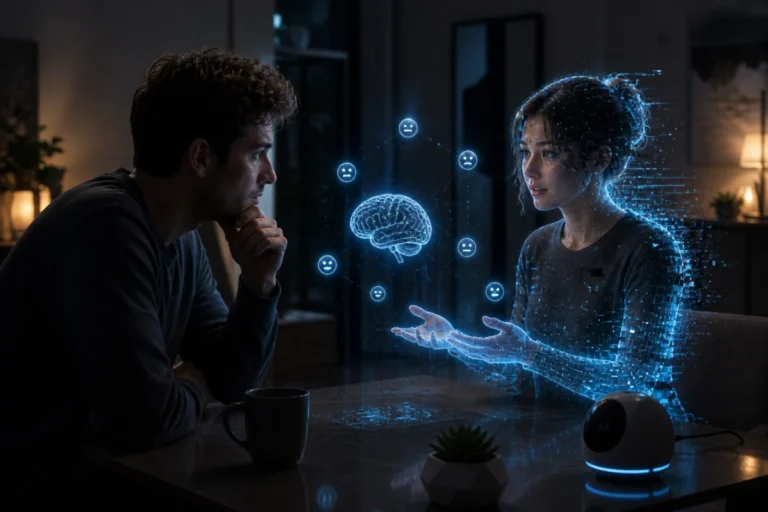

What Happens When AI Companions Become Mainstream

Key Take-Aways
- Mainstream AI companions could reshape communication, emotional support, the sexual marketplace and everyday routines.
- Companion systems may become normalized alongside messaging apps, smart assistants, and social media.
- Industries including healthcare, elder care, education, and customer service may adopt companion-style interaction.
Right now, AI companions sit in a niche category. They are popular enough for tech enthusiasts to track, yet experimental enough that the general public views them as a novelty.
However, technology moves quietly until it becomes routine. Smartphones and video calls once felt unusual; automated companions will likely follow the exact same path.
The core question isn’t how the software improves, but rather what changes structurally when using an automated friend or sexual partner no longer carries a social stigma.
No matter which AI system you’re using, I’d strongly suggest you always use a VPN to safeguard your privacy and data!

The stigma probably fades first
When the future of social norms with robots begins to stabilize, public perception will rapidly soften.
Much like online dating transitioned from a niche taboo to a cultural standard, talking to an automated conversational tool will eventually feel as ordinary as opening a productivity app.
Will the same be said about having sex with AI robots? Not immediately, there will be a lot of resistance at first, but after awhile, once feminists and other bleeding hearts realize that this technology cannot be stopped, they too will become mainstream.
This drop in friction will dramatically expand global adoption. As a result, the social acceptance of AI companions will settle into daily life, fundamentally altering how communities cross the line between human and synthetic interaction.
When AI companions become mainstream, society will likely stop viewing them as tech experiments and start viewing them as standard infrastructure.
Stages of Cultural Acceptance
- Niche Adoption: Early users experiment with platforms while the general public expresses skepticism.
- Functional Integration: Features are built directly into standard mobile devices.
- Social Normalization: Public stigma drops and automated communication becomes a standard lifestyle choice.
Companionship may become more personalized
Human relationships are inherently unpredictable. Friends get busy, schedules conflict, girlfriends and wives refuse sex, and emotional support can be inconsistent.
Automated companion software is explicitly designed to eliminate this friction by tracking your exact conversation history and “remembering” your preferences.
If these tools keep scaling, hyper-personalization will define the market. You will interact with algorithms that instantly adapt to your preferred tone, remember your daily routines, know what you like in bed and actively track your emotional patterns over long development cycles.
Emotional support could become more accessible
One of the strongest arguments for this software is continuous availability. Human networks aren’t always accessible during a crisis, and professional mental health resources remain expensive.
While algorithms are not genuine therapeutic substitutes, they increasingly serve as an immediate conversational safety valve.
When analyzing what happens when everyone has an AI friend, having 24/7 access to a responsive interface allows isolated individuals to de-escalate stress before a real-world support system becomes available.
This availability explains why people are turning to AI companions at an accelerating rate globally, forcing us to weigh the delicate balance between AI companions and mental health potential and limits.
Healthcare and elder care may change significantly
Medical integration is moving far past the novelty phase.
Researchers are currently deploying conversational frameworks to manage early cognitive decline, log physical vitals, and mitigate the public health risks associated with chronic isolation.
| Care Context | Role of Companion Technology | Intended Outcome |
| Elder Care | Automated check-ins and active chat prompts | Combats daily isolation; preserves routine |
| Cognitive Assistance | Memory games and structured task guidance | Brain stimulation; reduces caregiver fatigue |
| Disability Support | Voice-integrated environmental controls | Promotes independent home living |
Importantly, healthcare operations utilize these platforms as operational supplements rather than human replacements.
A system that actively prompts an older adult to complete daily puzzles or log medication updates significantly reduces caregiver burnout while ensuring the patient maintains a stable routine.
You can already see this clearly in how AI companions are used in elder care today, as well as the rising deployment of social robots for people with disabilities.
Privacy becomes a much bigger issue
For conversational software to provide high-tier utility, it requires deep data collection. It must store your vulnerabilities, daily schedules, and emotional tendencies.
This creates an intimate data profile that presents substantial security challenges.
When millions of users feed personal variables into cloud servers daily, standard privacy parameters prove insufficient.
To me, this is incredibly disturbing and alarming, and it’s why I always recommend anyone who’s getting involved with AI companions (or who just goes online, really) to use a strong VPN. Protect your data and your privacy!
Human relationships may shift in subtle ways
A broader societal shift to ubiquitous AI won’t cause humanity to abandon face-to-face interaction entirely – but it could very well cause it to decrease 90%.
Instead, we will definitely, and at least, see a structural normalization of artificial intimacy, where software becomes a standard layer of our broader social habits.
For example, people will routinely use conversational models to process complex arguments, map out work conflicts, or practice social skills before engaging with a human partner.
And what about physical AI companions, i.e. sex robots? Once these hit the field and become “good enough” for the average Joe, the whole sexual marketplace will change.
This used to be, for all of civilised human history, be a realm where women were the gatekeepers of sex. What happens when they won’t be needed anymore for this, and every man can just buy an attractive AI sex robot who does what he tells them?
Society isn’t ready for this yet, but it’ll have to be, because this is coming very soon.
Conclusion
In summation, the widespread adoption of automated companions won’t alter human behavior overnight.
Instead, the transition will occur through subtle, everyday shifts: more targeted emotional support, smarter care tools, on-demand sexual affection and complex new privacy conversations.
Humans will do what they have always done when encountering disruptive technology: adopt until the completely unprecedented feels completely ordinary.
No matter which AI system you’re using, I’d strongly suggest you always use a VPN to safeguard your privacy and data!