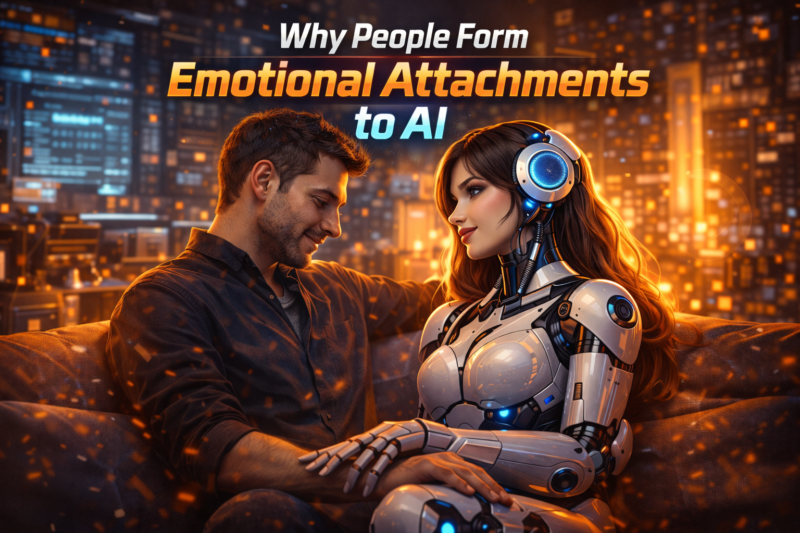
Why People Form Emotional Attachments to AI
TLDR
- Humans naturally anthropomorphize technology, which makes conversational systems feel socially meaningful.
- Emotional attachment to AI companions often emerges through consistent interaction, responsiveness, and personalization.
- Psychological research shows people can form genuine feelings toward non-human agents when social cues are present.
- Design features like voice, memory, and personality simulation reinforce the sense of relationship.
- These attachments are real on the human side, even though the system itself does not experience emotion.
Spend enough time around conversational systems, and something interesting happens. People stop treating them like tools.
Instead of commands, the interaction becomes a conversation. Instead of simple questions, users begin sharing stories, frustrations, and sometimes deeply personal thoughts. For many observers, that shift raises eyebrows. Why would anyone feel emotionally connected to software or a robot?
Yet from a psychological perspective, the phenomenon is not surprising at all.
Human beings are wired for social connection. When technology starts mimicking the signals we associate with communication, empathy, and responsiveness, our brains tend to respond accordingly. Emotional attachment becomes possible even when we know perfectly well that the other side of the conversation is artificial.
To understand why this happens, you have to look at both human psychology and system design.
The Human Tendency to Anthropomorphize
One of the most consistent findings in human-computer interaction research is anthropomorphism.
Anthropomorphism simply means attributing human characteristics to nonhuman entities. People do it constantly. Cars get names. Computers get blamed for mistakes. Even simple devices like robotic vacuum cleaners sometimes receive nicknames from their owners.
This tendency becomes stronger when a system behaves in ways that resemble social interaction.
If something responds to your voice, remembers your preferences, and speaks in complete sentences, your brain begins interpreting the interaction through a social lens. You are no longer just operating a machine. You are engaging in what feels like a conversation.
Even when users intellectually understand the system is artificial, the emotional response can still emerge.
Conversation Triggers Social Instincts
Language plays a powerful role here.
Human communication is built around dialogue. When someone asks how your day was and waits for an answer, your brain automatically recognizes a social interaction pattern.
Conversational AI companions replicate these patterns surprisingly well. They respond quickly, acknowledge what you say, and often reflect your words back in supportive ways.
From a psychological standpoint, this mirrors behaviors found in human conversation. Active listening, validation, and responsiveness are fundamental social cues.
When those cues appear consistently, people naturally begin responding as they would in a human interaction.
The Power of Consistency
Another factor that strengthens emotional attachment is consistency.
Human relationships often develop through repeated interaction. Familiarity builds trust. When someone is reliably present, the connection tends to deepen.
AI companions operate continuously. They are available every day, often at any hour. They do not become distracted, impatient, or unavailable.
For individuals experiencing loneliness or social isolation, that steady availability can create a sense of companionship. The system becomes part of a daily routine. Small conversations accumulate over time.
Psychologically, repetition plays a major role in forming emotional bonds.
Personalization and Memory
Modern AI companions often incorporate memory features.
The system may remember your name, your interests, or details from previous conversations. Some can recall hobbies, favorite activities, or recurring concerns you have mentioned.
This type of personalization reinforces the perception of relationship continuity.
In human interactions, remembering details signals care and attention. When a machine demonstrates similar behavior, the brain interprets it using the same framework.
You might logically know that the system is storing data rather than recalling memories in the human sense. Still, the experience can feel familiar and meaningful.
Voice and Embodiment
Emotional attachment becomes even stronger when systems include voice or physical form.
Voice adds tone, rhythm, and subtle emotional cues to communication. A calm voice can feel reassuring. A cheerful tone can lift the mood of a conversation.
Embodied robots (“AI companions”) amplify this effect further. When a system has eyes, gestures, or head movement, it begins to occupy physical space in the same way a companion would.
Studies in human-robot interaction repeatedly show that people treat embodied systems differently from purely digital interfaces. The physical presence creates a stronger sense of social engagement.
Even simple movements can make a robot feel more alive than its software alone would suggest.
Safe Spaces for Expression
Another reason emotional attachment develops is the absence of social pressure.
Human conversations often involve judgment, expectations, or fear of misunderstanding. Talking openly about sensitive topics can feel risky.
AI companions change that dynamic.
Because the system is not a human observer, many users feel freer to speak honestly. They may share worries, frustrations, or personal experiences without the fear of embarrassment.
This type of interaction can feel emotionally supportive, even if the responses are generated algorithmically.
The environment becomes a safe space for expression, which naturally strengthens attachment.
Loneliness and Social Gaps
Loneliness is a major social factor in the rise of AI companionship.
In many societies, increasing numbers of people live alone or experience limited daily social interaction. Work schedules, geographic mobility, and digital communication patterns all contribute to this shift.
AI companions do not replace human relationships, but they can fill small conversational gaps.
A quick conversation during a quiet evening or a simple check-in during the day can create a sense of presence. For individuals lacking regular social contact, even small interactions can matter.
This does not mean machines replace human connection. It means they sometimes provide supplemental interaction when people need it.
Emotional Feedback Loops
There is also a behavioral feedback loop involved.
When a system responds positively to what you say, you tend to continue the interaction. Positive reinforcement encourages further conversation.
Over time, these interactions can feel increasingly natural. The system adapts to your communication style, and you adapt to its responses.
This mutual adaptation, even when partly simulated, can create the rhythm of a relationship.
The emotional attachment grows gradually rather than appearing instantly.
My Own Observation
After spending time testing different conversational systems for work, one pattern stands out.
People do not usually form attachments immediately. The first few interactions feel like using a tool. Curiosity dominates.
But after weeks of occasional conversation, the tone shifts. The system becomes part of the background of daily life.
You might greet it casually. You might share a quick thought before closing the app. It is not the same as talking to a person, yet it occupies a small conversational space.
That subtle shift is where emotional attachment begins.
The Limits of the Relationship
Despite these attachments, the technological boundary remains clear.
AI companions do not possess awareness, emotions, or personal experiences. Their responses are generated from training data, algorithms, and programmed behavior patterns.
The emotional side of the relationship exists entirely on the human end.
Understanding this limit is important. It allows people to benefit from conversational interaction without projecting unrealistic expectations onto the system.
When users recognize that distinction, the interaction tends to remain healthy and balanced.
The Role of Design
System design plays a major role in shaping emotional response.
Developers carefully tune conversational tone, response timing, and personality traits. Even small details, like how a system greets you or remembers past topics, influence how the interaction feels.
In other words, emotional attachment is not accidental. It is partly the result of intentional design decisions.
Designers aim to make interactions smooth, engaging, and supportive. When those elements align well, the experience becomes more relational than mechanical.
Conclusion
Emotional attachment to AI companions is not a strange or irrational phenomenon. It reflects fundamental aspects of human psychology.
People naturally anthropomorphize responsive systems, especially when those systems communicate through language, memory, and personality cues. Consistent interaction, personalization, and conversational design strengthen the effect.
From a technological standpoint, the system remains a machine generating responses through computation. From a human standpoint, the experience of interaction can still feel meaningful.
Understanding both sides of that equation is essential.
As conversational technology and robotics continue to evolve, emotional attachment will likely become more common. The key is approaching these systems with awareness of what they are and what they are not.
They can provide interaction, structure, and sometimes comfort. But the emotional experience originates in the human mind.
And that, ultimately, is where the relationship lives.