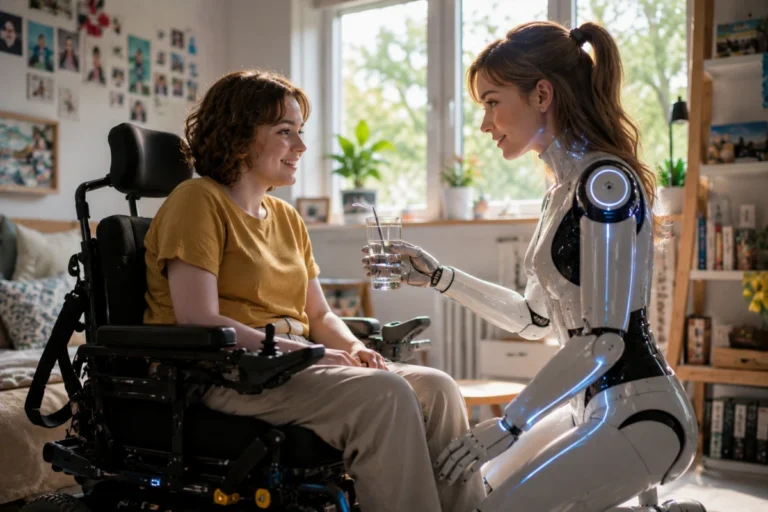

How Cultural Differences Shape AI Companion Design

Key Take-Aways
- Cultural values directly influence how AI companions are designed, from personality to appearance.
- Eastern markets tend to favor socially expressive, emotionally engaging robots with some curves, while Western designs often emphasize utility.
- Acceptance of robots varies significantly across countries, affecting how “human-like” companions are built.
If you’ve ever looked at two AI companions from different parts of the world and thought, ‘Why do these feel so different?” you’re not imagining it.
Designing a companion system is not just about sensors, processors, or speech models. It is about people.
And people, as it turns out, bring their cultural expectations into every interaction – especially the Japanese/Chinese and the Americans. Hot damn.
What feels friendly in one country can feel uncomfortable or even uncanny in another. That single fact quietly shapes almost everything in this space.
It dictates how robots look, how they speak, how they have sex and how they behave when you’re having a bad day.
Let’s unpack how cultural differences in AI design get baked into these systems in ways that are not always obvious at first glance.

Why Culture Matters More Than You Think
At a technical level, you could build one universal companion and ship it globally. Same hardware, same voice, same personality.
Simple. In practice, that approach rarely works. Research consistently shows that people from different cultures interpret and respond to interactive machines in different ways.
In some regions, users are more comfortable treating machines as social partners. In others, they prefer clear boundaries between human and machine roles. That difference alone forces companies to rethink design at a foundational level.
I’ve noticed this personally when testing different top AI companion platforms. Some feel like polite assistants, while others lean into something closer to a “presence.” That distinction is a result of how culture shapes robot personality.
Key Drivers of Cultural Variance
- Religious Roots: Animistic traditions vs. Abrahamic perspectives on the soul.
- Social Structure: Collectivist societies vs. individualistic cultures.
- Sexual Preferences: Some cultures value big boobs, others asses. The height/size of the AI sex companion also matters a lot – Western men can handle bigger female androids, for example.
- Economic Needs: Labor shortages in aging populations vs. tech-savviness in younger demographics.
Eastern vs Western Design Philosophies
One of the most well-documented contrasts shows up in Western vs Eastern social robots.
In countries like Japan, there’s generally a higher willingness to attribute human-like qualities to machines – or other various fetishes.
Cultural traditions have long supported the idea that non-living objects can carry intention or spirit. As a result, what are companion robots in these regions is often defined by companionship rather than just task-execution.
In contrast, Western users tend to approach machines more functionally. Even when systems are conversational, there is often a subtle expectation that they remain tools first.
You see this in the way AI companions differ from virtual assistants in Western markets, where utility remains the primary selling point.
This aligns with findings that people, not design features, make a robot social because user background does the heavy lifting.
Of course, this will change heavily once AI sex robots become a real, viable option.
Social Behavior and Interaction Styles
Beyond appearance, behavior is where culture-specific social cues in AI really start to matter.
Think about conversation pacing. In some cultures, pauses are normal; in others, silence feels like a system error.
Politeness is another massive hurdle. In high-context cultures, indirect communication and subtle cues play a major role.
Pacing and Politeness by Region
| Feature | High-Context (e.g., East Asia) | Low-Context (e.g., North America) |
| Directness | Subtle, suggestive, polite | Explicit, clear, instructional |
| Honorifics | Essential for social hierarchy | Rarely used or informal |
| Conversation Gap | Comfortable silences integrated | Rapid-fire style |
This depth of interaction is exactly what makes an AI companion feel human to a local user. If the natural language processing is not tuned to these nuances, the “buddy” feels like a foreign intruder.
The Role of Social Norms and Community
Companion systems do not exist in isolation. How people use them is shaped by their social environment.
In Japan, users often incorporate robots into social routines, bringing them to gatherings or celebrating milestones. This collective behavior reinforces the idea of robots as social participants.
In Western regions, usage tends to be more private. The companion stays at home, serving a personal function – cooking, cleaning, sex.
This difference determines how robots are designed for different markets. If a system is likely to be used socially, it needs to behave appropriately in group settings.
This is a core part of the social acceptance of AI companions worldwide.
Acceptance and Trust Across Cultures
Not every culture adopts companion systems at the same pace. Acceptance levels are influenced by a mix of factors: media representation, history with automation, and religious views.
Some users are comfortable storing and using personal data to improve the AI’s memory, while others view such data collection with deep scepticism.
Design has to respond to that. Features like data controls and behavioral transparency are emphasized differently depending on the market.
Conclusion
In summation, companion systems do not exist in a vacuum. They reflect the cultures they are built for, whether intentionally or not.
From appearance to behavior, every design choice carries cultural weight. As these systems become more integrated into daily life, that influence only grows stronger.
The future here is not about one universal companion. It is about many, each shaped by the people they are meant to interact with.
If you are choosing an AI companion platform responsibly, pay attention to how it feels. That feeling is often a direct reflection of the cultural assumptions behind the machine.