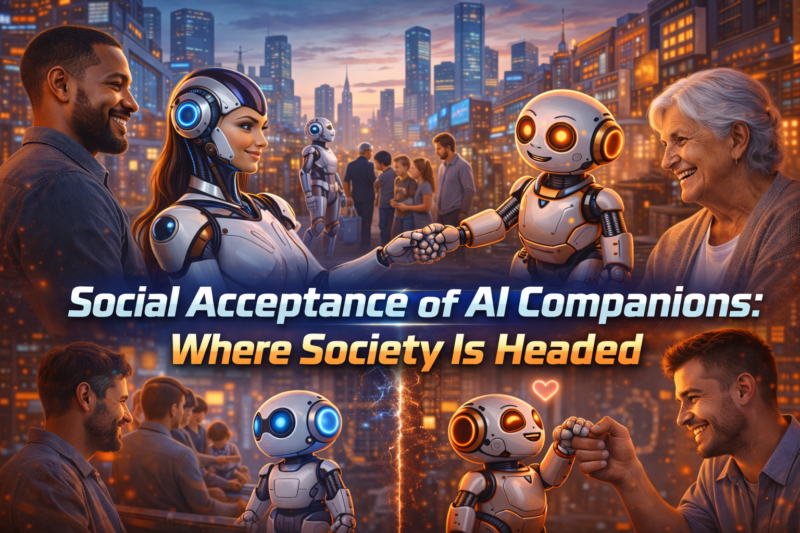
Social Acceptance of AI Companions: Where Society Is Headed
TLDR
- Public attitudes toward AI companions are shifting as conversational systems and social robots become more common in daily life.
- Acceptance tends to grow when people interact with the technology directly rather than only hearing about it.
- Use cases in elder care, education, and personal assistance are helping normalize human-machine companionship.
- Concerns remain around privacy, emotional dependency, and unrealistic expectations about machine capabilities.
- Social acceptance will likely depend on transparency, responsible design, and clear understanding of what these systems can and cannot do.
A decade ago, the idea of talking regularly to a machine still felt unusual to many people. Today it is increasingly normal. Millions of users interact daily with conversational assistants, chat-based companions, and early forms of social robots.
This shift raises an interesting question. How comfortable is society becoming with the idea of AI companions?
Technology adoption rarely happens all at once. It tends to move through phases. First comes curiosity, followed by skepticism, then gradual normalization as the technology proves useful in everyday situations.
AI companions appear to be moving through that exact process. Public opinion is evolving, and understanding that evolution helps explain where this field might be headed next.
Early Skepticism Toward Machine Companionship
When social robots and conversational companions first appeared in research labs, public reactions were often mixed.
Some people saw the technology as fascinating and futuristic. Others reacted with discomfort or distrust. The idea that a machine could act as a companion raised philosophical questions about authenticity and human relationships.
Popular media sometimes amplified these concerns by portraying artificial companions in dramatic or dystopian ways. As a result, early public perception tended to swing between excitement and unease.
This pattern is common with emerging technologies. The unfamiliar often triggers caution before acceptance begins to grow.
Familiarity Changes Perception
One of the strongest predictors of acceptance is simple exposure.
When people encounter social robots or conversational systems in real life, their reactions often soften. What once seemed strange becomes easier to understand after a few minutes of interaction.
Research in human-robot interaction repeatedly shows that direct experience increases comfort levels. Participants who initially express skepticism often report more positive attitudes after interacting with a robot during experiments.
The technology begins to feel less abstract and more practical.
This shift from imagination to experience plays a big role in social acceptance.
Practical Use Cases Matter
Another major factor influencing acceptance is usefulness.
Society tends to embrace technologies that solve real problems. In the case of AI companions, several practical applications have started to demonstrate clear value.
In elder care settings, social robots are being used to stimulate conversation and engagement among residents. In education, some robots assist with language learning or interactive teaching exercises.
In personal technology, conversational assistants help with daily organization and information retrieval. Some people even have sex with AI companions, a niche that is growing rapidly.
When people see these systems performing helpful roles, the conversation changes. The focus moves from novelty to function.
That transition is critical for long-term acceptance.
Cultural Differences in Acceptance
Interestingly, attitudes toward social robots and AI companions vary across cultures.
In some countries, particularly those with strong robotics industries like South Korea and Japan, public acceptance has grown relatively quickly. Robots in customer service, hospitality, and healthcare settings are already visible in everyday environments.
In other regions, people remain more cautious about the idea of machines occupying social roles.
These cultural differences often reflect broader attitudes toward technology, automation, and human-machine relationships. Societies that already integrate robotics into daily infrastructure tend to adopt companion technologies more comfortably.
Over time, global exposure to these systems may gradually narrow the gap.
The Role of Design in Social Comfort
The physical and behavioral design of AI companions also plays a large role in acceptance.
A robot that looks overly mechanical may feel cold or intimidating. On the other hand, designs that attempt to mimic humans too closely can trigger discomfort known as the “uncanny valley.”
Developers therefore spend considerable time refining how these systems look, move, and communicate.
Small details matter. Eye contact, voice tone, and gesture timing can make interactions feel more natural. When a system behaves in a predictable and friendly way, people tend to respond positively.
Design choices influence whether a companion feels approachable or unsettling.
Media Narratives and Public Perception
Public opinion about new technology is shaped not only by direct experience but also by cultural storytelling.
Films, television, and news coverage all influence how people imagine artificial companions. Stories about helpful robots often inspire curiosity and optimism. Stories about machines replacing human relationships can trigger concern.
Over time, as real-world examples become more visible, these narratives start to evolve.
When people see robots assisting in hospitals or helping elderly individuals stay engaged, the technology begins to feel less like science fiction and more like a practical tool.
That shift in storytelling gradually influences public acceptance.
Ethical Questions Remain Part of the Conversation
Despite growing familiarity, ethical questions remain central to discussions about AI companions.
Many observers wonder whether machines should occupy roles traditionally associated with human relationships. Questions about emotional dependency, privacy, and transparency are frequently raised.
These concerns are not signs of rejection. Instead, they reflect society’s attempt to define responsible boundaries for the technology.
Healthy public debate is often part of the adoption process for new innovations. It helps establish guidelines that shape how technology develops and how it is used.
In the case of AI companions, those conversations are still unfolding.
Generational Perspectives
Age can also influence how people perceive companion technologies.
Younger generations who grew up with smartphones, voice assistants, and digital communication often view conversational technology as a natural extension of existing tools.
Older generations may initially approach the idea with more caution, particularly when robots are involved.
However, research involving social robots in elder care environments shows that many older adults become comfortable with the technology after direct interaction.
Once again, familiarity tends to reduce hesitation.
Personal Observations From Watching This Field
Working in the robotics and AI coverage space, I have noticed something interesting during demonstrations and industry events.
People often begin cautiously. They approach a social robot with curiosity, sometimes even skepticism.
Then the robot speaks, responds to a question, or gestures in a friendly way. Within minutes the atmosphere changes. Conversations begin. People laugh. Someone inevitably pulls out a phone to record the interaction.
That small shift captures something important about social acceptance. It rarely happens through theory alone. It happens through experience.
Once people interact with the technology directly, the concept becomes easier to accept.
Where Society Might Be Heading
Looking ahead, several trends suggest that AI companions will gradually become more visible in everyday life.
Advances in natural language processing have made conversational systems far more capable than earlier digital assistants. At the same time, hardware improvements are making social robots more practical and affordable.
As these technologies continue to mature, they will likely appear in more environments. Homes, healthcare facilities, educational institutions, and customer service settings are all potential locations for companion systems.
Each new setting introduces more people to the technology.
That exposure, over time, contributes to normalization.
Acceptance Through Integration
The long-term trajectory of social acceptance may depend less on dramatic breakthroughs and more on quiet integration.
When technologies slip naturally into daily routines, people stop thinking about them as unusual. Smartphones followed this path. So did voice assistants.
AI companions may follow a similar trajectory.
Instead of being viewed as replacements for human relationships, they are more likely to be seen as supportive tools. They provide information, conversation, reminders, and engagement when needed.
Framed that way, the concept becomes easier for society to accept.
Conclusion
Social acceptance of AI companions is evolving gradually rather than dramatically.
Initial skepticism is giving way to curiosity and practical experimentation as more people encounter these systems in real environments. Direct interaction often reduces hesitation and reveals the technology’s potential benefits.
At the same time, society continues to debate important ethical questions about privacy, emotional attachment, and appropriate roles for machines in human life.
That conversation is healthy and necessary.
If current trends continue, AI companions will likely become a familiar part of the technological landscape. Their acceptance will depend not only on technical progress but also on thoughtful design, transparency, and clear understanding of what these systems can and cannot do.
In other words, social acceptance will grow alongside responsible development.