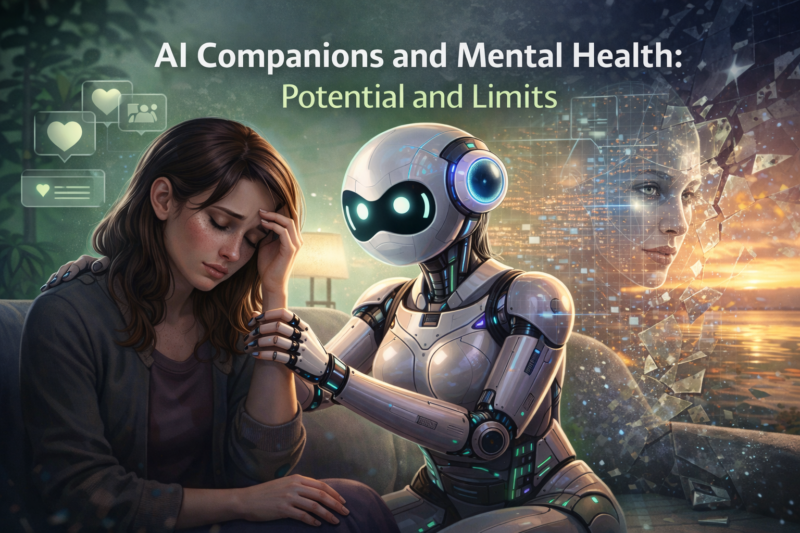
AI Companions and Mental Health: Potential and Limits
TLDR
- AI companions are increasingly used for emotional support, mood tracking, and conversational coping tools.
- Research shows measurable short-term benefits in engagement, stress reduction, and accessibility to support.
- These systems are not licensed therapists and cannot diagnose or replace professional care.
- Key concerns include accuracy, crisis handling, data privacy, and overreliance.
- The strongest use case is as a supplement to human mental health services, not a substitute.
Mental health support has always been limited by time, cost, geography, and stigma. Not everyone can access a therapist quickly. Not everyone feels comfortable speaking openly in a clinical setting.
AI companions have entered this gap.
Over the past few years, conversational agents designed for emotional support have moved from experimental prototypes to widely used consumer tools. Some are text-based. Others include voice interaction. A smaller number are embodied as social robots.
The interest is understandable. If you can talk to a system at any hour, without judgment, the barrier to opening up feels lower.
But we need to separate what these systems can realistically do from what marketing sometimes implies.
What AI Companions Actually Provide
Most AI mental health companions rely on large language models combined with structured therapeutic frameworks.
Some systems are designed to incorporate elements of cognitive behavioral therapy. They guide users through reframing exercises, journaling prompts, or structured reflection. Others focus on mood tracking and daily check-ins.
A few have been evaluated in peer-reviewed research settings. Studies have reported reductions in self-reported symptoms of anxiety and depression over short intervention periods, particularly when tools are used consistently.
It is important to be precise here. These results are typically modest and measured over weeks, not years. They demonstrate potential support, not comprehensive treatment.
Accessibility and Immediate Availability
One clear strength is availability.
AI companions are accessible around the clock. There is no scheduling delay. For people in rural areas or on waiting lists for therapy, this matters.
Cost can also be lower compared to traditional therapy sessions. Some platforms offer free tiers or subscription models that are less expensive than weekly appointments with licensed clinicians.
If you are experiencing mild stress, loneliness, or temporary overwhelm, immediate conversational access can feel stabilizing. The system responds instantly. That immediacy alone has value.
Engagement and Reduced Stigma
Another documented benefit is reduced stigma.
Research in digital mental health suggests that individuals who hesitate to seek in-person therapy may feel more comfortable interacting with a nonhuman agent. The absence of perceived judgment can lower the threshold for disclosure.
Users often report feeling freer to express thoughts they might withhold in face-to-face conversations.
That does not mean the system understands in a human sense. It means the interaction environment feels psychologically safer for some individuals.
Emotional Simulation and Its Limits
Here is where boundaries become critical.
AI companions simulate empathy through pattern recognition and language generation. They produce responses that align with supportive communication styles. They can validate feelings and suggest coping strategies.
However, they do not possess emotional awareness or lived experience. They do not independently assess risk in the way a trained clinician can.
In controlled studies, conversational agents can follow predefined crisis protocols. But real-world unpredictability remains a challenge. Misinterpretation of user intent or ambiguous language can occur.
That limitation is structural. It stems from how these systems operate.
Crisis Management and Safety Protocols
Many AI mental health platforms include crisis detection features.
If a user expresses suicidal ideation or severe distress, the system may provide hotline information or encourage contacting emergency services. Some systems are designed to escalate or redirect conversations in high-risk situations.
However, independent research has shown variability in how consistently conversational agents detect and respond to crisis language. Performance depends heavily on training data, system updates, and prompt structure.
This is why regulators and professional organizations emphasize that AI tools should not be marketed as replacements for crisis care.
If you are dealing with acute risk, human intervention remains essential.
Data Privacy and Sensitive Information
Mental health conversations involve highly personal content.
AI companion platforms often store conversation logs to improve personalization or maintain continuity. This raises legitimate concerns about data security and secondary use.
In many jurisdictions, digital mental health tools must comply with data protection laws. However, not all AI companion apps qualify as regulated healthcare providers. That distinction affects how data is handled.
If you are considering using one of these systems, reviewing privacy policies and data retention practices is not optional. It is part of informed use.
Overreliance and Substitution Effects
There is ongoing debate about whether AI companions might reduce motivation to seek human support.
At present, research does not conclusively demonstrate widespread substitution of therapy with AI companions. Many users treat them as supplementary tools rather than replacements.
Still, the risk of overreliance exists at the individual level. If someone withdraws from real-world relationships and relies exclusively on a conversational agent for emotional processing, social isolation could deepen.
Technology design influences this dynamic. Systems that encourage offline action and real-world connection tend to align better with healthy use patterns.
Embodied AI and Social Robots in Mental Health
Beyond smartphone apps, embodied social robots are also being studied in mental health contexts.
In elder care facilities, robotic companions have been associated with reduced loneliness and increased social engagement. In pediatric settings, small humanoid robots have been used to facilitate emotional expression exercises.
The physical presence of a robot can amplify engagement. Human beings are wired to respond to embodied agents.
However, the same limits apply. The robot does not understand suffering. It follows programmed interaction patterns.
The benefit lies in structured engagement, not emotional reciprocity.
Clinical Integration and Professional Oversight
Some mental health professionals are beginning to explore hybrid models.
In these models, AI tools are used between therapy sessions to reinforce coping exercises or track mood patterns. Data generated by the system can sometimes inform clinical discussions.
This integrated approach appears promising because it preserves professional oversight. The AI system acts as an adjunct tool rather than a standalone provider.
Regulatory bodies are increasingly evaluating digital mental health technologies under medical device frameworks when therapeutic claims are made. Oversight is tightening, which is a positive development for quality control.
My Perspective From Watching This Evolve
Over the past few years, I have tested several AI companion platforms out of professional curiosity.
What stands out is not artificial brilliance. It is consistency. The system does not get tired. It does not rush you. It always responds.
For someone feeling isolated at 2 a.m., that steady presence can feel meaningful.
At the same time, the conversations lack depth when complexity increases. Subtle emotional nuance sometimes slips through the cracks. You can sense the boundary.
That boundary is not a flaw. It is simply the current state of the technology.
The Realistic Use Case
If you approach AI companions as structured self-help tools, their value becomes clearer.
They can prompt reflection. They can reinforce coping strategies. They can provide immediate conversational space. They can track mood trends over time.
They cannot diagnose psychiatric conditions. They cannot provide psychotherapy in the clinical sense. They cannot assume legal or ethical responsibility for your wellbeing.
The healthiest framing is augmentation, not replacement.
Conclusion
AI companions and mental health intersect in a space filled with both promise and caution.
Evidence shows that conversational agents can improve engagement, reduce mild symptoms, and increase access to support. They lower barriers and provide immediate interaction.
But they operate through simulation, not understanding. Crisis management, diagnostic assessment, and deep therapeutic work remain firmly within the domain of trained professionals.
If you use these systems with clarity about their limits, they can become useful tools in a broader mental health strategy.
The future of AI companionship may indeed have a body, a voice, and a comforting tone. What it does not have is consciousness. Keeping that distinction in view allows you to benefit from the technology without overestimating it.