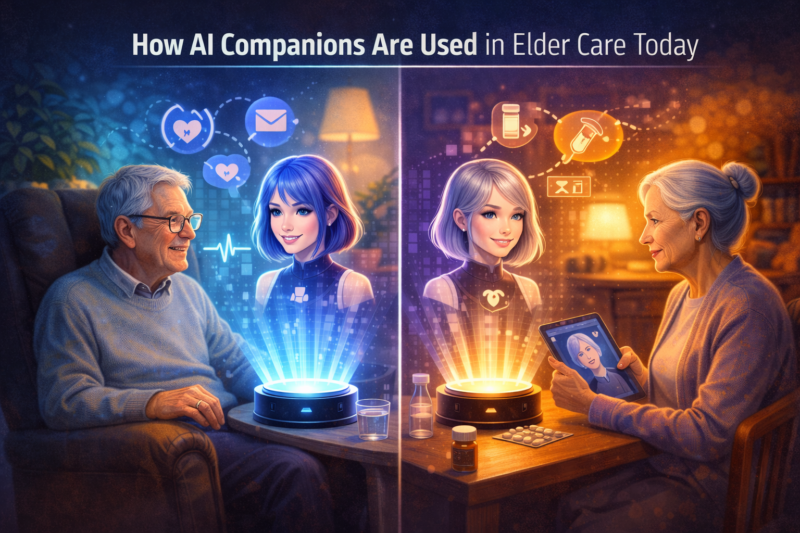
How AI Companions Are Used in Elder Care Today
TLDR
- AI companions are increasingly used in elder care to reduce loneliness and support daily emotional well-being.
- Companion systems help with reminders, light conversation, cognitive stimulation, and routine guidance.
- Current elder-care AI tools focus on assistance and engagement rather than medical diagnosis or replacement of human caregivers.
- Privacy, safety, and ethical design remain central concerns when deploying companion technology for seniors.
- Real-world adoption is growing in assisted living facilities and home care environments.
If you spend time around elder care communities today, you may notice something quietly changing.
Alongside nurses, family visitors, and caregivers, you might see small conversational devices or friendly robotic companions sitting on bedside tables or moving slowly through common rooms. They don’t replace human care, but they add another layer of interaction that can make daily life feel less isolated.
Loneliness among older adults is a serious global concern, and technology designers are trying to respond in practical ways. AI companions are becoming tools that support emotional engagement, simple cognitive assistance, and routine reminders.
The goal is not to turn care into something mechanical. Instead, it is to help seniors stay connected, oriented, and socially stimulated.
Let’s look at how these systems are actually used in elder care settings today.
Reducing Loneliness and Supporting Emotional Well-Being
One of the biggest uses of AI companions in elder care is combating social isolation.
Many older adults live alone or spend long periods without conversation partners. Conversational companions can provide simple dialogue interaction, allowing seniors to talk about hobbies, memories, or daily events.
These systems are not conscious listeners, but they are designed to maintain conversational flow and respond politely and consistently.
In assisted living environments, staff sometimes observe that residents engage more frequently in social spaces when conversational devices are available.
From a psychological perspective, predictable and nonjudgmental interaction can provide comfort, especially for individuals who feel hesitant initiating conversation with strangers.
In my own observations of care technology demonstrations, I’ve noticed that seniors often treat these AI companions like friendly assistants rather than thinking of them as machines.
That kind of acceptance is actually an important design success.
Memory Support and Routine Assistance
Another practical application is helping seniors remember daily tasks.
AI companions can provide reminders for medication schedules, hydration, appointments, and meal times. Memory support is particularly helpful for individuals experiencing mild cognitive decline.
These systems do not replace medical supervision, but they can act as supplementary cognitive aids.
Some platforms allow family members or caregivers to update reminder schedules remotely, creating a small but useful communication bridge.
The technology works by combining calendar management algorithms with conversational prompts.
Instead of sounding like a strict alarm, the companion may remind the user gently, using natural language phrasing.
Cognitive Stimulation and Mental Engagement
Keeping the mind active is important for aging populations.
Many elder care AI companions offer simple games, trivia questions, storytelling features, or music recommendation functions.
Cognitive stimulation activities are associated with maintaining mental agility in older adults.
The interaction is usually designed to be low pressure.
For example, a companion might ask about favorite historical periods, childhood memories, or music preferences.
This type of interaction supports recall exercises and social reminiscence, which research suggests can improve mood in some elderly populations.
Voice Interaction and Accessibility
Voice technology plays a major role in elder care companion systems.
Older users may find touchscreens difficult due to mobility limitations or vision changes.
Voice commands allow hands-free interaction.
Modern systems use speech recognition models that can handle variations in pronunciation, speaking speed, and mild background noise.
This is important because real elder care environments are rarely quiet.
The best systems are trained to understand natural, conversational speech rather than requiring rigid command structures.
Safety Monitoring Without Being Intrusive
Some AI companions include passive safety monitoring features.
These may detect unusual activity patterns such as prolonged inactivity, abnormal movement, or missed routine interactions.
If risk signals appear, the system can notify caregivers or family contacts.
However, ethical design is crucial here.
Developers must balance safety monitoring with privacy protection.
Most modern implementations avoid continuous video surveillance unless explicitly authorized.
The focus is on supportive awareness rather than control.
Social Presence Without Replacing Human Care
One important principle in elder care technology is that AI companions should supplement, not replace, human caregivers.
Human contact remains essential for emotional health, medical supervision, and social connection.
AI companions are best viewed as supportive interaction partners rather than primary care providers.
Healthcare organizations are careful about this distinction because overreliance on automated systems could reduce human social contact, which is critical for long-term well-being.
Ethical Design and User Consent
Elder care technology must respect dignity, autonomy, and informed consent.
Seniors should understand that they are interacting with software, not a conscious being.
Transparency helps prevent emotional manipulation or confusion.
Developers are also working on systems that allow users to control how much personal data is stored or processed.
Security standards are particularly important because elder care data can be sensitive.
Physical Companion Robots in Care Facilities
Some elder care environments deploy physical companion robots.
These robots may provide simple movement interaction, deliver reminders, or offer conversational engagement.
Mobility assistance and object transportation are still limited in many models, so most robots focus on social interaction rather than physical caregiving tasks.
Sensors, computer vision, and navigation algorithms are improving, but safe operation in unpredictable human environments remains a technical challenge.
My Perspective on Elder Care Companions
Watching seniors interact with conversational companions has been interesting.
What stands out is not that people believe the machines are alive.
It is that they treat the interaction as a friendly presence.
Many residents enjoy having something that listens patiently and responds politely without pressure.
In elder care settings where staff time is limited, even small conversational engagement can make a difference in daily mood.
That said, I have also seen situations where family visits are still the most emotionally meaningful events of the day.
Technology works best when it supports, not substitutes, human relationships.
Current Limitations
Despite progress, AI companions in elder care are not medical devices.
They cannot diagnose disease, manage complex medical decisions, or provide emotional therapy.
Language understanding can still fail in ambiguous or culturally specific conversation.
Hardware durability, battery life, and environmental robustness are ongoing engineering concerns.
Conclusion
AI companions are gradually becoming helpful tools in elder care environments.
They support emotional engagement, routine reminders, cognitive stimulation, and basic safety awareness.
The technology is not meant to replace human caregivers but to extend the quality of daily life for older adults.
As companion robotics continues evolving, the central design challenge will remain the same.
How can technology provide useful assistance while preserving human dignity, privacy, and social connection?
If developers succeed in balancing these goals, AI companions may become quiet but meaningful helpers in the lives of aging populations.