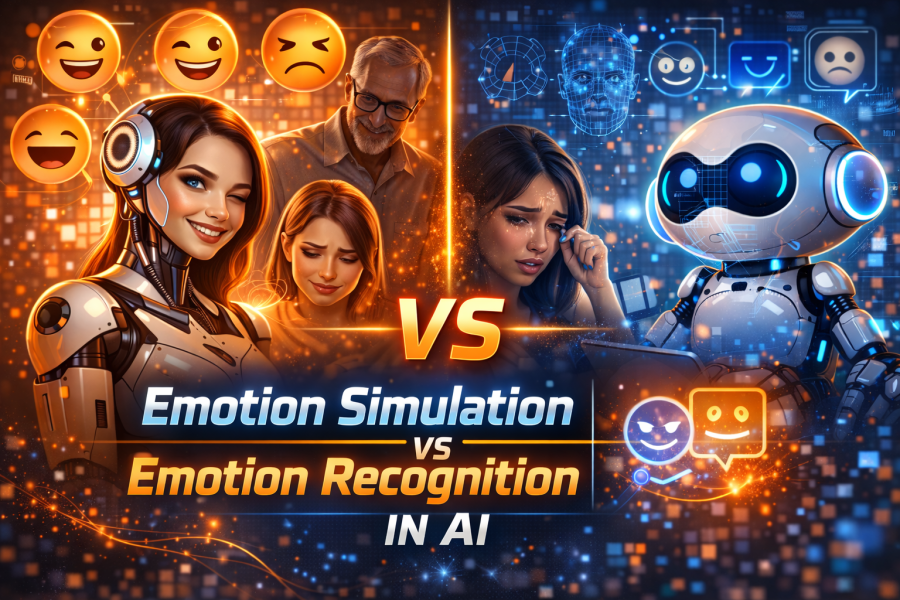
Emotion Simulation vs Emotion Recognition in AI
TLDR
- Emotion simulation focuses on generating humanlike emotional responses in conversation.
- Emotion recognition focuses on detecting human emotional states from data signals.
- Simulation helps interaction feel natural, while recognition helps systems interpret users.
- Modern AI companions combine both techniques to improve dialogue quality.
- Neither simulation nor recognition means machines actually feel emotions.
When you talk to a conversational AI, something interesting happens.
You might feel that the system understands you, even though you know it is not conscious. That feeling comes from two different technologies working together: emotion simulation and emotion recognition.
These two ideas are often confused. One tries to express emotion-like behavior. The other tries to detect emotional signals from humans.
Understanding the difference helps you see how modern interactive systems are built and why they feel surprisingly social.
Let’s break it down in a simple way, the way you might explain it to a friend over coffee.
What Emotion Simulation Really Means
Emotion simulation is about generating responses that resemble emotional communication.
When an AI companion responds with warmth, encouragement, or empathy-like language, it is using simulation techniques.
The system does not experience emotion. Instead, it follows patterns learned from large datasets of human conversation.
For example, if you express frustration, the system may respond with supportive phrasing. If you share good news, it may respond positively.
This design helps conversation feel smoother and more socially natural.
In companion technology, this is important because people tend to prefer interaction that feels conversational rather than mechanical.
You have probably noticed this if you have chatted with modern digital assistants. The difference between a blunt answer and a friendly reply can change how comfortable you feel during interaction.
How Emotion Recognition Works
Emotion recognition is about understanding human emotional signals.
Systems use machine learning models to analyze text, voice tone, facial expression, or behavioral patterns.
In text analysis, algorithms examine word choice, punctuation, and conversational style to estimate emotional state.
In voice-based systems, features such as pitch variation, speech speed, and acoustic energy are analyzed.
Some research shows that multimodal emotion recognition, combining voice, facial expression, and context, improves accuracy compared to single-channel analysis.
These systems are commonly used in customer service automation, mental health support tools, and human-robot interaction environments.
But you should remember one important point.
Recognition does not mean understanding in a human sense. It is statistical pattern matching.
Why Simulation and Recognition Are Different
Think of emotion simulation as the output side of interaction.
The system tries to behave in a way that feels socially appropriate.
Emotion recognition is the input side.
The system tries to interpret how you feel.
If you imagine conversation like a feedback loop, recognition observes, while simulation responds.
Modern conversational platforms often combine both.
For example, if you sound upset, the system may detect emotional signals and generate a more supportive reply.
This combination is one reason AI companions feel more socially capable today than earlier chatbots.
The Role of Machine Learning Models
Large language models are central to emotion simulation.
These models are trained on massive collections of human text.
During training, they learn statistical relationships between emotional language patterns and response styles.
The model does not store emotional experiences.
Instead, it predicts likely conversational responses based on probability distributions.
That is why responses can sometimes feel surprisingly human.
It is also why sometimes responses may be slightly off or overly polite.
The system is guessing based on patterns.
Human Psychology Plays a Huge Role
You are not imagining it if you feel emotionally engaged with a conversational system.
Human brains are wired to interpret social signals.
When something responds quickly, uses your name, or mirrors emotional tone, your brain may treat it as a social interaction.
This is called anthropomorphic response tendency.
It is a natural cognitive behavior, not a technology flaw.
People have shown similar responses to simple interactive objects, even before modern AI existed.
Applications in Companion Technology
Emotion simulation and recognition are important in several real world applications.
In customer service, they help reduce frustration during automated support conversations.
In eldercare robotics, they help create more comfortable interaction environments.
In educational tools, they help maintain student engagement.
In conversational companion platforms, they help users feel socially supported.
From a design perspective, the goal is not to replace human relationships but to provide supplementary interaction.
Limitations You Should Know
Current technology cannot truly experience emotion.
AI systems do not have subjective awareness, personal desire, or consciousness.
Emotion simulation is behavioral, not experiential.
Emotion recognition is probabilistic, not perfect.
Factors like cultural differences, sarcasm, or unusual speech patterns can reduce accuracy.
Developers are still working to improve robustness and fairness in these systems.
My Personal Observation
What fascinates me most is how quickly people adapt to conversational machines.
I have seen users treat chat companions like helpful coworkers, sometimes even thanking them after receiving information.
It reminds me that humans are naturally social creatures.
If something responds politely and consistently, we tend to treat it as socially meaningful, even if we intellectually know it is software.
That says more about human psychology than about machine intelligence.
Conclusion
Emotion simulation and emotion recognition represent two sides of modern interactive AI design.
Simulation focuses on how machines express responses that feel emotionally appropriate.
Recognition focuses on how machines interpret human emotional signals.
Neither technique gives machines real emotional experience.
But together, they help create interaction that feels more natural, supportive, and socially intuitive.
As companion technology continues to develop, these systems will likely become more sophisticated in balancing responsiveness, safety, and user comfort.
The future of human-machine interaction is not about machines feeling emotions.
It is about machines communicating in ways that respect how humans feel.
Blog
-
Social Acceptance of AI Companions: Where Society Is Headed
Public attitudes toward AI companions are shifting as conversational systems and social robots become more common in daily life.
-
Can AI Companions Reduce Loneliness Long-Term?
AI companions have demonstrated real potential to reduce feelings of loneliness in the short term.
