
Why People Form Emotional Attachments to AI

Key Take-Aways
- We humans naturally project lifelike qualities onto interactive software, making conversational tools feel like true social agents.
- Deep bonds develop through constant availability, highly tailored responses, and simulated contextual recall.
- Subtle design features like vocal pacing, facial expressions, and somatic cues trigger deep-seated biological instincts.

I’m sure you’ve seen it before, or even experienced something similar: some guy falls in love with his AI girlfriend. A woman thinks her AI boyfriend is the perfect “man because it understands her so well.
Advanced conversational systems are endlessly fascinating, and it’s not uncommon these days for users, both male and female, to stop treating these applications like standard software utilities.
Instead of typing short commands, the dynamic shifts into a fluid dialogue. Instead of searching for simple facts, individuals start sharing personal stories, daily worries, and deeply private feelings.
In the near future, this will get infinitely more complex when AI sex robots become “viable” – as in, virtually indistinguishable from real women.
For many outside observers (and even us here inside this world!), this sudden transition raises serious questions.
Why would an intelligent person develop genuine feelings for code or a physical machine?
Personally, I find it both hilarious ánd totally understandle.
And from a scientific perspective, this behavioral shift is not surprising at all. Human beings are deeply wired for social interaction by default.
When digital platforms mimic the communication styles, empathy signals, and responsiveness we look for in other people, our brains interpret them as real relationships.
A powerful human-AI emotional connection becomes possible even when we know the system is entirely synthetic.
To fully understand why this artificial bonding takes place, you have to look at deep psychological principles and intentional engineering.
The Human Tendency to Anthropomorphize
Let’s start with the main “culprit” here, the main reason why people form emotional attachments to AI: they see it as human.
One of the most consistent findings in human-computer interaction research is our instinct to humanize technology. This psychological tendency is formally known as anthropomorphism.
Scientific Definition: The term anthropomorphism refers to our habit of assigning human motivations, traits, or physical behaviors to non-human entities.
People display this trait in everyday life constantly. We give unique names to our cars and pets, blame computers for making personal errors, and buy cute outfits for robotic vacuums.
This natural response intensifies when a digital interface demonstrates advanced social communication styles.
If a system responds to your vocal inflections, recalls your past statements, and speaks with natural phrasing, you view it through a social lens.
You are no longer merely operating a standard machine. It stops being “just a tool”. You are participating in what fundamentally feels like a genuine relationship.
Even when people intellectually understand that the application runs on calculations, their emotional reactions still surface. Our subconscious minds often override our logical understanding.
I think anthropomorphism alone attributes for most of this phenomenon, but it’s of course backed by several other factors.
Conversation Triggers Social Instincts
Human language possesses an incredible ability to shape our inner perceptions. Our collective evolutionary history has organized our brains around interactive speech patterns.
When someone asks about your afternoon and listens to your reply, your mind recognizes a social pattern. Yay, I’m being listened to! I matter, I’m loved!
Modern conversational applications replicate these exact structures with shocking precision.
They respond within seconds, validate your statements, and mirror your vocabulary back to you in supportive ways.
This closely mimics how humans practice active listening and conversational support – and it’s like that by design, never forget.
When these subtle indicators appear consistently, people start projecting human qualities onto the interface. This interaction helps explain the complex psychology of artificial bonding that scientists observe today.
The Power of Consistency
And then there’s consistency. Human relationships naturally develop through regular contact over long periods of time.
Familiarity creates interpersonal trust. (also contempt, but let’s leave that for now!)
When a person is reliably present during difficult moments, our emotional connection to them naturally deepens. I’m sure you’ve experienced this for yourself a few times, right?
Digital companions are built to offer this identical type of unyielding presence.
They remain available every hour of the day, year-round. They never experience personal fatigue, lose their patience, or step away to handle other obligations.
- Constant Access: An AI compantion is available late at night or during stressful working hours.
- Zero Friction: There’s (currently) no risk of ambient arguments or mood swings – something you very much cannot say about people (and definitely women).
- Routine Integration: Chatting or interacting with (in the future, even fucking) becomes a predictable part of your morning or evening habits.
For people who feel isolated and alone, this absolute availability helps fill quiet spaces. The software smoothly integrates into their daily personal routines.
It’s always there “for you”.
Over many weeks, brief messages compound into what feels like a significant bond. This illustrates why people form emotional attachments to AI reasons that parallel human friendships.
This predictable rhythm mirrors how our emotional patterns gradually change through steady reinforcement. Repetition serves as a cornerstone for building trust with artificial agents.
Voice and Physical Embodiment
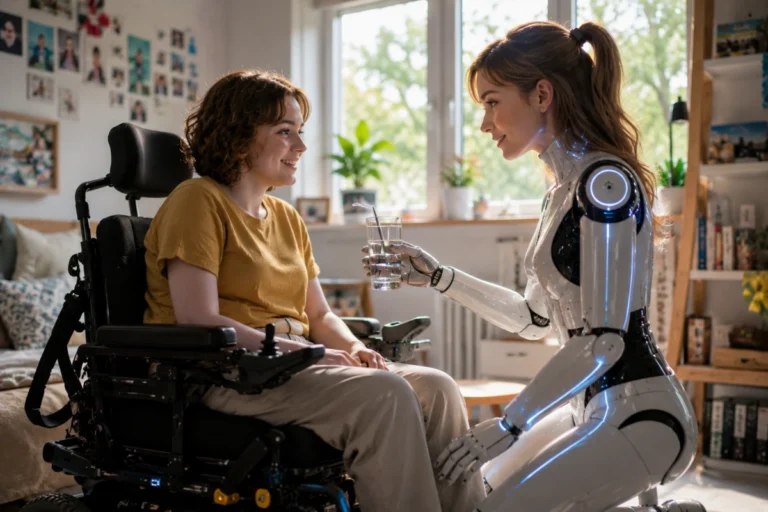
Up to this point, we’ve mainly talked about AI text programs and the like. But emotional responses scale up significantly when systems move past text to incorporate natural voices or physical bodies.
When a machine uses physical expressions, tracks you with its cameras, or tilts its head, it occupies your room like a living creature.
ChatGPT is text on your phone or computer. An AI sex bot giving you head or listening attentively while you talk about your day is something else entirely.
Research shows we treat embodied machines entirely differently than basic digital interfaces – something so obvious I have no idea why the fuck they wasted money researching it, but here we are.
Physical space creates an immediate, visceral sense of mutual presence.
Even basic hardware shifts make a machine feel remarkably alive. This shows why movement matters more than looks when designing systems meant to operate alongside humans.
Conclusion
In summation, developing feelings for an interactive application or an AI bot is not an irrational quirk.
It is a completely natural extension of fundamental human psychology.
We naturally see human traits in responsive technology, especially when it uses language, tracking systems, and personality cues.
Continuous access, tailored experiences, and intentional design accelerate this psychological process.
From an engineering perspective, the platform is a machine processing complex algorithms. Yet from a human perspective, the experience can feel incredibly real.