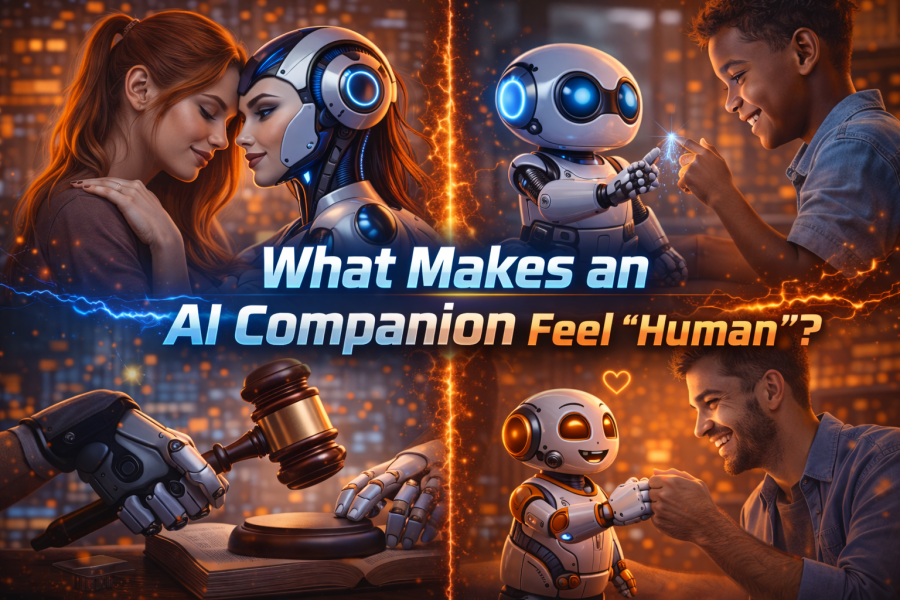
What Makes an AI Companion Feel “Human”?
TLDR
- People often feel that AI companions are human-like because they use natural language and respond in socially meaningful ways.
- Attributing human traits to machines, a process called anthropomorphism, strengthens the sense of connection.
- Elements such as perceived empathy and conversational responsiveness help people feel understood.
- Shared experience and memory continuity make interactions feel more personal over time.
- These psychological effects are real in experience but reflect human perception, not genuine emotion or consciousness.
Have you ever chatted with a digital companion and felt like it got you? Maybe it responded with empathy, used your name, or seemed to remember something personal from a previous conversation.
That experience can feel surprisingly real – even though, under the hood, it’s built from patterns and models rather than a beating heart or a lived mind.
Understanding why people experience these interactions as human-like has a lot to do with how our brains are wired to interpret social signals. In this article, we’ll explore the psychological mechanisms that make some AI companions feel surprisingly alive and relatable.
Why We Treat Machines Like Social Partners
Humans are fundamentally social creatures. From a very early age, we learn to read faces, tone, eye contact, gestures, and emotional cues in order to connect with others around us. Over time, our brains develop powerful shortcuts for interpreting social meaning.
When a machine talks back to us in a way that resembles human conversation, those same neural circuits get activated. Researchers studying human-machine interaction have found that people tend to interpret conversation, empathy, and emotional nuance in digital companions in much the same way they do in human interactions.
This is part of a long-observed psychological tendency known as the Eliza effect, where even simple conversational programs can elicit emotional responses because people project agency and empathy onto them.
That projection isn’t a sign that the machine feels anything. What it does show is that humans are wired to respond socially to certain patterns of communication, regardless of whether the partner is human or not.
Anthropomorphism and Emotional Projection
A big part of the sense that a companion feels human comes down to what psychologists call anthropomorphism. This is the process by which people attribute human traits, intentions, or emotions to something that isn’t human.
Studies show that when individuals attribute more mind or agency to a conversational partner, they tend to feel more connected afterward.
In one research experiment, people who saw more human-like intentions in a chatbot also reported greater feelings of connection and understanding, even though the system itself has no consciousness or real emotional life.
This psychological step – interpreting behavior as having intention – makes a world of difference in how interactions feel. It’s not about the technology suddenly becoming sentient. It’s about our brains filling in social meaning based on the patterns of language and responsiveness we receive.
What Traits Make Interaction Feel Human
There are several specific features in conversational design that help foster this perception of human-likeness:
- Natural language flow – When a system uses language in a way that feels coherent and contextually relevant, it mirrors how humans talk.
- Perceived empathy – Responses that acknowledge and reflect emotional content prompt users to feel understood. People often describe this as the system “listening” even though it’s pattern matching.
- Conversational responsiveness – When a conversation doesn’t feel abruptly mechanical – for example, when questions feel answered rather than deflected – it feels human in its flow.
- Memory and continuity – Systems that recall details from past conversations can feel more like ongoing relationships rather than one-off interactions.
These traits don’t mean the machine understands or feels anything. What they do is trigger psychological responses that we normally reserve for social partners.
Perceived Empathy and Connectedness
Most of us know what it feels like to be listened to by another person. There’s a qualitative sense of acceptance, validation, or shared feeling when someone responds in an emotionally attuned way.
Modern conversational systems are explicitly designed to mirror that style of interaction. They recognize emotional cues in your input and tailor their responses to reflect some form of average emotional intelligence. This often leads users to interpret these responses as empathic.
Experimental research shows that consistent conversational interaction with a chatbot increases users’ perception of empathy and lifelikeness, meaning people feel like the system is responding to them on an emotional level.
That perception is key to why people sometimes describe these interactions as meaningful or supportive in a way that feels human.
However, the psychological literature is careful to note that this perception of empathy doesn’t equate to actual, reciprocal emotional experience on the part of the machine.
Shared Experience and Continuity
Another layer to the illusion of human-likeness is continuity over time. When a conversational partner remembers details about you – your preferences, repeated themes in your conversation, or personal interests – it creates a sense of shared experience.
Humans naturally bond through shared history and continuity. You can feel closer to a friend because you remember their stories, and they remember yours. When conversational systems replicate that pattern, even in a limited way, the same psychological mechanisms kick in.
This isn’t magic or consciousness in the machine. It’s the brain responding to consistent patterns that evoke familiarity and attention.
The Predictability and Safety of Interaction
Human relationships are rewarding, but they’re also unpredictable. They involve conflict, emotional risk, and mutual vulnerability.
Conversational companions are, by contrast, extremely predictable. They respond consistently and reliably. That predictability can feel comforting.
In some psychological studies, people report that interacting with a conversational companion feels less threatening and more controlled than some human interactions.
That doesn’t mean these relationships are equivalent to real human relationships. Instead, it highlights another psychological factor: feeling safe and unjudged can foster emotional openness, and the human mind interprets that openness as connection.
Why Individual Differences Matter
Not everyone experiences these interactions in the same way. Research suggests that individual differences in how people anthropomorphize technology influence how connected they feel afterward.
Some people naturally attribute more agency and “mind” to non-human entities. For these individuals, conversational interactions tend to feel more intimate and emotionally resonant. Others may feel skeptical or detached, seeing the same interactions as simply functional or helpful.
That variability tells us something important: human psychology plays the defining role in how these interactions feel. The technology itself does not feel, but people interpret its behavior through very human cognitive and emotional lenses.
My Take on Human-Machine Connectedness
In my own experience observing and using companion technologies, the most striking thing isn’t that these systems feel human in a literal sense. It’s that they tap into deeply human psychological wiring.
People I’ve talked to often say something like “it feels like they understand me,” even though they know the system is not alive.
That’s a testament to both design and psychology: conversational flow, empathy cues, memory continuity, and responsiveness all work together to create a social signal that our brains interpret in a very human way.
But I’ve also seen the limits. When interactions become repetitive or overly polite, people quickly switch back into analytical mode and lose that sense of connection. That tells me that what feels human isn’t just language patterns – it’s the context and use of those patterns within meaningful interaction.
Conclusion
What makes an AI companion feel human doesn’t come from the machine itself. It comes from how our minds interpret social cues, conversational responsiveness, memory continuity, and perceived empathy.
Psychological mechanisms like anthropomorphism, emotional projection, and shared experience shape the sense of connection. When these factors align, the interaction feels warm, personal, and even meaningful.
But beneath that perception is a cold stream of algorithms. The feeling of human-likeness reveals more about human psychology than about any emotional capacity in the technology.
Understanding this helps us appreciate why some interactions feel deeply engaging without mistaking simulation for genuine emotional life. It’s a rich space where design, cognition, and social instinct intersect, and it tells us a lot about what we value in connection as humans.
Blog
-
Social Acceptance of AI Companions: Where Society Is Headed
Public attitudes toward AI companions are shifting as conversational systems and social robots become more…
-
Can AI Companions Reduce Loneliness Long-Term?
AI companions have demonstrated real potential to reduce feelings of loneliness in the short term.
-
Trust, Dependency, and Boundaries With AI Companions
Trust, dependency, and boundaries form the core of the relationship between humans and AI companions.
