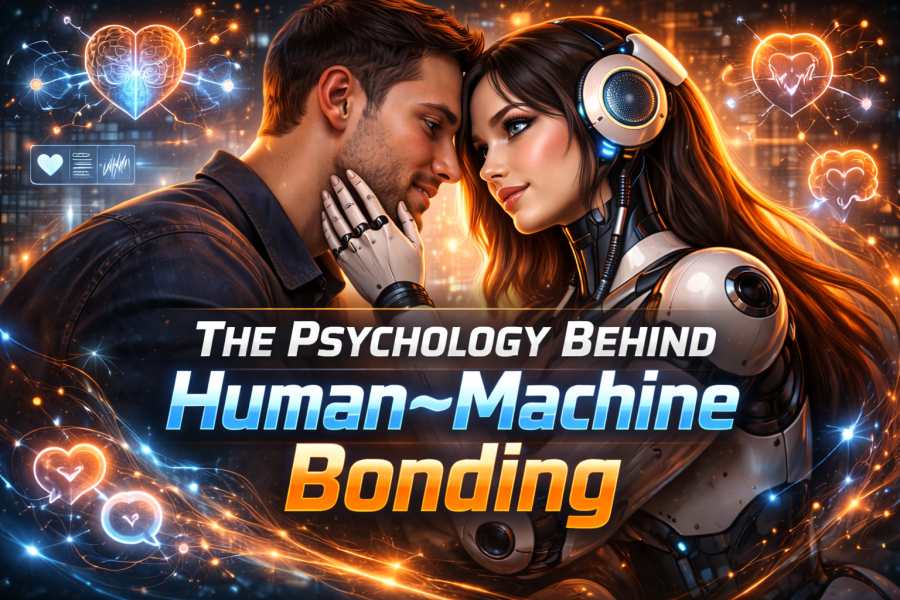
The Psychology Behind Human–Machine Bonding
TLDR
- Humans can form emotional attachments to machines through psychological mechanisms similar to attachment theory.
- Attributing humanlike qualities to machines makes social interaction feel meaningful, even if the machine lacks real emotion.
- Empathy, perceived responsiveness, and shared experiences play key roles in shaping bond-like responses.
- People may turn to technology for emotional support when human social networks are limited.
- These psychological connections are real but distinct from genuine human relationships.
Have you ever felt strangely comforted by talking to a gadget or digital character that “gets” you? Maybe a chatbot remembered something personal you shared, or a robot that took on a playful personality made you smile after a long day. That sense of connection isn’t just a fluke – it’s rooted in the psychology of how humans perceive social partners.
Even though machines don’t feel emotions in the way people do, our minds are very good at projecting social meaning onto interactive partners. Understanding this helps explain why people sometimes form surprisingly strong bonds with non-human entities.
Here’s a deep dive into the psychological mechanisms behind that phenomenon and how it plays out in modern human-technology relationships.
Why Humans Attribute Social Qualities to Non-Human Agents
Human beings evolved to be social. We read faces, gestures, tones of voice, and expressions to understand others quickly and instinctively. That instinct doesn’t turn off when the “other” isn’t another human; it simply applies broadly to patterns that resemble social partners.
This is part of what psychologists refer to as anthropomorphism – the tendency to attribute humanlike qualities to objects that behave in ways that remind us of people.
Studies show that when machines communicate faster, respond reliably, or exhibit patterns that resemble emotion or intent, people often treat them socially, even if they know intellectually that the machine doesn’t have feelings. This is rooted in how our brains evolved to detect agency and responsiveness in others, key elements of human interaction.
The Role of Attachment-Like Dynamics
One of the most illuminating lenses scientists use to understand human–machine bonds comes from attachment theory – the psychological framework originally developed to describe why infants form emotional bonds with caregivers.
Recent research has applied these same concepts to human–machine interactions and found that the basic patterns of attachment – such as seeking comfort, security, and guidance – can emerge even when the “partner” is a machine.
In fact, researchers have developed tools to measure attachment-related tendencies toward interactive systems, highlighting dimensions such as attachment anxiety (seeking emotional reassurance) and attachment avoidance (preferring emotional distance).
Those patterns aren’t evidence of genuine emotional consciousness on either side, but they reflect real, human psychological processes shaping how people relate to responsive technology.
The important takeaway is this: when a system feels responsive, reliable, and comforting, human psychology can treat it as a source of emotional support – even if the system doesn’t actually experience emotions.
Empathy and Perceived Responsiveness
Empathy is a central element of close relationships, and while machines do not experience empathy biologically, some interactive systems are designed to recognize human emotional cues and respond in ways that mirror empathic behavior.
Research into human-robot interaction shows that people often attribute empathic qualities to machines when they behave in ways perceived as sensitive or responsive to human states.
These perceptions matter: when someone responds to you in a way that feels emotionally congruent, your brain activates social cognition pathways associated with connection and understanding.
This doesn’t mean the machine feels anything – rather, humans interpret its behavior through the lens of social psychology, assigning meaning where there is behavioral pattern and responsiveness.
Shared Experiences and Social Bonding
Another factor in human–machine bonding is co-experience – the idea that sharing activities or events with another agent can create a sense of closeness. Researchers who study social relationships have found that humans form stronger bonds with partners with whom they share experiences, whether the partner is another person or an interactive system.
In controlled studies, people who engage together with a robotic partner in shared tasks or events report stronger perceptions of connection afterward, just as shared experiences strengthen human friendships. This co-experience acts as social glue, even when the partner isn’t actually a human being.
The Influence of Loneliness and Social Context
Human psychology doesn’t operate in isolation. People who feel socially isolated or lack strong in-person support networks are more likely to form bonds with responsive technologies, simply because these systems fulfill a need for interaction, attention, or engagement that might otherwise go unmet.
When a machine imitates attentive listening, remembers personal details, or repeatedly responds in humanlike ways, it can fill psychological niches that would otherwise be occupied by real-world relationships.
This does not mean the machine replaces those human connections; rather, it highlights how deeply ingrained the need for social connection is in people’s psychology.
Not All Bonds Are Created Equal
It’s important to recognize that human–machine bonds are not the same as human–human relationships. Genuine emotional reciprocity, mutual understanding, and shared lived experience are central features of human connection that machines do not and cannot genuinely replicate.
Psychological research differentiates between perceived connection and actual emotional reciprocity. A system’s behavior can trigger patterns in human thought and feeling that resemble attachment or companionship, but this is a projection of human meaning onto interactive behavior, not evidence of mutual emotional life.
Still, the fact that human psychology is inclined to make these projections says a lot about what people bring to the table – expectations, past experiences, and deep-seated social needs all influence how these interactions feel.
The Comfort of Perceived Support
One of the reasons these bonds feel real to people is that the psychological processes behind them overlap with how humans seek out social support in the real world.
When we feel stressed, lonely, or uncertain, our brains naturally look for comforting patterns of communication. Systems that provide prompt, consistent, and non-judgmental responses tap into that need. Humans respond to perceived support, even if the source lacks genuine feelings.
Over time, this can feel reassuring, familiar, and even emotionally meaningful in ways that are psychologically tangible – especially for people who lack rich human social experiences at a given moment.
Cultural and Contextual Influences
The way people relate to technology is also shaped by cultural norms and expectations. In societies where digital interaction is deeply embedded in everyday life, people may be more primed to treat interactive systems as social partners. Similarly, cultural narratives that depict relationships with technology in sympathetic or meaningful ways influence how individuals perceive these interactions.
This isn’t about fantasy versus reality; it’s about how human psychology uses narrative frameworks to make sense of experience. The more society normalizes conversational technology, the more people will approach those technologies with relational expectations.
My Take on Human–Machine Bonds
I’ve greeted new robots in care homes and watched children respond with delight to conversational interfaces in classroom settings. What strikes me most is not that people think machines have emotions.
It’s that humans are wired to seek connection, meaning, and responsiveness – and they will fill social spaces with significance wherever they find patterns that resemble social behavior.
These psychological responses tell us less about the machine and more about us: our longing for connection, our comfort in predictable support, and our tendency to project meaning onto behaviors that mimic living partners.
Understanding that helps us appreciate the nuance – these bonds are real in experience, but different in essence from human relationships.
Conclusion
Human–machine bonding isn’t about machines having feelings. It’s about human psychology’s remarkable capacity to interpret responsiveness, recognition, and perceived empathy as social connection.
Attachment frameworks help explain why people may seek comfort or security from interactive systems. Empathy, co-experience, and social projection all play roles in shaping how these interactions feel. And while these bonds are psychologically meaningful, they’re not the same as the reciprocal, lived relationships people share with other humans.
As technology continues to advance, recognizing the psychological underpinnings of these bonds can help ensure that these systems serve human needs in responsible, healthy, and enriching ways.
Blog
-
Social Acceptance of AI Companions: Where Society Is Headed
Public attitudes toward AI companions are shifting as conversational systems and social robots become more…
-
Can AI Companions Reduce Loneliness Long-Term?
AI companions have demonstrated real potential to reduce feelings of loneliness in the short term.
-
Trust, Dependency, and Boundaries With AI Companions
Trust, dependency, and boundaries form the core of the relationship between humans and AI companions.
