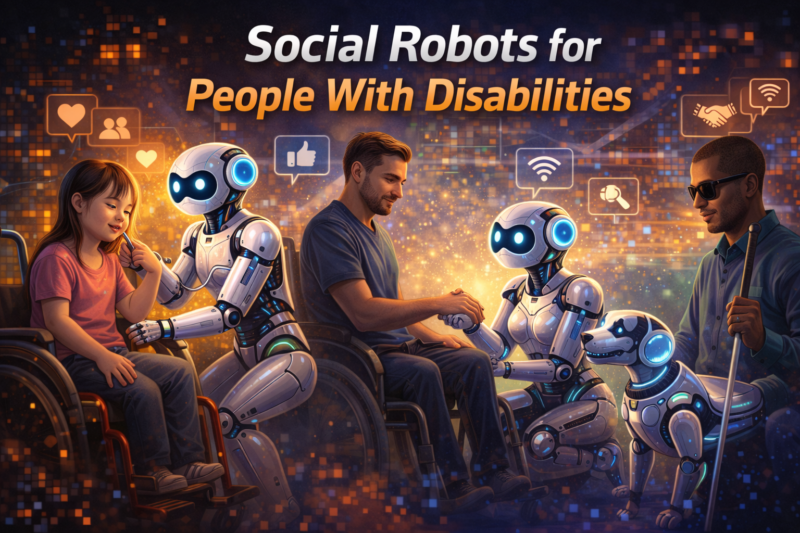
Social Robots for People With Disabilities
TLDR
- Social robots are being deployed in disability support for communication training, cognitive stimulation, and daily assistance.
- Evidence from recent clinical and field studies shows measurable benefits in engagement, social interaction, and therapy adherence in specific populations.
- These robots are tools, not replacements for caregivers, and work best when integrated into structured support programs.
- Key design factors include accessibility, adaptability, safety, and data privacy.
- Adoption is growing in education, rehabilitation, and assisted living environments, with careful attention to ethics and regulation.
Social robots are no longer confined to research labs or trade show demos. They are being tested and deployed in classrooms, therapy centers, rehabilitation clinics, and assisted living facilities.
For people with disabilities, these systems can serve as structured communication partners, therapy aids, and daily support tools. The conversation around them has matured. It is less about spectacle and more about measurable outcomes.
If you are evaluating this field, the key question is simple: what can social robots actually do today, and where are the boundaries?
Let’s look at the evidence and the engineering behind it.
What We Mean by Social Robots
A social robot (or “AI Companion”) is a physically embodied system designed to interact with humans using speech, gestures, facial expressions, or other social cues.
Unlike purely digital assistants, these robots have a physical presence. They may move their heads, track gaze, gesture with arms, or navigate short distances. Many incorporate speech recognition, speech synthesis, and computer vision.
In disability support contexts, common platforms include small humanoid robots used in autism therapy, robotic pets used in dementia care, and assistive robots designed for communication practice.
The physical embodiment matters. Research in human-robot interaction consistently shows that people respond differently to a physical agent compared to a voice-only interface.
Autism Spectrum Disorder and Social Skill Training
One of the most studied applications involves children with autism spectrum disorder.
Clinical and educational studies over the past decade have examined whether humanoid social robots can support social skills training. These robots are often used to model facial expressions, practice turn-taking, or guide structured interaction exercises.
Several peer-reviewed studies report increased engagement and improved eye contact during robot-assisted sessions compared to some traditional therapy formats. The predictability of robot behavior appears to reduce social anxiety for certain children.
It is important to be precise here. Robots do not replace therapists. They are used as tools within structured interventions led by trained professionals.
When integrated carefully, they can enhance participation and motivation.
Dementia and Cognitive Support
In elder care settings, robotic companion systems have been deployed to support individuals with dementia.
Robotic pets, for example, are designed to respond to touch and sound. Studies in care facilities have reported reductions in agitation and improvements in mood when residents interact with these devices.
There is also research into humanoid robots used for guided cognitive exercises, reminders, and structured activities. Some systems can prompt users to engage in memory tasks or simple physical exercises.
The evidence base here continues to grow. While results vary depending on context, many studies indicate that social robots can increase engagement and social interaction in dementia care environments.
Again, they function as supplements to human caregiving, not substitutes.
Physical Disabilities and Assistive Interaction
For individuals with physical disabilities, social robots can serve as accessible interfaces.
Voice-controlled humanoid or tabletop robots can provide reminders, answer questions, control connected home devices, or facilitate communication. For users with limited mobility, hands-free interaction is essential.
Some assistive robots are designed to work alongside augmentative and alternative communication systems. They may provide conversational scaffolding or interactive prompts to encourage speech practice.
The hardware design here is critical. Microphone sensitivity, speaker clarity, and interface simplicity directly affect usability. Accessibility features must be embedded at the system level, not added as an afterthought.
Rehabilitation and Therapy Motivation
In rehabilitation contexts, motivation is often a barrier.
Studies involving stroke recovery and motor rehabilitation have explored the use of social robots to guide exercises and provide feedback. The presence of a robot can increase adherence to repetitive training tasks.
This is not because the robot performs the therapy itself. It is because structured prompts, encouragement, and consistent pacing can improve compliance.
When patients perceive the interaction as engaging rather than clinical, participation tends to improve. That behavioral component is where social robotics contributes.
Design Considerations for Disability Contexts
Designing robots for people with disabilities requires careful attention to detail.
First, physical safety is non-negotiable. Devices must meet consumer electronics and medical device safety standards where applicable. Stability, material choice, and electrical protection are essential.
Second, adaptability matters. A robot used in autism therapy may need customizable facial expressions and adjustable speech pacing. A robot in dementia care may require simplified interaction modes.
Third, privacy cannot be ignored. Many social robots rely on cloud-based speech processing or data logging to improve interaction. When used in healthcare or educational settings, data protection regulations apply.
If you are deploying these systems, you need transparent data handling policies.
Limitations and Realistic Expectations
It is tempting to overstate what social robots can accomplish.
They do not possess empathy. They simulate responses based on programmed behavior and machine learning models. They cannot independently diagnose conditions or replace clinical judgment.
The benefits observed in research typically occur in structured environments with trained facilitators. Outcomes can vary widely depending on implementation quality.
As someone who has followed robotics development closely, I find that expectations often determine satisfaction. When viewed as assistive tools, social robots can be genuinely helpful. When viewed as autonomous caregivers, they disappoint.
Clarity matters.
Economic and Accessibility Factors
Cost remains a practical consideration.
Some research-grade humanoid robots are expensive, limiting widespread adoption. However, lower-cost robotic companion systems and pet-like devices are increasingly available to care facilities.
There is ongoing discussion about insurance coverage and reimbursement for technology-assisted therapy. Policies differ by country and healthcare system.
For families and institutions, evaluating cost against measurable benefit is essential. The strongest case for adoption comes from clearly defined therapeutic goals and documented improvements in engagement or participation.
Ethical Considerations
Ethical discussions in this space focus on dignity, autonomy, and transparency.
Users should understand that the robot is a machine. Deception about the nature of the system is widely considered inappropriate. Clear communication supports informed use.
There are also concerns about overreliance. If robotic interaction displaces meaningful human contact, that becomes problematic. Most current best practices emphasize integration rather than replacement.
The ethical consensus emerging in professional guidelines is straightforward: social robots should enhance human care, not reduce it.
A Personal Perspective
In demonstrations I have attended, what stands out is not the novelty of the robot itself. It is the reaction of the user.
When a child who is typically withdrawn maintains eye contact with a small humanoid robot for longer than usual, that moment feels significant. When an older adult smiles while interacting with a robotic pet, the emotional response is visible.
The machine is simple compared to human complexity. But the interaction can still matter.
That balance between technological limitation and human impact defines this field.
The Road Ahead
Advances in speech recognition, affective computing, and lightweight robotics will likely expand capabilities over the next few years.
However, the core principle is unlikely to change. Social robots are assistive technologies designed to support communication, engagement, and therapy goals.
Their success depends less on flashy hardware and more on thoughtful integration into care frameworks.
If you are evaluating social robots for disability support, focus on evidence, usability, and ethical deployment. Look for systems tested in real-world environments, not just showcased in marketing videos.
Conclusion
Social robots for people with disabilities represent a practical, evolving application of embodied AI.
They are being used in autism therapy, dementia care, rehabilitation, and assistive communication. Evidence shows improvements in engagement and participation under structured conditions.
They are not magic solutions. They are tools built from speech processing, mechanical design, and behavioral programming.
When deployed responsibly, they can enhance human-led care. And that, ultimately, is the right lens through which to evaluate them.