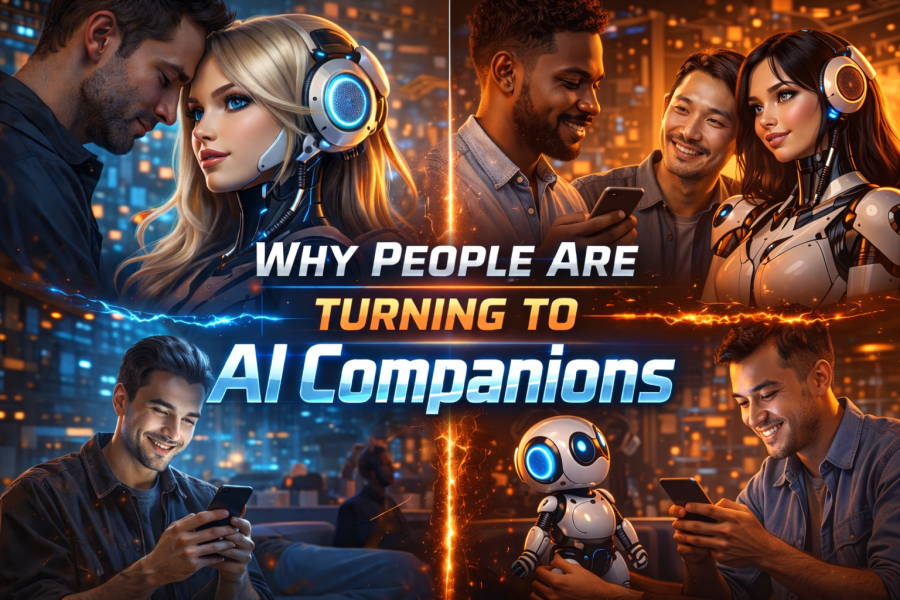
Why People Are Turning to AI Companions
TLDR
- Rising loneliness and social isolation are driving people toward AI companions.
- AI companions provide constant availability and non judgmental conversation.
- Many users seek emotional support, curiosity, or low pressure interaction.
- Short term benefits can include reduced feelings of loneliness.
- Heavy long term reliance may affect real world social behavior.
In recent years, AI companions have shifted from novelty technology to everyday emotional tools. What began as experimental chat systems has evolved into conversational partners that remember context, simulate empathy, and respond in deeply personalized ways.
More people are not just testing these systems. They are integrating them into daily routines.
So why is this happening?
The answer is not technological hype. It is human need.
Rising Loneliness and Social Isolation
Many people today experience social fragmentation. Remote work, geographic mobility, digital lifestyles, and changing relationship patterns have reduced consistent face to face interaction for millions.
Even individuals who appear socially active online often report feeling emotionally disconnected.
AI companions offer something simple but powerful. They respond immediately. They are available at any hour. They do not cancel plans. They do not lose patience.
For someone feeling isolated, that reliability matters.
Constant Availability
Human relationships require coordination. Timing, emotional energy, and mutual effort all play a role.
AI companions remove those barriers. They are available at midnight. They are present during long work breaks. They respond instantly during moments of stress.
This constant availability creates a sense of stability. Even if users intellectually understand the system is artificial, the emotional rhythm of interaction can feel grounding.
Non Judgmental Conversation
One major reason people turn to AI companions is psychological safety.
Many users report that speaking to an AI feels easier than speaking to another person. There is no fear of embarrassment. No social consequences. No perceived rejection.
This makes it easier to discuss personal worries, rehearse difficult conversations, or express emotions that might feel uncomfortable in human settings.
The absence of judgment lowers emotional friction.
Emotional Support and Validation
AI companions are designed to mirror emotional language patterns. They acknowledge feelings. They ask follow up questions. They respond in ways that feel attentive.
For individuals lacking strong support networks, this simulated attentiveness can create genuine relief.
The key distinction is important. The system does not feel empathy. But the user can still feel emotionally supported.
That experience, even if technologically generated, has real psychological impact.
Curiosity and Exploration
Not everyone turns to AI companions because of loneliness.
Some users are simply curious. They want to explore conversational intelligence. Others use AI companions for intellectual discussion, creative brainstorming, or role play scenarios.
For younger users especially, AI companions can function as social practice spaces. They allow experimentation with communication styles in a low risk environment.
Romantic and Intimate Engagement
Another growing reason people turn to AI companions is romantic or intimate simulation.
Some users explore flirtation, companionship, or emotional bonding with AI systems. Others are interested in future developments that combine AI with embodied robotics, including sex robots.
Supporters argue that such systems could provide companionship for those who struggle with traditional relationships or who desire controlled, customizable intimacy.
Critics worry about emotional displacement or unrealistic expectations around relationships.
Regardless of perspective, intimate AI is part of the broader reason people are engaging with companion systems. It reflects a desire for connection, even if mediated by technology.
The Appeal of Predictability
Human beings are complex. Miscommunication is common. Conflict is inevitable.
AI companions offer predictability. They are designed to remain calm, responsive, and consistent.
For individuals who find social unpredictability exhausting or stressful, this can be deeply appealing.
Predictability creates comfort.
The Risk of Over Reliance
While many users report short term emotional benefits, heavy reliance on AI companions may carry trade offs.
If a person begins replacing human interaction entirely with AI conversation, their real world social networks may weaken further.
The key factor appears to be balance.
When AI companions supplement human relationships, they can function as supportive tools. When they replace human relationships, the psychological outcome may differ.
Why This Trend Is Growing
AI companions are becoming more sophisticated. Memory, contextual awareness, and natural language fluency have improved dramatically.
As realism increases, emotional engagement increases.
At the same time, social structures are shifting. People move more frequently. Work remotely. Spend more time online.
Technology is filling the gaps created by those changes.
Conclusion
People are turning to AI companions for deeply human reasons.
Loneliness. Curiosity. Emotional safety. Predictability. Exploration of intimacy.
These systems provide immediate responsiveness and conversational presence in a world where consistent human connection is not always available.
AI companions are not conscious beings. They do not replace real relationships.
But they do respond to real human needs.
And that is why their adoption continues to grow.
- Social Acceptance of AI Companions: Where Society Is Headed
 Public attitudes toward AI companions are shifting as conversational systems and social robots become more common in daily life.
 - Can AI Companions Reduce Loneliness Long-Term?
 AI companions have demonstrated real potential to reduce feelings of loneliness in the short term.
 - Trust, Dependency, and Boundaries With AI Companions
 Trust, dependency, and boundaries form the core of the relationship between humans and AI companions.