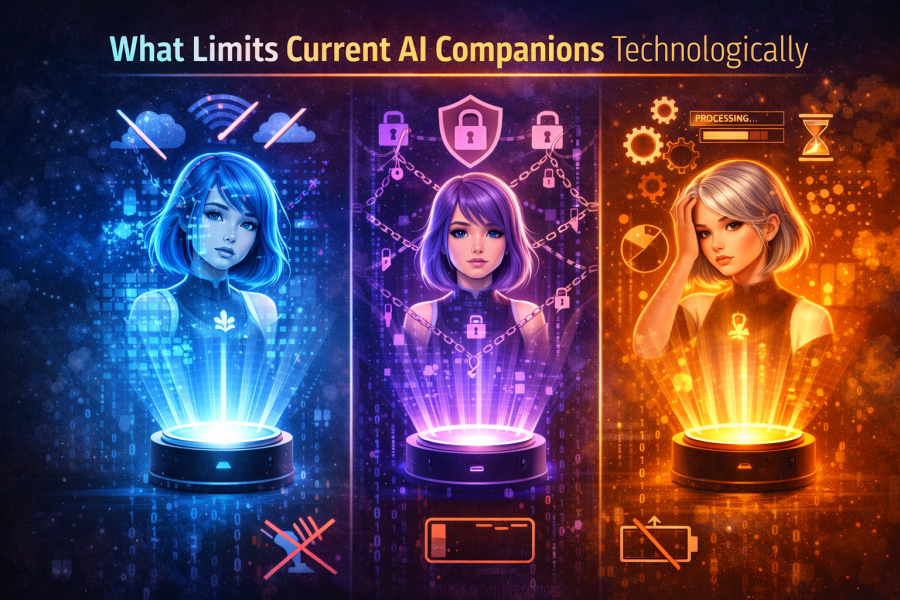
What Limits Current AI Companions Technologically
TLDR
- Current AI companions are limited by their inability to truly understand or feel emotions, meaning interactions can feel superficial in complex human contexts.
- Technical limitations like contextual understanding, memory capacity, and computational demands constrain conversational depth and continuity.
- Privacy, security, and ethical concerns shape what developers can and cannot reasonably build into companion systems today.
- Hardware constraints, affordability, and general accessibility affect how widely companion robots and systems are adopted.
- Too much dependence on cloud processing and internet connectivity continues to impact responsiveness and reliability in everyday use.
You may have noticed that the more you talk with a conversational companion, the more its limitations start to show. At first it feels responsive and helpful.
But sooner or later you run into moments where it misunderstands context, struggles to follow complex emotional nuance, or simply flatlines into generic responses.
That’s not a coincidence. Beneath the surface of these systems lie real, current technological boundaries. These limits aren’t due to a lack of ambition or curiosity on the part of developers.
They’re the result of hard‑wired constraints in computing, language understanding, data privacy, and the very nature of how these systems are built and trained.
In this article, we’ll unpack what specifically caps the capabilities of today’s AI companions and what that means for how you experience them.
Lack of Genuine Emotional Understanding
One of the most frequently discussed limitations is that conversational companions do not genuinely understand emotion. They can simulate empathy and respond in ways that sound warm, supportive, or reflective, but this is not driven by emotional awareness.
Instead, responses are generated from patterns learned in training data. So when a system replies to something sad with a comforting phrase, it’s matching textual patterns – not experiencing or truly grasping emotional depth.
This can make interactions feel shallow or hollow when users seek meaningful emotional connection. In sensitive or complex emotional situations, these systems are limited at interpreting intent or nuance, which sometimes results in irrelevant or even inappropriate replies.
That’s an important difference between simulation of empathy and actual emotional understanding, and it shapes every conversation you have with these tools.
Contextual and Conversational Memory Limits
Another set of constraints comes from the way conversations are processed.
Current models have a finite context window – a technical way of saying they can only “remember” a limited amount of what you have said during a session. If you refer back to earlier parts of a conversation outside that window, the system can fail to follow or misinterpret your intent.
This means long, ongoing dialogues can feel patchy. Some systems try to approximate memory by storing snippets of user information that seem relevant over time, but this isn’t a perfect substitute for continuous understanding.
What feels like inconsistency to users is often a reflection of how these memory systems are engineered.
Even when memory features are implemented, they are constrained by concerns about privacy and data handling, so developers often intentionally limit what is retained.
Reliance on Cloud Processing and Connectivity
Many AI companions operate by sending your input to powerful servers on the internet, where large language models run their computations before sending back a reply.
That cloud‑based design allows for access to large models and greater language versatility, but it also introduces dependency on internet connectivity. If your signal drops or bandwidth is limited, the conversation can lag or fail.
Responsiveness matters more than most people realize. When a reply takes too long, it interrupts the natural flow of conversation and can make the system feel less intelligent or more robotic.
Attempts to run advanced models locally on devices without cloud support are improving, but hardware limitations mean local models are generally less capable than their cloud counterparts.
Computational Costs and Model Scale
Behind every conversational reply is a complex neural model performing billions of calculations.
This is why very large language models require significant computational power and why this power is often centralized in large data centers.
Scaling these systems to be fast, reliable, and affordable for everyday use is a difficult engineering challenge.
Even small inefficiencies in processing can slow down response time or reduce the richness of replies. That’s why there is a trade‑off between model size, conversational depth, and practical responsiveness in consumer devices.
Privacy and Security Concerns
To function effectively, many AI companions collect data about how you talk, what you are interested in, and sometimes even emotional cues inferred from your language or voice.
This creates genuine privacy concerns, as conversational content can be very personal. Storing and processing such data responsibly requires secure systems and clear user consent processes.
In many cases, developers deliberately limit data retention to protect users, which in turn limits conversational personalization.
Sensitivity to privacy means systems can appear less personalized than they might be if they kept extensive memory, leading to interactions that feel less tailored or less rich over time.
Ethical and Regulatory Boundaries
As companion technologies have become more mainstream, lawmakers and regulators are taking notice.
In some regions, companion systems are now subject to laws requiring transparency about their non‑human nature and responsibilities around crisis detection or user safety.
These rules are intended to protect users – especially young or vulnerable users – but they also require developers to restrict certain capabilities until they can be proven safe and reliable.
That reality shapes how AI companions are deployed today and influences what features are available to users – particularly in emotionally sensitive domains.
Hardware and Robotics Challenges
When AI companions are embodied in physical robots rather than just software, additional technological limits appear.
Mobility, perception, manipulation of physical objects, and environmental understanding are still challenging for many robots.
Navigation in dynamic environments, safe movement around people, and reliable object recognition are areas where many systems are not yet robust enough for unsupervised use outside controlled settings.
These practical engineering limits affect not just what the robot can do, but how it is perceived. A robot that can’t reliably get around a room or respond fluidly to physical cues feels less capable, even if its conversational software is strong.
Affordability and Accessibility
High development costs and the use of advanced technologies mean that many AI companions remain relatively expensive for end users.
Premium models can cost thousands of dollars, and even software‑only platforms may require ongoing subscription payments to access more capable conversational engines.
That price point limits adoption and slows broader social learning about how these systems fit into everyday life.
Affordability isn’t a technical limitation in a strict sense, but it strongly influences who gets access to the most advanced companions and how those companions are experienced in real life.
Dependence and Misuse
A less‑talked‑about limitation is how users adapt to companion systems in practice.
Some individuals begin to depend on conversational agents in ways that diminish their engagement with real people. This behavioral effect doesn’t come from a technical glitch in the system.
It arises because humans naturally seek comfort and familiarity, and a conversational system that responds predictably can become a psychological crutch.
Developers and researchers are actively discussing how to design systems that support healthy use, but current companion technologies do not yet include built‑in safeguards to prevent dependency or misuse.
My Personal Observation
I’ve spent time interacting with both text‑based companions and robot prototypes, and the pattern is clear.
The more realistic the system feels, the more users project social complexity onto it.
But as soon as the conversation hits a deeper emotional or contextual question – something nuanced that a real human would easily navigate – the system can falter or revert to generic patterns.
That moment reminds me that behind the conversational facade, these systems are still tools – sophisticated tools, but not conscious beings.
Conclusion
Today’s AI companions are remarkable in many ways, yet they come with a set of real, verifiable technological limits.
They do not truly understand human emotion. They struggle with long‑term context. They rely on cloud servers and internet connectivity. They are constrained by privacy and security considerations. They are expensive and sometimes hardware‑limited.
All of these factors shape how current companion systems perform and how you experience them as a user.
What’s exciting is that researchers and developers around the world are actively working to address these boundaries. In time, we may see companions that feel more nuanced, responsive, and contextually grounded.
But for now, it helps to appreciate both the capabilities and the limits of the technology we have today – and to design with those realities in mind.
Blog
-
Social Acceptance of AI Companions: Where Society Is Headed
Public attitudes toward AI companions are shifting as conversational systems and social robots become more common in daily life.
-

Can AI Companions Reduce Loneliness Long-Term?
AI companions have demonstrated real potential to reduce feelings of loneliness in the short term.
