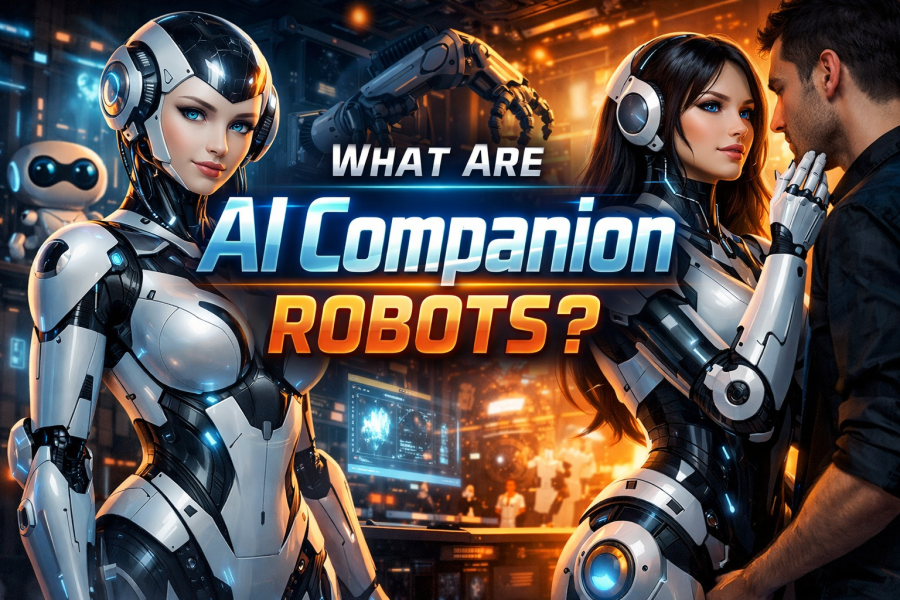
What Are Companion Robots?
Spend enough time around robotics labs or early-stage startups and you start to notice a shift. The conversation is no longer only about automation or efficiency. It is about presence.
Companion robots are part of that shift. They are physical machines designed to interact with people socially, emotionally, or supportively over time. Not as tools you pick up and put down, but as systems that live in your space and respond to you.
This is not novelty robotics. It is applied human–machine interaction with a body attached.
Defining Companion Robots Clearly
A companion robot is a physically embodied system built to engage with humans through ongoing interaction. That interaction can include conversation, reminders, physical gestures, touch feedback, movement, or environmental monitoring.
The key difference between a companion robot and a traditional service robot is intent. A warehouse robot optimizes logistics. A surgical robot assists precision procedures. A companion robot is designed around relational continuity.
It exists to be interacted with repeatedly.
Most companion robots combine several core components:
- Sensors for vision, sound, and touch
- Onboard processors for perception and decision making
- Connectivity for updates or advanced language processing
- Actuators for movement, expression, or object manipulation
The technology stack blends robotics engineering with machine learning and natural language systems. It is multidisciplinary by necessity.

Embodiment Changes Everything
You can put conversational intelligence into a phone or speaker. That is familiar territory. But when that same system has eyes that track you, a head that turns, or a body that moves closer, the psychological effect shifts.
Embodiment increases perceived social presence. Research in human–robot interaction consistently shows that people respond differently to a physical agent than to a disembodied voice.
Even simple motion, like subtle head tilts or gaze tracking, changes engagement levels.
This is one reason why robotic pets such as Sony’s Aibo have persisted over multiple product generations. The physicality matters. Touch matters. Motion timing matters.
The body is not decoration. It is part of the interface.
Where Companion Robots Are Actually Used
The most established use case today is eldercare and assisted living.
Robotic systems such as Paro, the therapeutic robotic seal developed in Japan, have been used in care environments to stimulate interaction among dementia patients. Clinical studies have documented improvements in mood and reductions in agitation in certain contexts.
That is measured behavioral response, not marketing language.
Another example is ElliQ, designed specifically for older adults living independently. Its focus is conversational engagement, reminders, and proactive prompts that encourage activity or connection with family members.
These systems are not general-purpose humanoids. They are tightly scoped around specific human needs.
Companion robots also appear in pediatric hospital units, autism therapy environments, and customer-facing hospitality settings. In each case, the goal is structured engagement.
Not friendship. Not sentience. Structured engagement.
The Technology Under the Hood
Let’s break this down in practical terms.
A companion robot must perceive input. That typically means cameras for facial detection, microphones for speech capture, and sometimes depth sensors for spatial awareness.
It must process that input. This can happen partially on device using embedded processors and partially in the cloud depending on computational requirements and privacy constraints.
Speech recognition systems convert audio into text. Dialogue management systems determine the appropriate response. Behavioral models select gestures, posture adjustments, or motion patterns.
Then it must act. Motors control head rotation, arm gestures, wheel movement, or expressive elements like LED eyes or screen-based faces.
Safety systems are critical. Companion robots designed for home or care environments use force limits, soft materials, and conservative motion planning to reduce risk during physical interaction.
Battery management is another real constraint. These machines must operate for hours in lived spaces without constant charging interruptions.
None of this is trivial engineering.
On-Device Versus Cloud Intelligence
One of the more interesting technical decisions in this space involves where processing happens.
On-device computation improves privacy and reduces latency. It allows a robot to function even without constant internet connectivity.
Cloud processing enables more advanced language models, large-scale updates, and aggregated system improvements.
Most current companion robots use hybrid architectures. Immediate sensory processing often happens locally. More complex language interpretation may rely on remote servers.
This balance is shaped by regulation, cost, and user trust.

Designing for Emotional Response
Companion robotics forces engineers to think like behavioral designers.
Motion timing, voice tone, response delay, and gaze direction all influence user perception. Research shows that small behavioral cues significantly impact trust and comfort levels.
A slight delay in response can change whether a robot feels attentive or distracted.
This is why many successful companion robots avoid hyper-realistic human appearance. Slightly stylized or animal-like forms often produce more positive reactions and reduce discomfort.
It is not about making robots human. It is about making interaction intuitive.
The Rise of Sex Robots
Within the broader companion robotics landscape, sex robots represent a controversial but growing subcategory.
These systems are typically humanoid robotic platforms combined with conversational AI and customizable physical features. Some models incorporate articulated skeletons, heating elements, responsive sensors, and basic dialogue capabilities.
Manufacturers in this space position their products as intimate companions rather than purely physical devices. The technological overlap with mainstream companion robotics is real: speech systems, facial recognition, personalization algorithms, and app-based control platforms are increasingly integrated.
However, the technical sophistication varies widely. Many commercially available systems are mechanically advanced but limited in autonomous interaction. True real-time conversational depth remains constrained by current processing and integration limits.
From an industry standpoint, sex robots raise significant ethical and regulatory questions. Issues include consent simulation, data privacy, psychological impact, and the potential reinforcement of harmful behavioral patterns.
There are also ongoing debates among researchers about whether these systems alleviate loneliness or risk deepening social isolation.
Regardless of position, the category is part of the companion robotics discussion because it centers on embodied interaction and long-term human attachment to machines.
It is not fringe. It is part of the broader trajectory of personal robotics.
Economic and Practical Realities
Companion robots remain relatively expensive compared to purely software-based assistants.
Hardware components, custom actuators, safety certifications, and continuous software development increase cost. In care environments, adoption depends on measurable outcomes.
Facilities need evidence that these systems reduce workload, improve engagement, or support patient wellbeing.
In private homes, perceived value must justify both the initial purchase and any ongoing service fees tied to updates or connectivity.
This is still a developing market. Growth is steady, but it is grounded in practical constraints.
What Companion Robots Are Not
They are not conscious. They are not autonomous agents with personal goals. They are not replacements for human relationships.
They are engineered systems optimized for interactive routines.
The most effective companion robots operate within clearly defined boundaries. Medication reminders. Conversational prompts. Engagement activities. Telepresence support.
When expectations align with capability, the technology works.
A Personal Perspective
I have observed companion robots in both demonstration spaces and real care environments. The contrast is revealing.
In a showroom, attention centers on novelty. In a care facility, attention centers on response. Does conversation continue longer? Does agitation decrease? Does someone who was withdrawn become more engaged?
Those outcomes are subtle. They do not look futuristic. They look human.
That is what makes this category worth analyzing seriously.
Conclusion
Companion robots represent a serious technological frontier. They combine mechanical engineering, machine learning, behavioral science, and product design into embodied systems designed for sustained human interaction.
From therapeutic robotic pets to socially assistive platforms and intimate robotics, the spectrum is broad. What unites them is physical presence.
The next phase of artificial intelligence is not just software running in the background. It stands in the room with you.
Understanding how that presence is engineered, regulated, and integrated into society is not optional anymore. It is essential.
- Social Acceptance of AI Companions: Where Society Is Headed
 Public attitudes toward AI companions are shifting as conversational systems and social robots become more common in daily life.
 - Can AI Companions Reduce Loneliness Long-Term?
 AI companions have demonstrated real potential to reduce feelings of loneliness in the short term.
 - Trust, Dependency, and Boundaries With AI Companions
 Trust, dependency, and boundaries form the core of the relationship between humans and AI companions.
 - Why People Form Emotional Attachments to AI
 Spend enough time around conversational systems, and something interesting happens. People stop treating them like tools.
 - Domestic Robots vs Companion Robots Key Differences
 Domestic robots and companion robots share a technological foundation, but their missions diverge sharply.