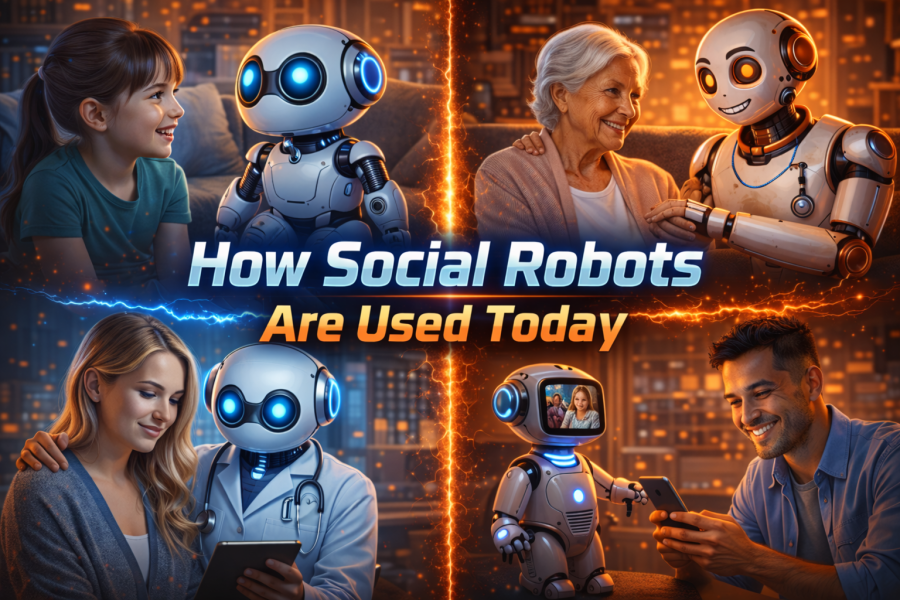
How Social Robots Are Used Today
TLDR
- Social robots are actively used in eldercare settings to support wellbeing and reduce loneliness among older adults.
- In educational environments, robots serve as tutors and engagement tools, especially for young learners and students with special needs.
- Therapeutic and healthcare contexts include robots that assist with emotional support, rehabilitation, and patient engagement.
- Public spaces, customer service, and hospitality sectors are experimenting with robots that greet, guide, and interact with people.
- Long-term deployments show that social robots can create meaningful interaction patterns and even emotional attachment over time.
If you’ve ever spent time around children, seniors, or even curious tech enthusiasts, you might have bumped into a small robot trying to make sense of the world around it.
Social robots have quietly spread into real everyday settings, and they are doing much more than just turning heads at trade shows.
Today’s social robots are finding homes in places that hit close to our daily lives: care facilities, classrooms, therapy rooms, and public spaces.
They walk (or roll), they speak, they listen, and in some cases they even learn to recognize people’s faces and moods.
Let’s explore how these robots are actually being used right now, not in sci-fi films, but in real rooms with real people.
In Elder Care and Wellbeing
One of the most documented uses of social robots today is in eldercare.
You’ll find robots designed specifically to keep older adults company in assisted-living facilities and private homes.
These machines do a range of things: they interact with residents through conversation, help reduce loneliness, encourage physical activity, and even promote healthy routines.
Some of the robots in these settings are built to respond to sound and touch in ways that mimic pet therapy, providing calming interaction without the complexities of caring for a live animal.
They can offer reminders for medication or appointments, prompt light exercise, and even encourage users to share memories or stories.
Social robots in eldercare are often part of a broader wellbeing strategy that includes human caregivers and family support.
My aunt’s retirement community recently trialed one of these robots for a few weeks. Residents laughed when it responded to greetings, but it also sparked games, discussions, and even small group activities that otherwise might not have happened.
Educational Settings
Children and teens are another group where social robots are making a tangible difference.
In classrooms, social robots serve as tutors, peer learners, and engagement boosters. Unlike tablets or apps, robots bring a physical presence and expressive behavior that can make learning feel more interactive.
In some programs, children practice language skills, problem solving, or emotional expression with robots that adapt to their responses and offer personalized feedback.
These tools are especially valuable in specialized learning environments, such as supporting students with autism or developmental differences.
Because robots can repeat instructions patiently and provide consistent interaction without judgment, students often engage more readily than they might in conventional settings.
From what I’ve seen and heard from educators, these robots don’t replace teachers – they amplify what a classroom experience can be by offering new ways for students to explore ideas and express themselves.
Healthcare and Therapeutic Support
Social robots aren’t just in schools and senior centers. They are showing up in clinics and therapy spaces too.
In some healthcare environments, robots are used to support rehabilitation exercises, encourage patient participation, and provide emotional comfort during long stays.
For patients dealing with anxiety, pain, or recovery challenges, robots can offer distraction, reassurance, or prompt reminders for therapy routines.
In developmental and psychological therapy contexts, certain robots are used to help patients practice social skills and emotional regulation.
Their consistent, interactive behavior gives therapists another tool to support individuals who might find human interaction overwhelming or exhausting in some moments.
Public Spaces and Customer Interaction
You might also see social robots in places like museums, retail lobbies, or hotel entrances.
Some of these robots function like guides or assistants, greeting visitors, offering information, and answering simple questions. They might direct you to exhibits, explain features of a product, or help you find your way around a building.
These roles are usually structured and limited – robots in public spaces are not expected to carry on deep conversations.
Instead, they serve as approachable, consistent touchpoints that make environments feel more engaging and intuitive for people who visit.
Research and Pilot Deployments
Sometimes the most interesting use cases are not obvious at first glance.
Universities and research teams frequently deploy social robots as part of pilot projects to understand how people interact with machines over longer stretches of time.
In these deployments, robots function as receptionists, companions in public settings, or embedded tools within homes.
Participants in these studies provide feedback about what feels safe, helpful, or meaningful. Some projects focus on ethical design, like how robots should handle privacy and safety when interacting with strangers.
Others track how people’s emotional responses evolve as the novelty wears off and the robot becomes a familiar presence.
Long-term studies have even found that families sometimes retain social robots after formal programs end, integrating them into routines and forming attachments that outlast the robot’s initial functional purpose.
Human-Robot Interaction in Daily Life
What stands out across all these real-world deployments is the pattern of routines and relationships forming over time.
People who live with social robots often start by treating them as tools or curious gadgets.
Over weeks or months, however, the robots become part of daily rhythms: a morning greeting at breakfast, a reminder to take medication, a shared moment of light-hearted engagement.
That transition – from novelty to familiar presence – is significant. It shows that social robots are not just experiments.
They are machines that people interact with repeatedly across their lives, and for many users, that repeated interaction shapes their experience of daily living.
My View from the Field
As someone who’s been lucky enough to see these systems in action across care homes and classrooms, I find the most interesting part of their use is not the technology itself, but how people interpret it.
One moment I won’t forget involved a shy student who usually avoided group activities but lit up when a robot asked a question in class.
I’ve also seen older adults start conversations in communal rooms around robots, turning what could have been a quiet afternoon into a shared experience.
These machines aren’t perfect. They don’t replace human connection. But they do create sparks – moments where people smile, engage, think, or genuinely have a different experience than they would without them.
Conclusion
Social companion robots are already part of our world in meaningful ways.
In eldercare, they support wellbeing and offer companionship. In classrooms, they make learning interactive. In healthcare, they assist with therapeutic engagement. In public spaces, they greet and orient people.
And in research deployments, they are helping us understand what long-term human-machine interaction looks like.
The interesting thing about social robots today is not just that they exist, but how they integrate into human routines and relationships.
As these systems continue to improve and expand, what they do will likely evolve – but their core purpose remains resolutely human.
These robots engage, they respond, and in many cases, they help people feel a little less alone in a complex world.
- Social Acceptance of AI Companions: Where Society Is Headed
 Public attitudes toward AI companions are shifting as conversational systems and social robots become more common in daily life.
 - Can AI Companions Reduce Loneliness Long-Term?
 AI companions have demonstrated real potential to reduce feelings of loneliness in the short term.
 - Trust, Dependency, and Boundaries With AI Companions
 Trust, dependency, and boundaries form the core of the relationship between humans and AI companions.