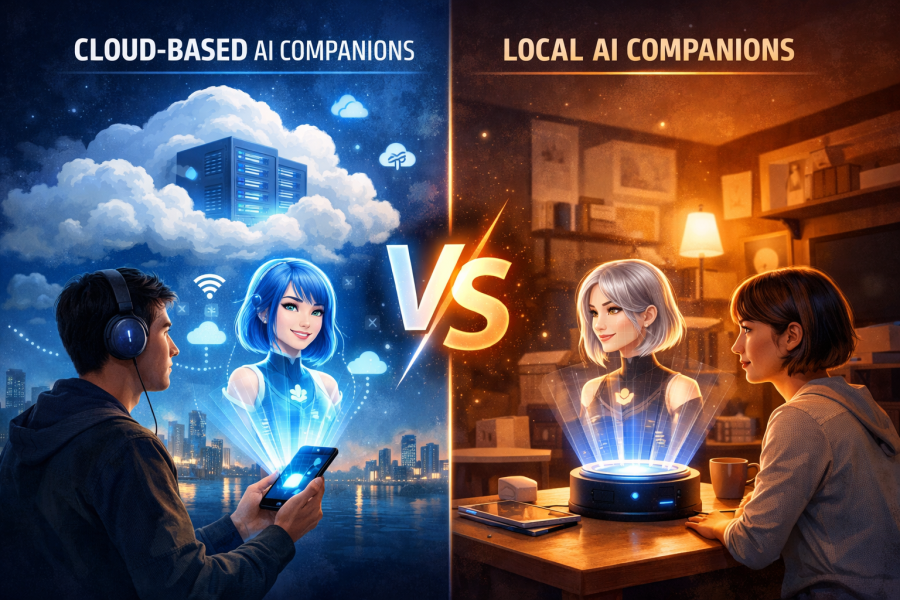
Cloud-Based vs Local AI Companions
TLDR
- Cloud-based AI companions rely on remote servers for processing and tend to offer stronger computational power.
- Local AI companions run directly on your device, improving privacy and reducing dependence on internet connectivity.
- Cloud systems are usually better at large-scale learning and conversation diversity.
- Local systems prioritize response speed and data security.
- Many modern companion platforms are exploring hybrid architectures.
When people talk about AI companions, one of the first technical questions that comes up is where the intelligence actually lives.
Some systems think in the cloud, sending information to remote servers for processing. Others keep everything inside your device, running models locally.
Both approaches have strengths and trade-offs, and neither is universally better. The right choice depends on what you value more, whether it is raw computational power, privacy, or real-time responsiveness.
If you have ever noticed how some assistants feel more knowledgeable but slightly slower, you have already experienced this architectural difference.
Let’s walk through what makes these two approaches different in practice.
How Cloud-Based AI Companions Work
Cloud-based companions rely on remote infrastructure to handle heavy computation.
When you send a message, your request is transmitted to data centers where large machine learning models process it and generate a response.
This design allows developers to use powerful hardware clusters that would be impossible to fit into a consumer device.
Cloud architectures are especially useful for conversational systems that require large language modeling, continuous training updates, or complex reasoning tasks.
From a user perspective, cloud companions often feel more knowledgeable because they draw from larger datasets and more powerful processing pipelines.
However, your experience depends heavily on internet stability.
If your connection is weak, response latency can increase.
In companion robotics and conversational AI products, minimizing perceived delay is important because humans tend to interpret slow responses as lower intelligence or lower engagement quality.
Advantages of Cloud AI Companions
Cloud-based systems excel in scalability.
Developers can update models centrally without forcing users to download large updates.
This is useful because modern conversational models can contain billions of parameters.
Another advantage is cross-device continuity.
If you use the same companion service on your phone and home device, cloud memory systems can maintain conversation history across platforms.
This helps create a more consistent interaction experience.
Cloud companions also tend to support more advanced features such as multi-modal reasoning, large knowledge retrieval, and adaptive learning pipelines.
In many commercial products, cloud processing is the backbone of advanced conversational performance.
Limitations of Cloud Systems
The biggest concern with cloud companions is privacy.
Because data must travel to external servers, there is theoretical exposure risk if security protocols fail.
Major technology companies invest heavily in encryption and secure communication channels to mitigate this risk.
Another limitation is dependency on network infrastructure.
If you are traveling, living in low-connectivity regions, or experiencing outages, cloud companions may become less reliable.
Latency is also a subtle but important psychological factor.
Even small delays can make conversation feel less natural.
Human dialogue typically follows rapid turn-taking patterns, so speed matters.
How Local AI Companions Work
Local AI companions process data directly on your device.
Instead of sending information to remote servers, models run inside smartphones, embedded hardware, or specialized chips.
This approach has become more feasible because modern hardware acceleration technologies have improved significantly.
Edge computing allows smaller models to perform conversational tasks efficiently.
Local systems are especially attractive for privacy-conscious users because personal data does not leave the device in most implementations.
If you value data sovereignty, local AI companions may feel more trustworthy.
Advantages of Local Processing
Speed is the biggest advantage of local companions.
Since computation happens inside the device, response time can be very fast.
This is important in real-time interaction environments such as robotics or voice interfaces.
Privacy is another major benefit.
Sensitive conversation data can remain stored locally.
Many users feel more comfortable knowing that their interaction history is not transmitted externally.
Local systems are also more reliable in environments with unstable internet access.
Limitations of Local AI
The main challenge is computational capacity.
Small devices cannot yet match the training scale and reasoning breadth of massive cloud models.
This means local companions may sometimes produce less diverse responses or have limited knowledge coverage.
Updating local models can also be slower because new versions must be distributed to individual devices.
Battery consumption can become a concern if processing workloads are high.
Hardware designers continue optimizing neural processing units to address this problem.
Hybrid Architecture Is Becoming Popular
Many modern companion platforms are moving toward hybrid designs.
In hybrid architecture, basic interaction tasks run locally while complex reasoning or learning occurs in the cloud.
This approach attempts to combine the best of both worlds.
You get faster response times and improved privacy from local processing.
At the same time, you benefit from large-scale intelligence resources available through cloud infrastructure.
In practice, hybrid systems are becoming the dominant direction in consumer AI companion development.
User Experience Matters More Than Technical Purity
From a product perspective, most users do not care whether intelligence is cloud-based or local.
What people notice is how the system behaves.
- Does it respond quickly?
- Does it remember context?
- Does conversation feel smooth?
These experiential factors are what ultimately determine satisfaction.
I have seen people become more attached to systems that respond naturally, even if those systems are technically simpler.
That tells us something important about design philosophy.
Security and Ethical Considerations
Both architectures require strong ethical governance.
Cloud systems must protect transmitted data.
Local systems must protect device storage and prevent unauthorized access.
Responsible companion technology development emphasizes transparency, user control, and data protection.
Many modern research frameworks are exploring privacy-preserving machine learning techniques.
Conclusion
Cloud-based and local AI companions represent two different philosophies of intelligent interaction.
Cloud systems offer computational strength, large knowledge capacity, and centralized learning.
Local systems prioritize privacy, speed, and independence from network infrastructure.
The future is likely hybrid, combining distributed intelligence with edge computing.
For you as a user, the most important factor is not where intelligence lives.
It is how well the companion communicates with you, responds naturally, and supports your interaction needs.
Technology will keep improving, but human comfort, trust, and usability will remain the real measure of success.
Blog
-
Social Acceptance of AI Companions: Where Society Is Headed
Public attitudes toward AI companions are shifting as conversational systems and social robots become more common in daily life.
-

Can AI Companions Reduce Loneliness Long-Term?
AI companions have demonstrated real potential to reduce feelings of loneliness in the short term.
