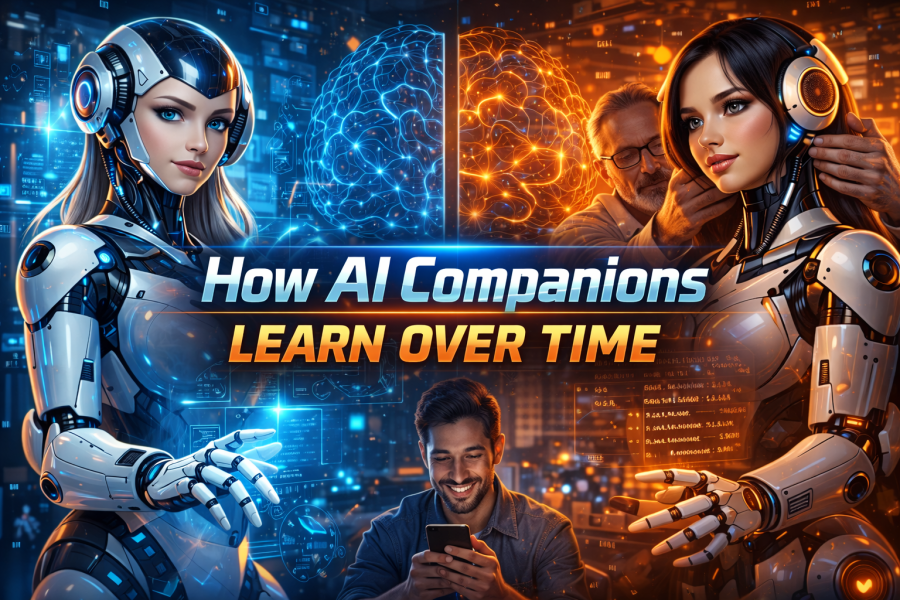
How AI Companions Learn Over Time
TLDR
- AI companions become more personalized by retaining memory and adapting responses based on past interactions.
- Machine learning techniques like reinforcement learning and memory frameworks help AI systems refine how they interact with users.
- Long-term personalization involves storing conversational context and user preferences to make future dialogues more relevant and meaningful.
- As these systems improve, ethical considerations around privacy, user consent, and emotional dependence become more important.
- Modern developments in memory and personalization technologies are enabling AI companions to feel more tailored and responsive over time.
Have you ever had a conversation with a digital companion and thought it seemed to “remember” you? Maybe after a few chats it started giving responses that felt more tailored to your interests or the way you speak. That’s no accident.
AI companions don’t learn in the way humans do, with consciousness and self-awareness. Instead, they use patterns and memory systems to make their interactions feel more special and personalized as time goes by.
In this article, we’re going to unpack how that learning process works in practice, why it matters to how these companions feel more intuitive over time, and what the trade-offs are when AI starts remembering more about us.
From Static Scripts to Dynamic Interaction
Early conversational systems were little more than decision trees: if you said X, the system replied with Y. There was no real notion of adapting to the person you were talking to. They were useful for predictable tasks, but not much else.
Modern AI companions, in contrast, are built on machine learning and natural language modeling. These systems parse patterns in text, not being limited to a fixed script.
That allows them to generate responses that are more contextually relevant because they are drawing from a broad dataset of human language examples.
Beyond that, recent innovations in AI architecture allow the modeling of longer conversational histories and more sophisticated user preferences.
Instead of treating each interaction as a one-off, AI companions can build a profile of recurring themes and preferences a user expresses over time. That’s a big part of what makes ongoing interaction feel more personal and natural.
Memory and Long-Term Personalization
At the core of how companions learn is memory – but not like human memory. Instead, AI systems implement different kinds of memory layers that help them maintain continuity in conversations.
One approach uses what’s often called conversational memory. This enables an AI system to store key details or preferences from previous chats.
For example, if you told a companion what you like for breakfast a few weeks ago, it might pull that detail up later in a related conversation. This ability to reference prior context makes the AI feel more consistent and attentive.
This trend towards memory-enabled AI is becoming more common across advanced platforms, and research shows that users with conversational memory enabled describe their interaction as more personalized and engaging because the assistant can recall past context and tailor its replies accordingly.
Reinforcement Learning and Behavioral Refinement
Another piece of the learning puzzle is reinforcement learning, a technique that helps AI companions refine their conversational strategies over time. Instead of just repeating patterns from their training dataset, systems can adjust behavior based on outcomes that are implicitly rewarded.
In reinforcement learning, an AI model iterates through many interactions, optimizing its decision process based on predefined signals of success. In some frameworks, this involves giving higher “reward” values for conversational responses that align better with user expectations.
Over many such adjustments, the system learns which kinds of replies and conversational paths lead to higher satisfaction and engagement.
This kind of learning doesn’t require self-awareness. It simply involves adapting internal weights in the AI model to better approximate user preferences and conversational goals. That’s how, over time, an AI companion can feel more attuned to your patterns.
Hierarchical and Agentic Memory Systems
While conversational memory allows a companion to keep track of facts or preferences, more advanced systems are built with what’s called agentic memory.
This approach combines multiple layers of memory – from short-term context in a single chat session to longer-term traits and behavioral patterns – and organizes it in a structured format.
The idea is to create a scalable system where an AI can recall not just facts but also patterns across many interactions. This can include preferences, interests, topics discussed in earlier chats, and stylistic tendencies in how you communicate.
By using a layered architecture, these memory frameworks help maintain coherent and personalized interactions even when sessions are spaced far apart.
That’s why, after talking to some AI companions regularly for a while, it can feel like “they remember you.” It’s not emotion or consciousness, but a structured recall and pattern-matching system that enhances continuity.
Real-World Personalization in Practice
In many real implementations, this means an AI companion can adapt how it responds based on:
- Words or phrases you use often.
- Topics you’re passionate about.
- Conversational tone you prefer.
- Preferences you’ve expressed in the past.
For example, if you frequently talk about your city, hobbies, or favorite books with a companion, over time the AI might reference those preferences to suggest relevant activities or continue a thread from a previous discussion. That kind of continuity comes from memory and personalization working together.
If you’re using a platform that supports memory, you might notice it recalling something you mentioned earlier in a way that feels thoughtful or surprisingly contextual. That’s the personalization framework doing its job.
The Human Role in the Loop
It’s important to note that despite all this learning and memory capability, humans are still central to shaping the experience.
When developers build AI companions, they often include mechanisms for user feedback, corrections, or preference settings. That means you can sometimes tell a system to “forget” something, update a preference, or refine how it interacts with you.
That human-in-the-loop approach – where users aren’t passive – helps keep personalization aligned with your intentions and expectations.
Beyond that, human researchers continually refine how memory and adaptability work in these systems by studying how people interact with AI over time.
Balancing Personalization and Ethical Considerations
As these companions get better at remembering and adapting, ethical questions arise about privacy, consent, and autonomy.
When a system stores more information about you to improve personalization, there is the potential for misuse if safeguards are not in place. That’s why many platforms emphasize transparency in how memory works and give users control over enabling or disabling these features.
Part of responsible design is ensuring that long-term memory doesn’t become intrusive or manipulative, but rather enhances the interaction in ways users find genuinely helpful.
My Personal Observations
I’ve spent time with a few platforms that offer conversational memory features, and the difference in how they feel over a few weeks is striking.
In early interactions, the responses seem generic – like chatting with someone who’s polite but doesn’t retain much about you. After several sessions where you mention things like your work, hobbies, or pets, however, companions start referencing that context without prompting.
It feels less like asking a question and more like continuing a dialogue. That shift – from transactional to contextual – is the heart of how these systems learn over time.
It’s a reminder that personalization in this space is really about crafting continuity.
Conclusion
AI companions learn over time by combining memory systems, reinforcement learning, and advanced conversational modeling to create experiences that feel personalized and responsive.
They don’t think or feel, but they can retain details, adapt responses based on patterns, and build a sense of continuity across interactions.
As these technologies evolve, they offer exciting opportunities for companionship, learning, and support – but they also demand mindful design when it comes to privacy and user control.
When you notice a companion starting to remember things about you, it’s not magic. It’s the result of layered memory structures and adaptive learning working behind the scenes to make each interaction feel more engaging and tailored to you.
Blog
-
Social Acceptance of AI Companions: Where Society Is Headed
Public attitudes toward AI companions are shifting as conversational systems and social robots become more…
-

Can AI Companions Reduce Loneliness Long-Term?
AI companions have demonstrated real potential to reduce feelings of loneliness in the short term.
-

Trust, Dependency, and Boundaries With AI Companions
Trust, dependency, and boundaries form the core of the relationship between humans and AI companions.
