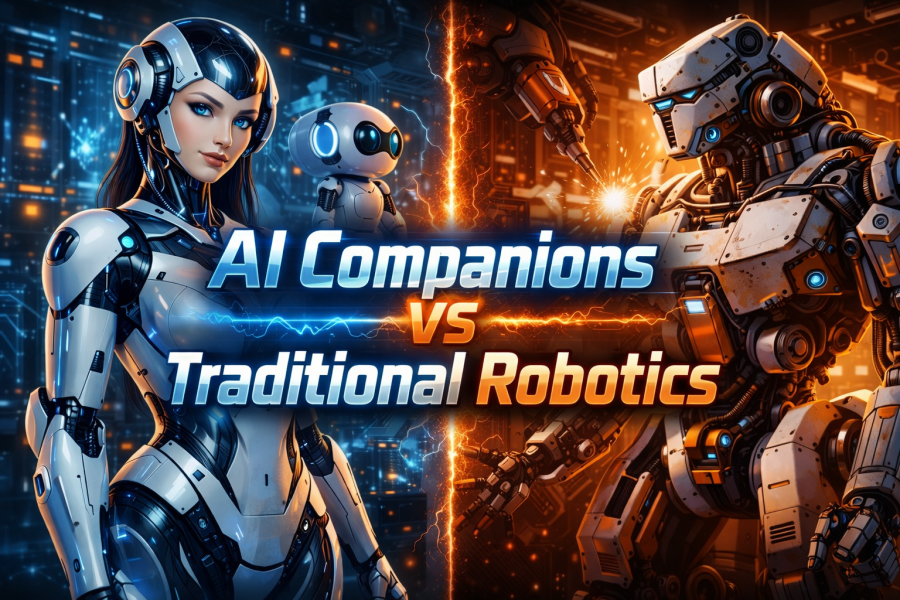
AI Companions vs Traditional Robotics
Walk into an automotive factory and you will see traditional robotics in its purest form. Steel arms moving with precision. Repeatable motion. No hesitation. No conversation.
Walk into a senior living apartment with a social robot on the kitchen counter and the atmosphere feels completely different. The machine greets its user. It asks about their day. It suggests a walk.
Both are robots. But they belong to very different technological worlds.
Understanding that distinction matters. The term “robot” gets thrown around loosely, and it hides a fundamental shift happening in engineering. AI companions are not simply smaller industrial machines. They are designed around interaction, not output.
What Traditional Robotics Was Built For
Traditional robotics emerged from manufacturing. The goal was clear: automate repetitive physical tasks with speed and precision.
Industrial robotic arms, mobile warehouse robots, surgical systems, and agricultural machines all share a common DNA. They optimize for:
- Accuracy
- Repeatability
- Throughput
- Mechanical strength
- Operational efficiency
They operate in structured environments. Factory floors are controlled. Warehouses are mapped. Inputs are predictable.
In most cases, human interaction is secondary. In fact, humans are often kept at a safe distance for obvious safety reasons.
The intelligence in these systems focuses on motion planning, object detection, force control, and task execution. Social awareness is irrelevant.
If a welding robot could speak, no one would care.
What AI Companions Are Built For
AI companions start from a different premise. The primary task is interaction.
These systems are designed to live in homes, care facilities, classrooms, and hospitality environments. Their performance is measured not by units produced, but by engagement quality and behavioral response.
Instead of throughput, we evaluate:
- Conversation continuity
- Emotional responsiveness
- Personalization
- User comfort
- Long term engagement
The hardware is often smaller, softer, and deliberately non-threatening. Materials matter. Motion speed matters. Even eye design matters.
An AI companion must feel approachable before it can function.

The Role of Artificial Intelligence
Traditional robotics has long used forms of AI. Path optimization algorithms and computer vision systems have been standard for years.
But AI companions rely much more heavily on machine learning models tied to language and behavior.
Speech recognition converts audio into text. Natural language systems interpret meaning. Dialogue managers determine responses. Personalization engines adapt interaction patterns over time.
This creates a feedback loop. The system improves as it interacts.
In contrast, an industrial robot’s learning cycle is often controlled offline through engineering updates rather than daily conversational use.
Environment: Structured vs Unstructured
One of the biggest differences between these categories is the environment they operate in.
Traditional robots thrive in structured spaces. Assembly lines are mapped down to millimeters. Variables are minimized.
AI companions live in messy environments.
Homes are unpredictable. Lighting changes. Background noise fluctuates. Users speak casually. Children interrupt conversations. Pets walk by.
The robot must adapt in real time without losing coherence.
This requires more flexible perception systems and robust error handling. A failed weld is a production issue. A failed conversation is a trust issue.
Safety and Design Philosophy
Safety in traditional robotics focuses on physical containment and mechanical safeguards. Emergency stop buttons. Caged workspaces. Force sensors.
Safety in AI companions extends into psychological territory.
Motion must be gentle. Proximity awareness must be conservative. Voice tone must not startle. Data privacy must be protected.
When a robot operates inches away from a person’s face or records speech in a private home, the design stakes are higher.
Companion systems are engineered not just to avoid harm, but to avoid discomfort.
Hardware Complexity vs Behavioral Complexity
Industrial robots often feature sophisticated mechanical assemblies. Multi-axis arms, precision gearboxes, high torque motors.
AI companions, while mechanically simpler in many cases, face a different complexity problem: behavioral realism.
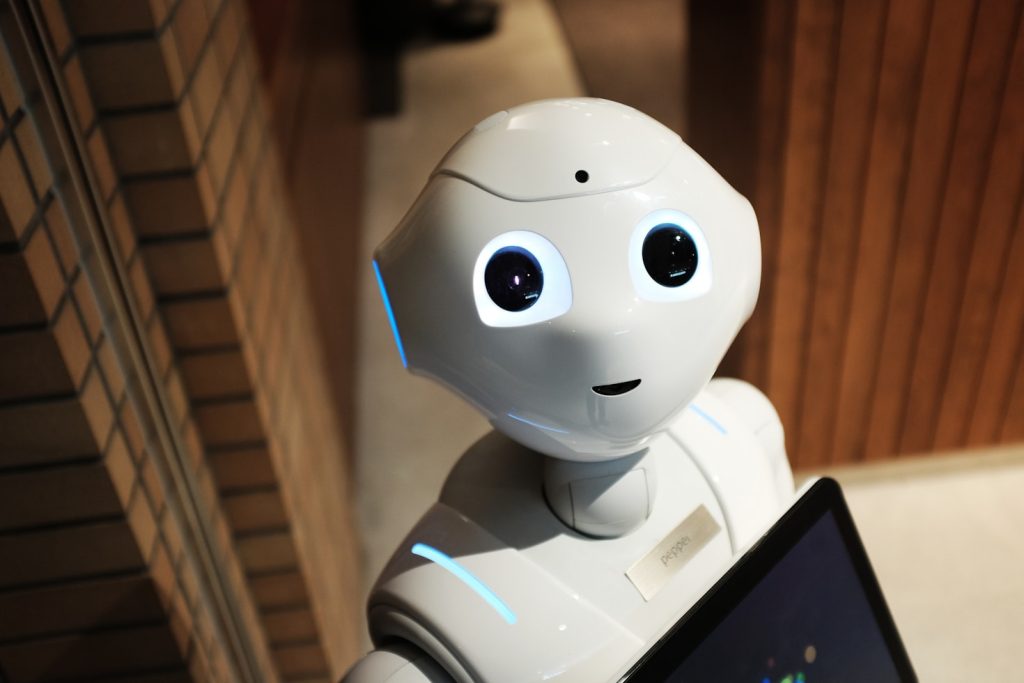
Coordinating eye movement with speech timing. Synchronizing gestures with conversational cues. Managing pauses naturally.
This kind of subtle behavioral integration is harder than it looks.
A robot that moves perfectly but responds awkwardly feels broken. In companion robotics, timing is everything.
Economic Models
Traditional robotics is driven by return on investment calculations. A manufacturing robot justifies itself through increased productivity and reduced labor cost.
AI companions operate under more nuanced value propositions.
In eldercare, value may be measured through increased engagement or reduced agitation. In hospitality, it may be brand differentiation. In private homes, it may be convenience and companionship.
The economics are less straightforward.
This is one reason companion robotics adoption moves more gradually. Emotional value is harder to quantify than assembly line output.
The Question of Attachment
Traditional robots are tools. No one forms emotional bonds with a palletizing arm.
AI companions are different. Humans anthropomorphize easily. When a machine maintains eye contact and remembers preferences, attachment can form.
This creates design responsibility.
Engineers must avoid overstating capability. Transparency about what the system can and cannot understand is essential.
The goal is support, not deception.
Where Sex Robots Fit Into the Comparison
Sex robots sit at the intersection of AI companionship and advanced mechanical design.
Mechanically, many incorporate articulated frames, temperature systems, and responsive sensors. Behaviorally, they increasingly integrate conversational AI and personalization features.
Unlike industrial robotics, the core function is intimate interaction rather than task automation.
Unlike general social robots, the interaction domain is highly specific.
This subcategory intensifies ethical and regulatory discussions because it combines embodiment, emotional simulation, and private data collection.
From a technological perspective, however, it draws from the same foundations as other AI companions: speech systems, sensor integration, behavioral modeling, and physical actuation.
It represents one extreme of human–machine relational design.
Public Perception and Cultural Framing
Traditional robotics is widely accepted as infrastructure technology. It builds cars, packages goods, assists surgery.
AI companions provoke more varied reactions.
Some see them as assistive tools. Others view them as social substitutes. Cultural acceptance varies by region and demographic.
This difference in perception shapes product development. Companies building industrial robots focus on efficiency metrics. Companies building companion systems must consider psychology, sociology, and ethics alongside engineering.
Are They Converging?
There is some overlap emerging.
Industrial robots increasingly integrate AI vision systems. Companion robots are adopting more robust navigation capabilities. Cloud connectivity links both categories to centralized intelligence platforms.
But the core objectives remain distinct.
Traditional robotics optimizes for physical productivity.
AI companions optimize for relational continuity.
A Personal Observation
When I visit a factory floor, I am impressed by precision. When I observe a well-designed companion robot in a care environment, I am struck by subtlety.
The most important moment is not when it speaks. It is when the person responds.
That is a different kind of engineering success.
Conclusion
AI companions and traditional robotics share foundational technologies: sensors, processors, actuators, control systems.
What separates them is purpose.
Traditional robots extend human physical capability in structured environments.
AI companions extend interaction into physical space.
One builds infrastructure. The other builds presence.
As artificial intelligence continues to evolve, the line between software and embodiment becomes more visible. The machines that matter most in the coming decade may not be the strongest or fastest.
They may be the ones that can hold a conversation, remember your preferences, and sit quietly in the room without making you uncomfortable.
Understanding that distinction is essential if you want to understand where robotics is heading next.
- Social Acceptance of AI Companions: Where Society Is Headed
 Public attitudes toward AI companions are shifting as conversational systems and social robots become more common in daily life.
 - Can AI Companions Reduce Loneliness Long-Term?
 AI companions have demonstrated real potential to reduce feelings of loneliness in the short term.
 - Trust, Dependency, and Boundaries With AI Companions
 Trust, dependency, and boundaries form the core of the relationship between humans and AI companions.